

A free digital marketing consultation is an introductory session in which a marketer reviews your goals, current channels, audience, and constraints, then identifies practical opportunities. The best sessions end with a short list of priorities, evidence behind each recommendation, and a clear explanation of what should happen next, whether you hire that provider or not.
Start with the business problem not the marketing channel
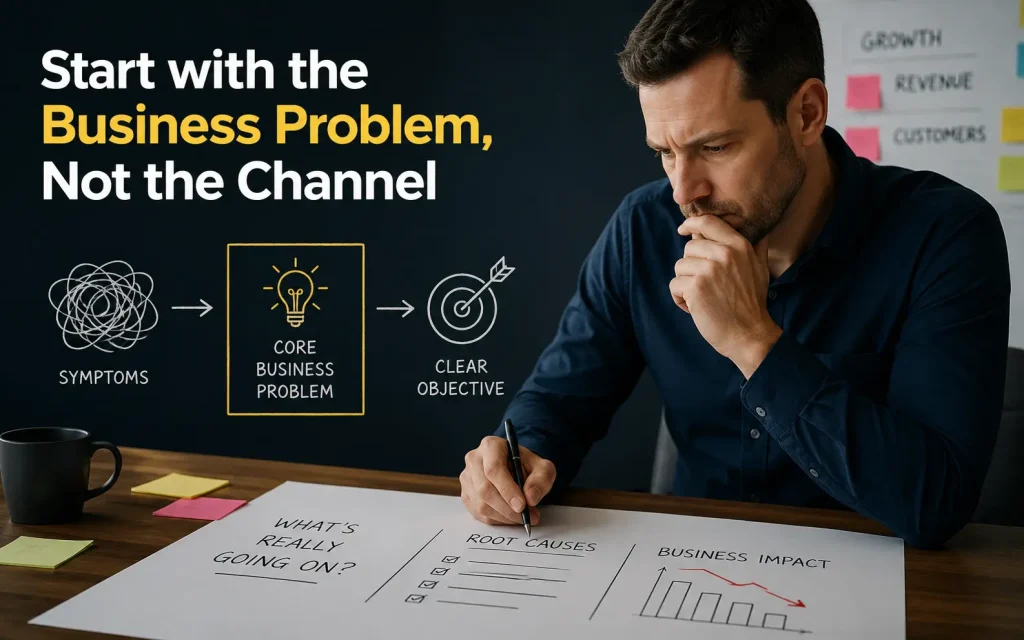
Many digital marketing consultation pages ask whether you need SEO, paid search, social media, or website help before they ask what is going wrong. That order can send a business toward the wrong fix.
Start by describing the commercial symptom:
- Your sales team is not receiving enough qualified enquiries.
- Paid traffic converts, but the cost per customer keeps rising.
- Organic traffic is growing while revenue stays flat.
- Customers buy once but do not return.
- You have several marketing activities running, but no reliable view of what produces sales.
- Your website receives visits from the wrong locations or industries.
A good advisor should connect that symptom to a measurable business outcome. For example, “we need more SEO traffic” is less useful than “we need 20 more qualified service enquiries per month from homeowners within 30 miles.”
That distinction also protects your budget. A conversion problem can look like an SEO problem when the real issue is unclear pricing, a weak landing page, slow follow-up, or a mismatch between the promise in the ad and the page visitors see.
What a strong consultation should examine
The provider does not need access to every account to make a useful first assessment. They do need enough context to avoid generic advice.
Your customer and buying situation
Expect questions about:
- Who buys from you and who influences the decision.
- The problem customers are trying to solve.
- The alternatives they compare before contacting you.
- How long the buying decision usually takes.
- Whether the sale happens online, by phone, in person, or through a proposal.
- The location, company size, income level, or job role that makes a lead valuable.
This matters because a marketing plan for a local emergency plumber should not be judged by the same measures as a six-month B2B software sale. One may need call quality and response time. The other may need pipeline contribution and account engagement.
The path from click to customer
The review should follow the journey rather than inspect isolated channels.
A practical sequence looks like this:
- A prospect discovers your company through search, an ad, a referral, or social content.
- They decide whether the message is relevant enough to continue.
- They evaluate your credibility and offer.
- They take an action, such as calling, submitting a form, booking a meeting, or buying.
- Your team responds and moves the opportunity forward.
- The sale is recorded in a way that can be connected to the original source.
Ask where measurement breaks. If forms are counted but sales are not imported into the CRM, the apparent “best” channel may simply be the one that generates the most low-value submissions.
Evidence from the existing account
A credible review should distinguish between what the advisor observed and what they are assuming.
Depending on the scope, that may include:
- Search queries and landing pages bringing organic visits.
- Ad groups with spend but weak conversion quality.
- Landing page engagement and form completion.
- Phone call source and duration.
- Local search visibility for important service terms.
- Email engagement by audience segment.
- Repeat purchase or lead-to-sale rates.
The session may not include a full technical audit. That is fine. It should still make clear which conclusions are based on account evidence, which are based on public information, and which need more investigation.
How to choose between competing free offers
The word “free” tells you the price of the first conversation, not the depth of the work. Compare the offer itself.
| What to compare | Strong signal | Question to ask |
|---|---|---|
| Scope | The page names channels, business questions, or outputs | “What will you review before or during the meeting?” |
| Preparation | The provider requests relevant details without asking for unnecessary access | “What should I send, and why do you need it?” |
| Evidence | Case studies, partner credentials, named specialists, or specific methods | “Have you worked with a business like mine?” |
| Time and format | A stated length, meeting format, and clear follow-up | “Will I receive notes or priorities afterward?” |
| Fit | The provider explains who the session suits and who it does not | “What would make you decline the project?” |
| Commercial terms | Paid work, minimum budgets, and next steps are explained plainly | “What happens if I do not continue?” |
Several competitor pages do some of this well. Logical Position describes live reviews across paid search, SEO, paid social, Amazon advertising, and email, and supports its offer with managed-spend figures, partner credentials, and client examples. Brandcraft gives a defined 30-minute duration and publishes experience and campaign results. AdHive asks detailed questions about business stage, competitors, team capability, priorities, and budget before a meeting.
Those signals are useful, but they do not remove the need to check fit. A large agency with extensive advertising experience may not be the right choice for a local business that needs call tracking and a better service page. A small consultant may be a better match if they can explain how they will measure qualified enquiries.
Questions to ask before you book

Use these questions to prevent an awkward mismatch:
- What is the actual output of the consultation?
Look for a discussion of priorities, observations, a follow-up summary, or a recommended test plan. “We will talk about growth” is not an output. - Which types of businesses benefit most from the session?
The answer should mention factors such as sales cycle, location, budget, or existing data. - Do you need access to my accounts?
A first call can often begin with public information and screenshots. Be cautious if a provider requests broad admin access before explaining the purpose. - How do you define a qualified lead or a successful sale?
This reveals whether the provider thinks beyond clicks and form volume. - What budget range makes the recommendations realistic?
There is no universal minimum, but a provider should explain the relationship between available budget, testing time, competition, and expected volume. - Will you tell me if I am not ready to spend more on marketing?
A trustworthy advisor may recommend fixing fulfilment, sales follow-up, tracking, pricing, or the offer before increasing acquisition. - Who will attend the meeting?
Ask whether you will speak with the person doing the review or with a salesperson who hands the work to another team.
Prepare a one-page consultation brief
You do not need a perfect marketing report. A concise brief gives the advisor enough information to make the hour useful.
Include:
- Business goal: the result you want in the next 90 days.
- Best customer: the person, company, location, or segment you most want to attract.
- Current offer: what you sell, approximate price, and why customers choose it.
- Current activity: channels, monthly spend, content cadence, and agencies or freelancers involved.
- Known numbers: enquiries, sales, average order value, close rate, and response time, even if approximate.
- Main concern: the decision you are struggling to make.
- Constraints: seasonality, service capacity, compliance limits, territory, staffing, or cash flow.
- Useful links: website, key landing page, social profiles, booking page, and one or two competitors.
Bring questions, not just documents. The best use of the meeting is often a conversation about trade-offs. For instance, should a local company improve its Google Business Profile, create service-specific pages, or increase search ad spend first? The answer depends on demand, competition, conversion quality, and how quickly the team can handle new enquiries.
What to do during the meeting
Treat the consultation as a working session. Take notes under four headings:
Observed
These are facts the provider can point to, such as an untracked form, a page with a confusing call to action, or search ads sending traffic to the homepage.
Hypothesized
These are plausible explanations that still need testing. A high bounce rate might reflect poor message match, slow loading, an accidental analytics configuration, or visitors who found the information they needed quickly.
Prioritized
Ask the advisor to rank recommendations by likely business impact, effort, confidence, and time to learn. A small tracking fix may deserve attention before a six-month content program.
Deferred
Strong consultants should be comfortable saying what not to do yet. A recommendation can be sensible but poorly timed if the business has no capacity to follow up leads or no reliable way to measure sales.
If the provider gives a long list of tactics without ranking them, ask: “If we could only complete three actions this quarter, which three would you choose, and what would each change?”
Warning signs that the session is mostly a sales pitch
No single sign proves that a provider is unreliable. Several together deserve caution:
- The advice is identical to what appears on every other client’s page.
- The provider promises a specific ranking, lead volume, or return without reviewing your market and baseline.
- The discussion focuses on vanity metrics while ignoring revenue, margin, lead quality, or capacity.
- The consultant pushes a large package before defining the problem.
- The audit uses fear, such as claiming your website is “invisible,” without showing how that affects customers.
- The provider will not explain who does the work after the call.
- The page says “free” but hides the meeting length, qualification process, or commercial expectations.
- You are pressured to grant extensive access immediately.
A free session can be a legitimate way for an agency to demonstrate its thinking. It becomes less useful when the provider withholds every meaningful observation so that the only answer is a paid engagement.
What to measure after the consultation
Do not judge the meeting only by how persuasive the consultant sounded. Score the usefulness of the advice.
Within 24 hours, write down:
- The main problem they believe is limiting growth.
- The evidence supporting that view.
- The first action and its owner.
- The metric that should move if the action works.
- The expected learning period.
- The cost, risk, and dependencies.
- What would cause you to stop or change direction.
For an ecommerce business, the first test may involve product page conversion, checkout completion, or repeat purchase rate. For a professional service firm, it may involve qualified call rate, speed to lead, proposal acceptance, or booked meetings from a specific service page.
The important point is to connect activity to a decision. “Publish four blog posts” is a task. “Publish and test two service pages because searchers are reaching a generic page, then compare qualified enquiry rate after eight weeks” is a measurable plan.
When a free consultation is the wrong next step

Sometimes the business needs a different kind of help:
- You need implementation immediately: book a paid working session or specialist sprint.
- Your tracking is unreliable: start with analytics, call tracking, CRM, and consent review.
- Your offer is unclear: work on positioning, pricing, packaging, and customer research.
- Your team cannot handle more demand: improve response time, capacity, and sales process first.
- You need regulated advice: find a provider with experience in your legal or compliance environment.
- Your business is pre-launch: validate the audience and offer before commissioning a full channel plan.
This is an important test of professional judgment. More marketing is not always the highest-value move.
A practical scorecard for comparing providers
After speaking with two or three advisors, rate each one from 1 to 5 on:
- Understanding of your customer and buying process.
- Ability to separate evidence from assumptions.
- Quality of questions asked.
- Clarity of priorities.
- Attention to measurement and lead quality.
- Relevant experience, not just impressive logos.
- Transparency about costs, access, and delivery.
- Comfort with explaining what not to do.
Write a short reason beside every score. The notes will be more reliable than your memory of who sounded most confident.
Competitor research for this topic shows recurring strengths and gaps. NexPrime uses a detailed intake form covering business type, country, pain points, budget, meeting preference, and time of day, but offers little visible proof. Notice the Elephant and Digital Lead explain the consultation invitation clearly, but their pages provide less detail about post-call deliverables. SoftCrust and Developed By Me emphasize broad digital services, while the decision criteria for choosing one service over another remain limited. MonsterClaw presents a wider consultant-led marketing discussion, but the reader still has to determine what a first session will produce.
That pattern creates a useful standard for any consultation page: show the likely questions, name the practical output, provide relevant proof, explain fit, and make the commercial boundary easy to understand.
FAQ
How long does a free digital marketing consultation usually take?
Many introductory sessions run for 30 to 60 minutes, but the advertised length varies by provider. Ask how much of that time is spent reviewing your situation and whether notes or recommendations follow afterward.
Should I share my Google Ads or Analytics login for a free consultation?
Usually, not at the start. Share screenshots, read-only reports, or a screen share first. If deeper analysis is needed, confirm exactly what access is required, who will use it, and when access will be removed.
Can a consultant tell me my marketing budget during a free call?
They can suggest a testing range after considering your customer value, margins, competition, sales capacity, and expected conversion rate. A responsible estimate is a planning range, not a guaranteed amount or outcome.
What should I ask a digital marketing consultant about SEO results?
Ask which pages and search themes they would prioritize, what business result those searches could support, how long the test may take, and how they will distinguish useful enquiries from unqualified traffic.
Is a free marketing audit the same as a free consultation?
Not always. A consultation may center on goals and decisions, while an audit may inspect selected channels or assets. Check whether the offer includes a live discussion, written findings, account data, public research, or only a high-level review.
How can a small business get useful advice with little marketing data?
Bring customer questions, recent enquiries, sales records, best-selling services, competitor examples, and any information about where customers heard about you. A lack of tracking is itself a finding and may become the first priority.
What happens if I do not hire the consultant after the call?
Ask this before booking. A reputable provider should state whether there is any obligation, follow-up sequence, minimum contract, or charge for additional recommendations.
How do I know whether a digital marketing consultant understands my industry?
Ask for a relevant example and have them explain the customer journey, buying cycle, compliance concerns, and key measurement issues. Industry experience is useful, but the ability to reason from your evidence matters just as much.
Final takeaway
A free digital marketing consultation is worth your time when it helps you make a better next decision. Prepare business context, ask how recommendations are supported, insist on priorities, and judge the provider by the quality of their reasoning rather than the size of their promise.
You should leave knowing what to fix first, how you will measure it, and what information is still missing. If you leave with only a proposal and no clearer view of the problem, the session has not done enough.