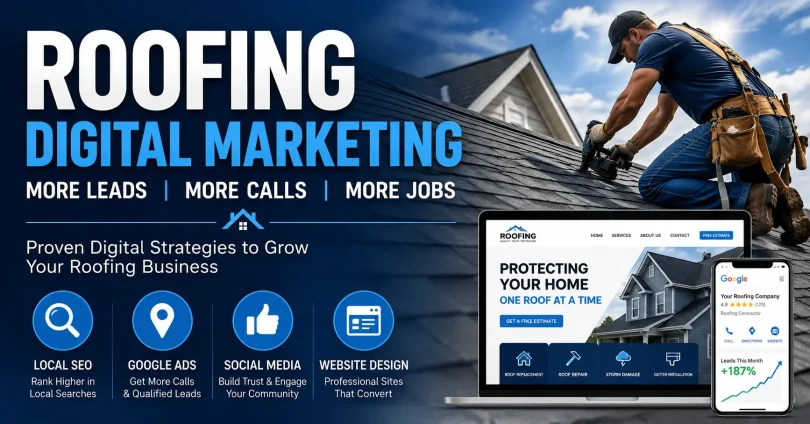

Roofing digital marketing is the practice of using online channels – search engines, paid ads, social media, email, and content – to attract homeowners, generate leads, and book more roofing jobs. Done right, it consistently outperforms traditional tactics like door knocking and yard signs because it puts your business in front of people who are already searching for a roofer right now.
Roofing digital marketing combines local SEO, Google Ads, social media, and reputation management to help roofing companies generate a predictable flow of inbound leads online. The highest-ROI channels for most roofers are Google Local Services Ads, local SEO (Google Business Profile), and targeted PPC campaigns – especially when activated quickly after storm events in your service area.
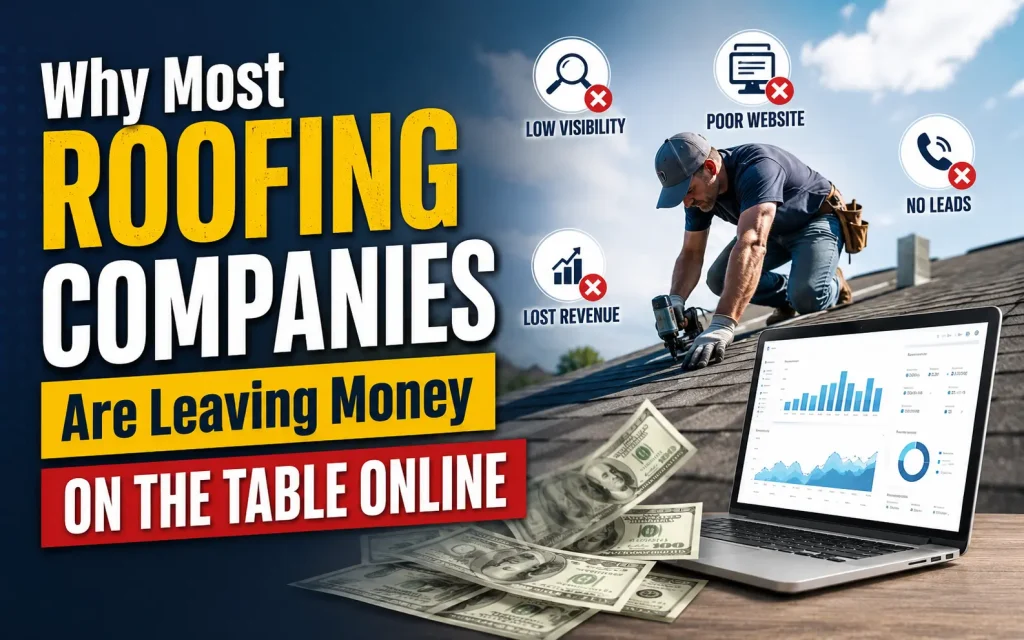
Why Most Roofing Companies Are Leaving Money on the Table Online
Before diving into tactics, here’s something most guides skip: roofing is one of the most high-intent, high-urgency service businesses on the planet. When a homeowner’s roof starts leaking or a hailstorm tears through the neighborhood, they’re not browsing casually – they need someone now.
That urgency changes how digital marketing should work for you. You’re not nurturing a months-long consideration cycle. You’re competing for the top spot at the exact moment someone types “emergency roof repair near me” or “hail damage roof replacement [city].”
74% of consumers choose a roofing contractor they found online. Yet most roofing companies are either invisible on Google, running ads with no conversion tracking, or relying purely on referrals with zero digital infrastructure to back it up. That’s the gap worth closing.
The Roofing Buyer Journey (And Why It’s Different From Other Trades)
Understanding how homeowners hire roofers changes your entire marketing approach.
Most roofing jobs are event-triggered, not planned. A leak, a storm, an insurance adjuster’s visit, or a failing inspection kicks off a search.
This means:
- Speed matters more than awareness. Homeowners decide within hours or days, not weeks.
- Trust signals close deals. Reviews, licenses, manufacturer certifications, and before/after photos all matter at the decision stage.
- Referrals still exist but start online. A friend recommends you, and the homeowner immediately Googles your name. What they find either confirms the recommendation or kills the deal.
One angle competitors almost never cover: roofing has an unusually long purchase cycle between repeat jobs (most residential roofs last 20-30 years), which means your marketing must be relentlessly focused on new customer acquisition and referral amplification rather than customer retention in the traditional sense.
The 7 Core Channels of Roofing Digital Marketing
Google Local Services Ads (The Most Underused Channel)
If you’re not running Google Local Services Ads (LSAs), you’re missing the highest-intent real estate on Google’s search page. LSAs appear above regular paid search ads and organic results, and they carry Google’s “Google Guaranteed” badge – a verified checkmark that signals to homeowners your business passed a background and license check.
Why this matters specifically for roofing:
- Homeowners searching after a storm or leak are in a high-trust-deficit moment. They’re handing over thousands of dollars to someone they just met. The Google Guaranteed badge reduces that friction immediately.
- You pay per lead, not per click – so if someone calls but doesn’t fit your service area, you dispute the charge.
- LSAs are tied directly to your Google Business Profile, so strong reviews there amplify your LSA performance.
How to start: Apply through Google’s LSA platform. You’ll need proof of insurance, a license (if required in your state), and a passing background check. Budget $500-$2,000/month to start and measure cost-per-lead, not cost-per-click.
Local SEO and Your Google Business Profile
Your Google Business Profile (GBP) is the single most important free digital asset a roofing company has. When someone searches “roofer near me” or “roof repair [city],” the map pack – those three local listings with stars and photos – is often the first thing they see.
The factors that move your ranking in the map pack:
- Proximity: How close you are to the searcher (you can’t change this, but you can create service area pages for surrounding cities).
- Review quantity and velocity: Not just how many reviews you have, but how recently you’re getting them. A company with 200 reviews and nothing new in six months can lose ground to one with 80 reviews and three this week.
- Profile completeness: Categories, services listed, Q&A answered, photos uploaded regularly.
- Review responses: Google notices – and homeowners definitely notice – whether you engage with your reviews.
What competitors miss: Most guides just say “get more reviews.” The real play is building a systematic review request process at job completion. A text message sent within 24 hours of finishing a job, with a direct link to your GBP review page, consistently outperforms asking in person or waiting to send an email. Response rates drop sharply after 48 hours.
Beyond GBP, your website needs location-specific pages if you serve multiple cities or counties. A single “Service Area” page listing 12 cities won’t rank. Individual pages – each with a unique description of your work in that area, local project examples, and localized FAQs – will.
Google Search Ads (PPC) with Storm-Surge Activation
Pay-per-click advertising on Google lets you appear at the top of search results for high-intent keywords immediately.
For roofing, the most valuable keywords cluster around:
- Replacement: “roof replacement cost,” “new roof installation near me”
- Repair: “roof leak repair,” “emergency roof repair”
- Storm-specific: “hail damage roof repair,” “wind damage roof claim”
- Competitor: “[competitor name] alternative” (more on this below)
The storm-surge strategy competitors never mention:
When a significant hail or wind event hits your service area, search volume for roofing terms spikes – sometimes 5-10x – within 24-72 hours. Roofing companies that have pre-built storm-specific ad campaigns (paused and ready to activate) can flip them on within hours of a storm and capture that surge before competitors even realize what’s happening.
Keep a paused campaign with ads referencing storm damage, emergency inspections, and insurance help. Monitor weather radar tools. When a storm hits, activate the campaign, increase bids, and broaden your geotargeting to cover affected ZIP codes.
Competitor conquesting: Running ads targeting searches for your local competitors by name is legal and common. Someone searching “[local roofer name] reviews” might be comparison shopping. A well-crafted ad for your company appearing at that moment can redirect that consideration.
Geofencing – Targeting Neighborhoods Not Just Cities
Geofencing is a programmatic advertising tactic that most roofing guides completely ignore. It lets you serve display or video ads to people whose phones have recently been inside a specific geographic boundary – like a neighborhood that just got hit by hail.
Practical applications for roofing:
- Post-storm targeting: After a storm, draw a geofence around affected zip codes and serve ads to residents for the following 2-4 weeks.
- Competitor targeting: Geofence the area around a competitor’s office or recent job sites. Homeowners in that area are clearly aware of roofing services.
- Insurance adjuster follow-up: Geofence neighborhoods where you know adjusters are actively visiting. Homeowners seeing your ads while waiting for their adjuster’s report is powerful timing.
Geofencing typically runs through demand-side platforms (DSPs) or roofing-specific marketing platforms. It’s not a standalone strategy – it works best layered on top of search campaigns.
Social Media Marketing – What Actually Works for Roofers
Most roofing companies treat social media as a chore – posting inconsistently and wondering why nothing converts. The issue is usually the content strategy, not the platform.
What works:
- Before/after photos: The single highest-performing content type for roofing on Facebook and Instagram. Dramatic transformations generate shares, comments, and saves. Post from every significant job.
- Storm response content: After a local storm, post immediately. “We’re in [neighborhood] today doing free inspections” with a real photo gets local engagement and shares.
- Drone footage: Relatively inexpensive now, drone clips of roof replacements in progress outperform static photos in video feeds. Even a 15-second clip of a crew at work shows scale and professionalism.
- Insurance claim education: Content explaining how the insurance claims process works for storm damage – when to file, what adjusters look for, what to watch out for – positions your company as a trusted advisor, not just a contractor.
Nextdoor for Roofers: Almost no competitor mentions Nextdoor, yet it’s one of the highest-converting platforms for home services. Homeowners post “anyone have a roofer recommendation?” regularly. Being active in your local Nextdoor community – responding to these posts, having customers tag you, and running Nextdoor Business ads -generates leads with extremely high close rates because they come pre-qualified with a neighbor’s endorsement.
Facebook and Instagram Ads: Useful for building local brand awareness and retargeting (see below), especially in the weeks following a storm. Target by ZIP code, homeownership status, and home age. Run “free storm damage inspection” offers – this is one of the highest-converting offers in residential roofing because it removes financial risk from the first step.
Retargeting – Converting the Visitors Who Didn’t Call
The majority of people who land on your roofing website leave without contacting you. Retargeting lets you follow those visitors with ads across Google’s display network, Facebook, and Instagram for the next 30-90 days.
For roofing, retargeting is particularly effective because:
- The decision to replace a roof takes time. Someone might visit your site today and make a decision in 2 weeks.
- Homeowners often get multiple quotes. Seeing your company’s ads repeatedly while they’re comparing reinforces your brand and keeps you top of mind.
Setup basics: Install the Meta Pixel on your website and set up a Google Ads remarketing tag. Create audience segments by page visited (roof repair visitors vs. replacement visitors) and show them relevant ads. A visitor who looked at your “hail damage” page should see ads about insurance claims assistance, not general roofing content.
Content Marketing That Actually Generates Roofing Leads
Content marketing for roofers isn’t about writing blog posts for the sake of it. Every piece of content should target a real question a homeowner types into Google or asks an AI.
High-value content topics for roofing:
- “How much does a roof replacement cost in [city]?” (Consistently one of the highest-traffic roofing searches)
- “Does homeowners insurance cover roof replacement?”
- “How long does a roof replacement take?”
- “Signs you need a new roof vs. repair”
- “How to file a roof insurance claim”
- “Best roofing materials for [climate/region]”
The insurance claim content angle: This is a massive information gap in most competitor content. A huge percentage of residential roof replacements are insurance-funded. Homeowners navigating this process are confused and anxious. A roofing company that publishes genuinely helpful guides on how the claims process works – what to document, how to work with public adjusters, what insurance companies look for – earns enormous trust and captures searchers who are mid-process and ready to hire.
The Trust Infrastructure Competitors Don’t Talk About

Getting found is only half the job. Converting that traffic into booked jobs is the other half – and it depends heavily on your trust signals.
Roofing-specific trust signals that convert:
- Manufacturer certifications: GAF Master Elite, Owens Corning Platinum Preferred, CertainTeed Select ShingleMaster. These certifications extend warranty periods and signal credibility. Display them prominently on your website and GBP.
- BBB accreditation and industry associations: NRCA membership, local roofing association affiliation.
- License and insurance verification: Make it easy. Link to your state license lookup directly on your website. Show your certificate of insurance. Homeowners filing insurance claims especially need to confirm you’re licensed and insured.
- Verified reviews on multiple platforms: Google is primary, but Angi, BBB, Facebook, and Houzz reviews also matter. A homeowner who Googles your name should find consistent 4.5+ star ratings across multiple sources.
- Photo documentation: Real photos of your team, equipment, and completed jobs. Stock photos are an immediate credibility killer for roofing.
Commercial vs. Residential Roofing – Different Marketing Playbooks
Most digital marketing guides treat roofing as a monolith. But if you serve commercial clients – property managers, HOAs, facility managers n – the marketing approach is fundamentally different.
| Residential Roofing | Commercial Roofing | |
|---|---|---|
| Decision timeline | Days to weeks | Weeks to months |
| Decision maker | Homeowner | Property manager, board, or facilities director |
| Primary channels | Google LSAs, local SEO, Facebook | LinkedIn, email outreach, commercial property directories |
| Content that converts | Insurance guides, cost estimators, testimonials | Case studies, lifecycle cost analyses, maintenance contract proposals |
| Key trust signals | Reviews, manufacturer certifications | Project portfolio with square footage, industry references |
| Lead sources | Google search, storm events | Referrals from property managers, commercial insurance adjusters |
If you do both, consider separate landing pages or even separate website sections. Homeowners and facilities managers are looking for very different things – trying to speak to both on the same page dilutes your message for each.
Measuring What Actually Matters – Roofing Marketing Metrics
The biggest mistake roofing companies make is optimizing for vanity metrics (clicks, impressions, followers) instead of business metrics.
Here’s what to actually track the metrics that matter:
- Cost per lead (CPL): Total ad spend divided by number of leads generated. Track this by channel.
- Lead-to-appointment rate: Of all leads, what percentage turn into booked inspections?
- Appointment-to-close rate: Of inspections performed, what percentage become signed contracts?
- Cost per acquired job: CPL divided by your close rates. This tells you what you actually pay to book a job.
- Average job value: Residential repair vs. full replacement vs. commercial – know your averages by job type.
- Return on ad spend (ROAS): Revenue generated / ad spend. Roofing jobs are high ticket, so a 3:1 ROAS on Google Ads is typically solid.
Attribution reality check: Most roofing jobs touch multiple channels before converting. Someone might see a Facebook ad after a storm, Google your name later, and call from your GBP listing. Pure last-click attribution credits Google – and you might cut your Facebook spend, which was actually what started the journey. Use call tracking software (CallRail is widely used) with UTM parameters on all campaigns to get a clearer picture.
Building a Realistic Roofing Digital Marketing Budget
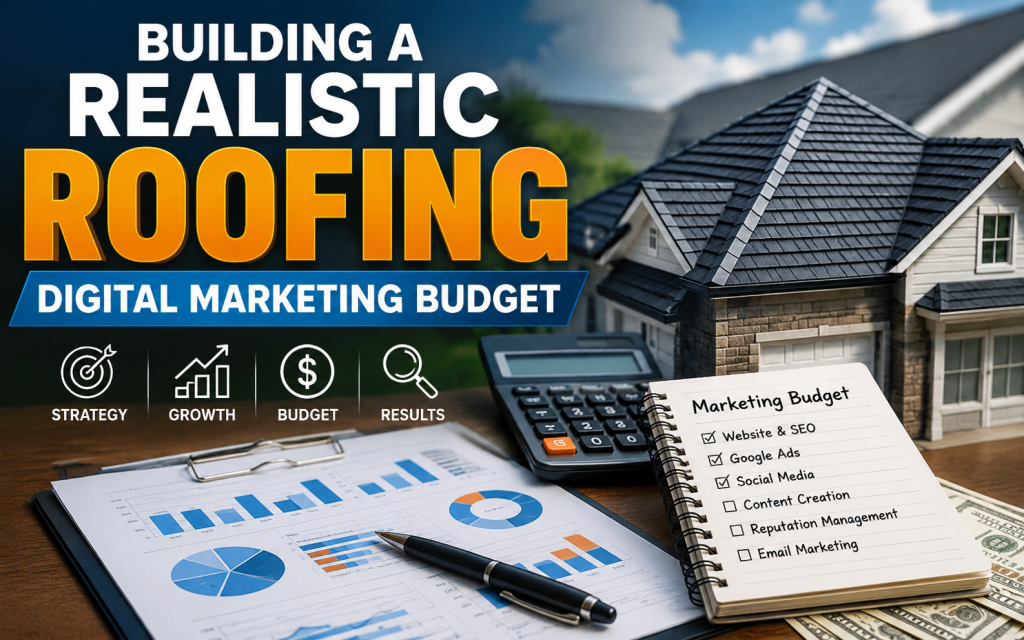
Here’s something almost no competitor publishes: actual budget guidance by company size.
Small roofing company (1-3 trucks, under $1M revenue):
- Focus: Google Business Profile optimization, LSAs, and review generation
- Monthly budget: $1,500-$3,000 in paid ads
- Time investment: 3-5 hours/week on content and social
Mid-size company (4-10 trucks, $1M-$5M revenue):
- Focus: Full local SEO, Google Ads + LSAs, Facebook remarketing, content marketing
- Monthly budget: $3,000-$8,000 in paid ads
- Time investment: 10-15 hours/week or hire a part-time marketing coordinator
Established/multi-location company ($5M+ revenue):
- Full-stack digital marketing with agency support or in-house team
- Monthly budget: $8,000-$25,000+
- Add geofencing, video production, commercial LinkedIn outreach
A note on timing your investment: If your market has a defined storm season (spring/summer hail, fall hurricanes), front-load your marketing budget in the 4-6 weeks before and during peak season. Running the same spend year-round when demand is flat in winter is less efficient than surging spend when homeowners are actively looking.
The Biggest Digital Marketing Mistakes Roofing Companies Make
- No conversion tracking: Running ads without tracking which ones generate calls and jobs. You’re flying blind.
- Slow lead response: Research consistently shows that responding to a lead within 5 minutes dramatically increases close rates. Most roofing companies take hours or days.
- Ignoring review requests: The #1 highest-ROI activity in roofing marketing is systematically asking every satisfied customer for a Google review. Most roofers do this sporadically at best.
- Generic website content: “Quality work at competitive prices” describes every roofing company on earth. Your website should speak to specific jobs, specific neighborhoods, and specific problems you solve.
- Abandoning channels too quickly: SEO takes 3-6 months to show results. Companies quit after 60 days and miss the return entirely.
- Chasing every lead aggregator: Angi, HomeAdvisor, Thumbtack, and similar platforms can generate leads, but you’re sharing those leads with competitors. Treat them as a supplement to your owned digital marketing, not a replacement.
- Not having a mobile-optimized website: Over 60% of roofing searches happen on phones. If your site loads slowly or is hard to navigate on mobile, you’re losing leads at the first moment of contact.
FAQ
How long does it take to see results from roofing digital marketing?
Paid channels like Google Ads and LSAs can generate leads within days of launching. Local SEO and content marketing typically take 3-6 months before you see meaningful organic traffic. Most roofing companies use paid ads for immediate lead flow while building organic presence in parallel.
What’s the best digital marketing channel for a new roofing company with no reviews?
Start with Google Local Services Ads and Facebook Ads targeting your service area. Both allow you to generate leads immediately without relying on SEO authority or reviews. Simultaneously, request reviews from every job you complete — even as a new company, 10-15 strong reviews in your first 90 days will noticeably improve your close rate.
How do I market my roofing company specifically after a hailstorm?
Activate any paused storm-damage PPC campaigns immediately. Post on Facebook and Nextdoor in the affected neighborhoods. Use geofencing to serve ads in storm-impacted ZIP codes. Offer free inspections in your messaging this is the highest-converting offer post-storm because it removes risk for homeowners. Speed is critical; the first 72 hours after a storm are when most homeowners decide who to call.
Should roofing companies use TikTok or YouTube for marketing?
Both can work, but with different expectations. YouTube is worth investing in for long-form content like “what to expect during a roof replacement” these videos rank in Google searches and build trust. TikTok works for building brand awareness and reaching homeowners organically, but it’s difficult to tie directly to leads. Neither should be prioritized over Google Ads and local SEO for lead generation.
How much should a roofing company spend on digital marketing?
A commonly cited benchmark is 5-10% of revenue reinvested in marketing. For roofing, 7-8% is a reasonable target. A company doing $1M in revenue should budget $70,000-$80,000 annually across all marketing including digital. Adjust upward if you’re in a competitive market or trying to grow aggressively.
What’s the difference between roofing SEO and roofing PPC?
SEO is building long-term organic visibility in Google through website optimization, content, and reviewsit takes months but generates free traffic once established. PPC is paying for placement at the top of search results immediately it generates leads right away but stops when you stop paying. Most successful roofing companies run both: PPC for immediate lead flow, SEO as a foundation for sustainable growth.
Do I need a roofing-specific marketing agency, or can a general digital agency do the job?
A general agency can handle the technical setup, but roofing has industry-specific nuances storm-season strategy, insurance claim content, LSA optimization, manufacturer certification marketing that generalist agencies often miss. If you hire a generalist, brief them thoroughly on how roofing customers make decisions. If you hire a roofing-specialist agency, vet them on their knowledge of LSAs, storm marketing, and attribution tracking.
How do I get more online reviews for my roofing company?
The most effective method is a text message sent within 24 hours of job completion with a direct link to your Google review page. Make it a company process, not an afterthought. Train every crew member or project manager to send the text as soon as the job wraps. A 20-25% review submission rate on satisfied customers is achievable with a consistent process. Avoid incentivizing reviews it violates Google’s policies and can get your profile penalized.
Final Thoughts
Roofing Digital Marketing is one of the most effective ways to attract qualified leads and grow a roofing business in today’s competitive market. A well-planned strategy that combines local SEO, Google Ads, social media marketing, content creation, and reputation management helps your company appear where homeowners are actively searching for roofing services.
By consistently optimizing your online presence and tracking campaign performance, you can generate more calls, increase estimates, and build long-term trust with potential customers. Investing in the right digital marketing approach today can create a steady pipeline of roofing leads and sustainable business growth for years to come.