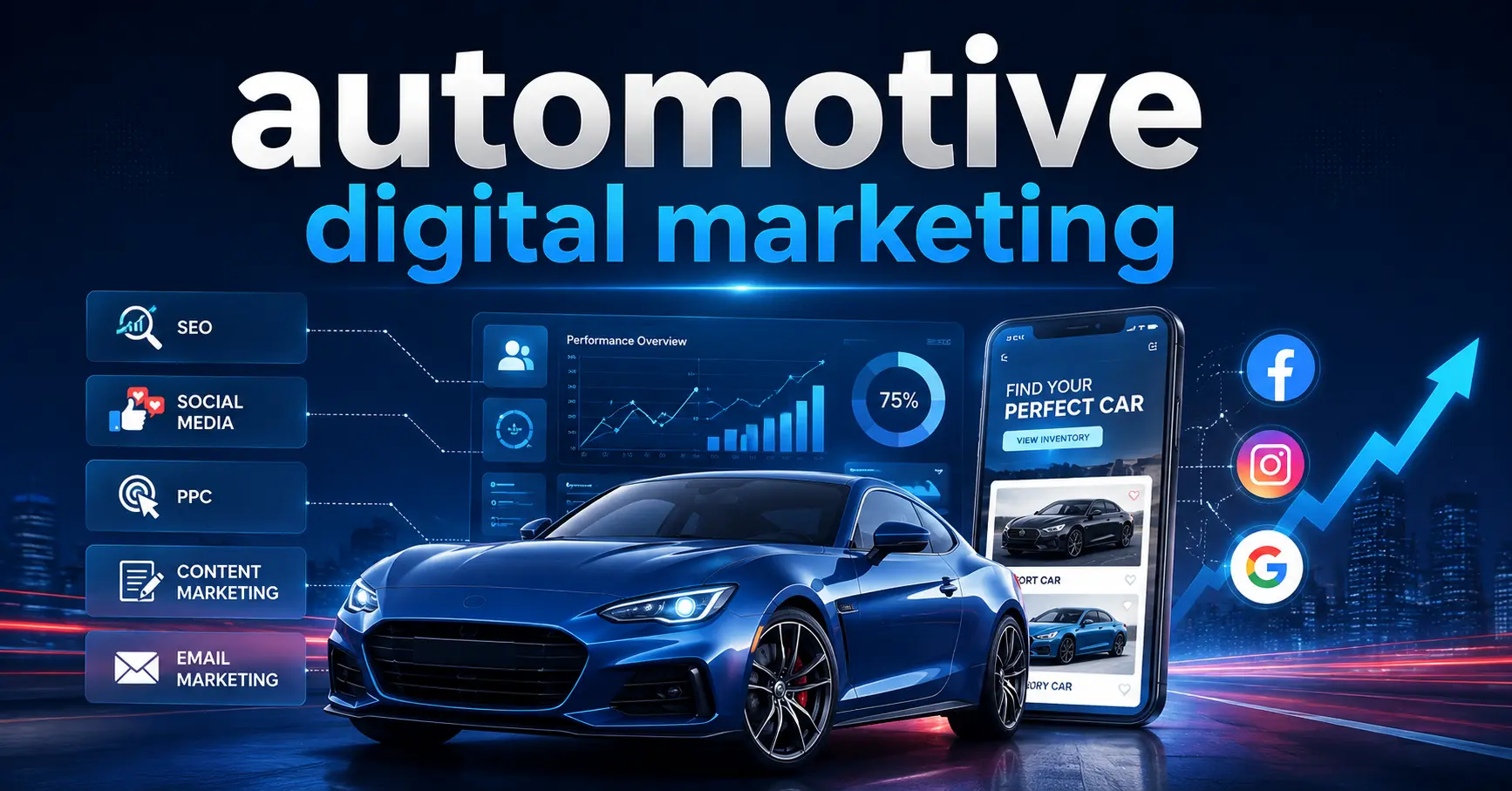

Automotive digital marketing has completely changed how people shop for vehicles. Car buyers no longer start their journey on a dealership lot. They begin on their phones late at night comparing prices reading reviews and watching walk around videos before they ever speak to a salesperson. This shift is exactly why automotive digital marketing has become the deciding factor between a dealership that grows and one that quietly loses market share.
This guide breaks down what automotive digital marketing actually involves which channels genuinely produce sales and where most dealerships and brands lose money without realizing it. It also covers budgeting measurement and the lead management step that most articles on this topic skip entirely.
What Is Automotive Digital Marketing
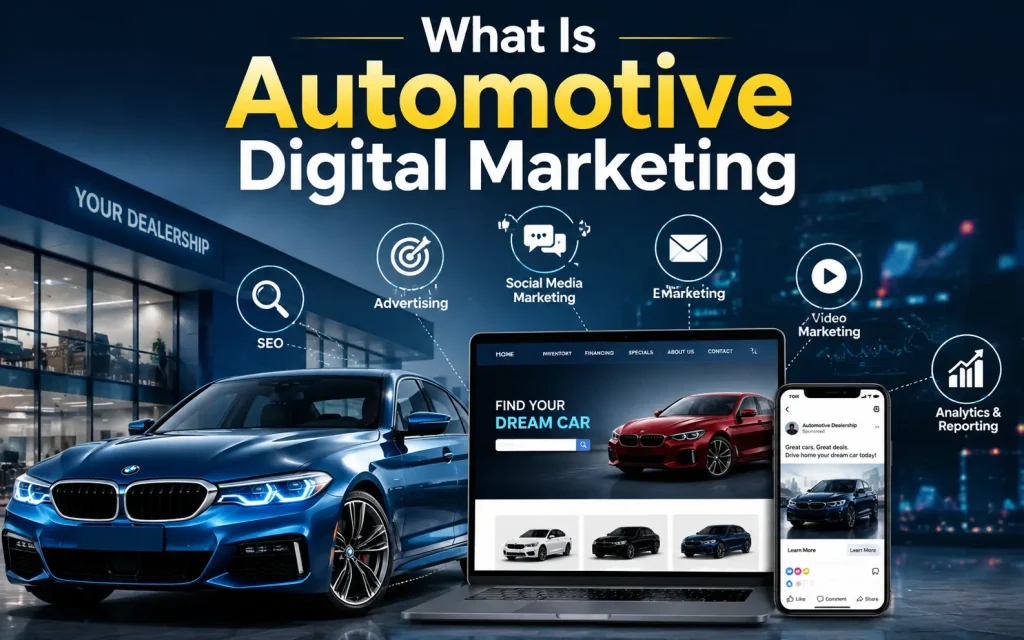
Automotive digital marketing is the use of online channels, tools, and data to attract, engage, and convert vehicle buyers. It covers everything from search engine visibility and paid ads to email follow-ups, video content, and the systems that route a lead to the right salesperson before a competitor gets there first.
It applies to:
- Car dealerships selling new and used vehicles
- Automotive OEMs and regional distributors
- Repair shops, service centers, and parts suppliers
- Auto insurance and finance providers
- Aftermarket and accessory brands
The goal is always the same: guide a buyer from curiosity to a signed deal, using the channels they actually use.
Why Automotive Digital Marketing Matters More Than Ever
Car buying has moved almost entirely online before the in-person visit happens. Consider how this plays out in practice:
- Most buyers research vehicles for weeks before visiting a dealership, comparing specs, prices, and reviews across multiple sites.
- Search engines and marketplace sites like AutoTrader or Cars.com are usually the first stop, not the manufacturer’s website.
- Video content, especially walk-arounds and comparison reviews, heavily influences which models make it onto a shortlist.
- Reviews and star ratings shape which dealership a buyer chooses to visit, sometimes more than price does.
If a dealership or brand is not visible, credible, and responsive across these touchpoints, it simply is not part of the conversation. That is the real cost of ignoring automotive digital marketing.
The Modern Car Buyer’s Journey
Understanding where a buyer is in their journey helps you match the right message to the right moment, instead of pushing a sales pitch too early.
| Stage | Buyer Mindset | What Works Best |
|---|---|---|
| Awareness | “I need a new car, but I don’t know what yet.” | SEO content, social video, brand campaigns |
| Consideration | “I’m comparing three or four models.” | Comparison content, reviews, paid search |
| Intent | “I’m ready to test drive or get a quote.” | Local SEO, retargeting ads, lead forms |
| Purchase | “I’m negotiating and finalizing details.” | Fast response, transparent pricing, chat |
| Loyalty | “I need service, or I’m ready to trade in.” | Email, SMS reminders, service offers |
Most competitor content treats these stages loosely. Mapping your budget and content to each stage specifically is what separates a dealership that converts traffic from one that just collects clicks.
Core Channels in Automotive Digital Marketing
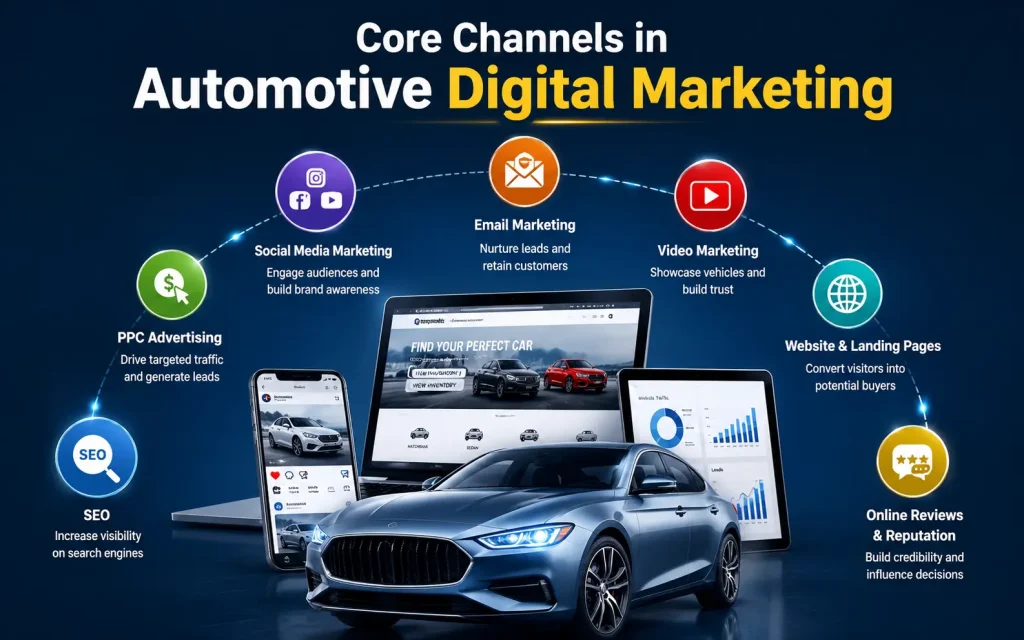
Search Engine Optimization (SEO)
SEO builds long-term visibility so buyers find you without you paying for every click. For dealerships, local SEO is especially valuable because most car searches include location intent, such as “Toyota dealership near me” or “used cars in Lahore.”
Practical steps that move the needle:
- Claim and fully complete your Google Business Profile, with accurate hours, photos, and service listings.
- Publish location-specific pages for each dealership branch rather than one generic page.
- Write genuinely useful content, such as maintenance guides, model comparisons, and financing explainers.
- Keep your site fast and mobile-friendly, since most car research happens on phones.
Paid Search (Google Ads)
Paid search captures buyers who already know what they want. Someone searching “Honda Civic price” or “best SUV under budget” is close to a decision, which makes this one of the highest-intent channels available.
To get real value from it:
- Bid on model-specific and comparison keywords, not just your brand name.
- Send traffic to a page built for that specific model or offer, not your homepage.
- Feed actual sales data back into the ad platform when possible, so it learns to find buyers who convert, not just people who click.
Paid Social
Platforms like Meta and Instagram are strong for lead volume, particularly through instant lead forms that let a buyer express interest without leaving the app. This removes friction, but it also invites low-quality submissions if left unmanaged.
- Use video and carousel formats to show the vehicle in motion, not just static photos.
- Layer in retargeting so people who watched a video ad see a follow-up offer.
- Validate every lead before it reaches a salesperson, since unmanaged volume is not the same as quality.
Video Marketing
Video influences buyers earlier in their journey than most other formats. Walk-arounds, owner testimonials, and side-by-side comparisons build trust because they show the vehicle honestly, rather than describing it.
- Keep dealership videos under two minutes for social platforms; longer detailed reviews perform better on YouTube.
- Show real interiors, real sound, and real driving footage. Buyers can tell the difference between a genuine video and a stock clip.
- Add captions, since most people watch with the sound off.
Marketplace and Publisher Partnerships
Sites like AutoTrader, Carwow, and What Car already have an audience of people actively comparing vehicles. Listing here puts you in front of buyers who have chosen to research rather than buyers who stumbled across an ad.
The catch is operational: leads from multiple marketplaces often arrive in different formats. Without a system to standardize and route them quickly, valuable leads sit unanswered while a buyer moves on to a competitor.
Email and SMS Marketing
This is one of the most overlooked channels in automotive marketing, and one that most competitor guides barely mention. Email and SMS are inexpensive, high-return tools for nurturing leads who are not yet ready to buy and for keeping past customers coming back for service.
- Send service reminders tied to mileage or time since last visit, not generic monthly newsletters.
- Follow up with unconverted leads using a short, useful sequence, such as financing options or a limited-time offer, instead of one message and silence.
- Text messages get opened far faster than emails, making SMS ideal for time-sensitive offers like test drive confirmations.
Reputation and Review Management
Reviews function as digital word-of-mouth, and they influence buyers more than most dealerships realize. A dealership with a 3.5-star rating loses trust before a buyer even reads the details.
- Ask for reviews right after a positive service or sales experience, when satisfaction is highest.
- Respond to every review, good or bad. A thoughtful reply to a negative review often reassures future buyers more than the review itself worries them.
- Monitor reviews across Google, Facebook, and marketplace platforms, not just one site.
Lead Generation Is Only Half the Job
This is the part most automotive marketing content leaves out entirely. Generating leads is not the same as generating sales, and a huge amount of marketing budget is wasted at this exact gap.
Common failure points include:
- Invalid or fake leads reaching sales teams, wasting time and eroding trust in digital channels.
- Duplicate submissions from buyers filling out the same form across multiple sites, inflating your reported numbers.
- Slow response times that let an interested buyer go cold or move to a competitor.
- Poor lead routing, where leads go to the wrong branch or the wrong salesperson.
- No closed-loop reporting, so nobody can tell which campaign actually led to a vehicle sale, only which one generated a form fill.
Fixing this does not require an enterprise-level system. Even a simple rule requiring a callback within fifteen minutes of a lead arriving can noticeably lift conversion rates, because speed is one of the strongest predictors of whether a lead turns into a sale.
Budgeting: How Much Should You Actually Spend
There is no universal number, but most successful automotive marketers work from a similar structure. Use this as a starting benchmark and adjust based on what your data shows over time.
| Budget Category | Typical Share | Purpose |
|---|---|---|
| Paid search and social | 40 to 50 percent | High-intent lead generation |
| SEO and content | 15 to 20 percent | Long-term organic visibility |
| Video production | 10 to 15 percent | Awareness and trust-building |
| Email, SMS, and CRM tools | 10 percent | Nurturing and retention |
| Reputation management | 5 percent | Trust and local credibility |
| Testing and new channels | 5 to 10 percent | Staying ahead of the market |
Dealerships that spend everything on paid ads and nothing on retention usually plateau. The customers you already sold to are cheaper to bring back than new ones are to acquire.
Measuring What Matters
Vanity metrics like impressions and page views feel good but rarely tell you whether marketing is working. Track these instead:
- Cost per lead (CPL): what you pay to generate one lead, broken down by channel.
- Lead-to-sale conversion rate: the percentage of leads that actually become sales, not just form fills.
- Response time: how quickly a lead gets a human reply.
- Cost per sale: the true cost once you account for wasted or invalid leads.
- Customer lifetime value: total revenue from a customer across sales, service, and future purchases.
- Review score trend: whether your reputation is improving or slipping month over month.
If you can only track one number beyond CPL, track lead-to-sale conversion rate. It exposes problems that lead volume alone hides completely.
Common Mistakes in Automotive Digital Marketing
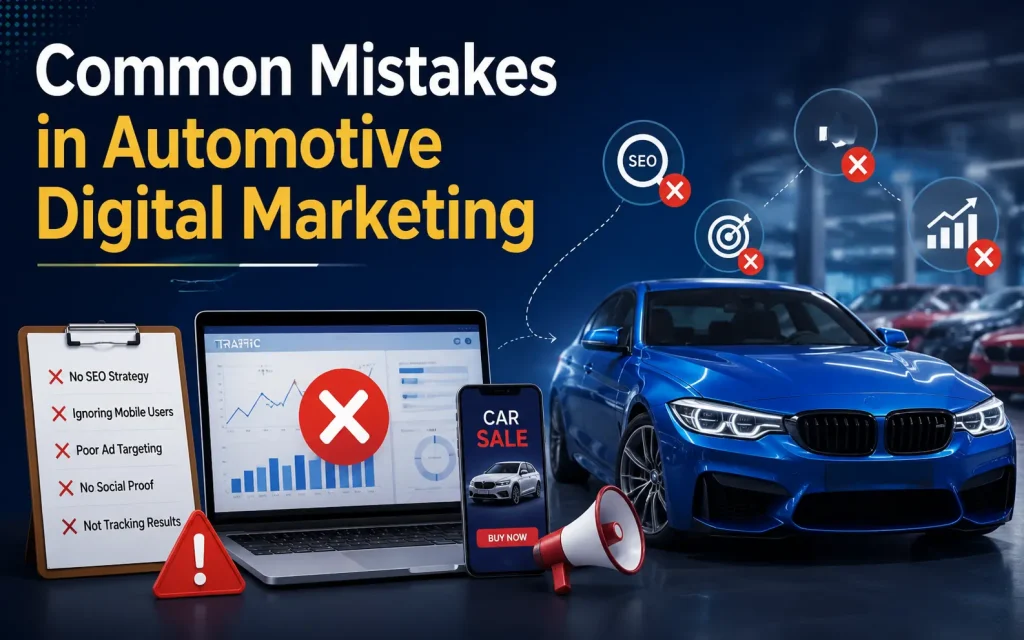
Even well-funded campaigns fail for predictable reasons:
- Sending all traffic to a generic homepage instead of a page built around the specific model or offer.
- Treating every lead the same, regardless of how warm or qualified it is.
- Ignoring mobile speed, even though most research happens on phones.
- Running ads without a plan for what happens after someone clicks.
- Copying a competitor’s strategy without checking whether it fits your own market and inventory.
Emerging Trends Worth Watching
Automotive digital marketing keeps shifting as buyer behavior and technology change. A few trends are worth planning around now rather than reacting to later:
- First-party data is becoming essential. As privacy rules tighten and third-party cookies fade, owning your customer data through email lists, CRM records, and direct relationships matters more than ever.
- AI-assisted search is changing how buyers find you. Buyers increasingly get summarized answers from AI tools before they even reach a search results page, which makes clear, well-structured content more important than keyword density alone.
- EV-specific marketing needs its own approach. Buyers researching electric vehicles ask different questions, around range, charging, and incentives, so generic vehicle content underperforms for this audience.
- Video commerce is growing. Livestreamed walk-arounds and shoppable video are starting to shorten the gap between watching a video and booking a test drive.
A Simple 90-Day Action Plan
If you are starting from scratch or resetting your strategy, this sequence keeps things manageable:
- Weeks 1 to 2: Audit your Google Business Profile, website speed, and current review scores. Fix the obvious gaps first.
- Weeks 3 to 4: Launch one paid search campaign focused on your best-selling model, with a dedicated landing page.
- Weeks 5 to 6: Set up a lead response process with a maximum response time, even if it is a simple shared inbox rule to start.
- Weeks 7 to 8: Produce two to three short vehicle walk-around videos and publish them across social platforms.
- Weeks 9 to 10: Build a basic email and SMS follow-up sequence for leads who have not yet converted.
- Weeks 11 to 12: Review the numbers, cost per lead, conversion rate, and response time, and reallocate budget toward whatever channel actually produced sales.
Frequently Asked Questions
What is automotive digital marketing?
Automotive digital marketing is the use of online channels such as SEO PPC social media email marketing and content marketing to attract car buyers generate leads and increase vehicle sales for dealerships manufacturers and automotive service businesses.
Why is digital marketing important for car dealerships?
Most buyers research vehicles online before visiting a dealership. A strong digital marketing strategy helps dealerships improve online visibility generate qualified leads increase showroom visits and sell more vehicles.
Which digital marketing channel works best for automotive businesses?
There is no single best channel. Local SEO Google Ads social media advertising video marketing and reputation management work best when combined into one strategy that targets buyers at different stages of the purchasing journey.
How much should a dealership spend on automotive digital marketing?
The ideal budget depends on dealership size location and sales goals. Many dealerships invest between 5 percent and 10 percent of their monthly revenue in digital marketing while tracking return on investment to optimize spending.
How do you measure the success of automotive digital marketing?
Success is measured through key performance indicators such as website traffic lead quality conversion rate cost per lead phone calls showroom appointments vehicle sales and overall return on marketing investment.
Final Thoughts
Automotive digital marketing is no longer optional for dealerships that want to stay competitive. Today’s buyers expect to find accurate information compare vehicles read reviews and connect with a dealership online before making a purchase decision.
The most successful automotive businesses combine SEO paid advertising content marketing social media email campaigns and reputation management into one data driven strategy.
When these channels work together and every lead is followed up quickly dealerships can attract more qualified buyers reduce marketing waste and achieve consistent long term growth.
You May Also Like It:
Digital Marketing Service Appkod