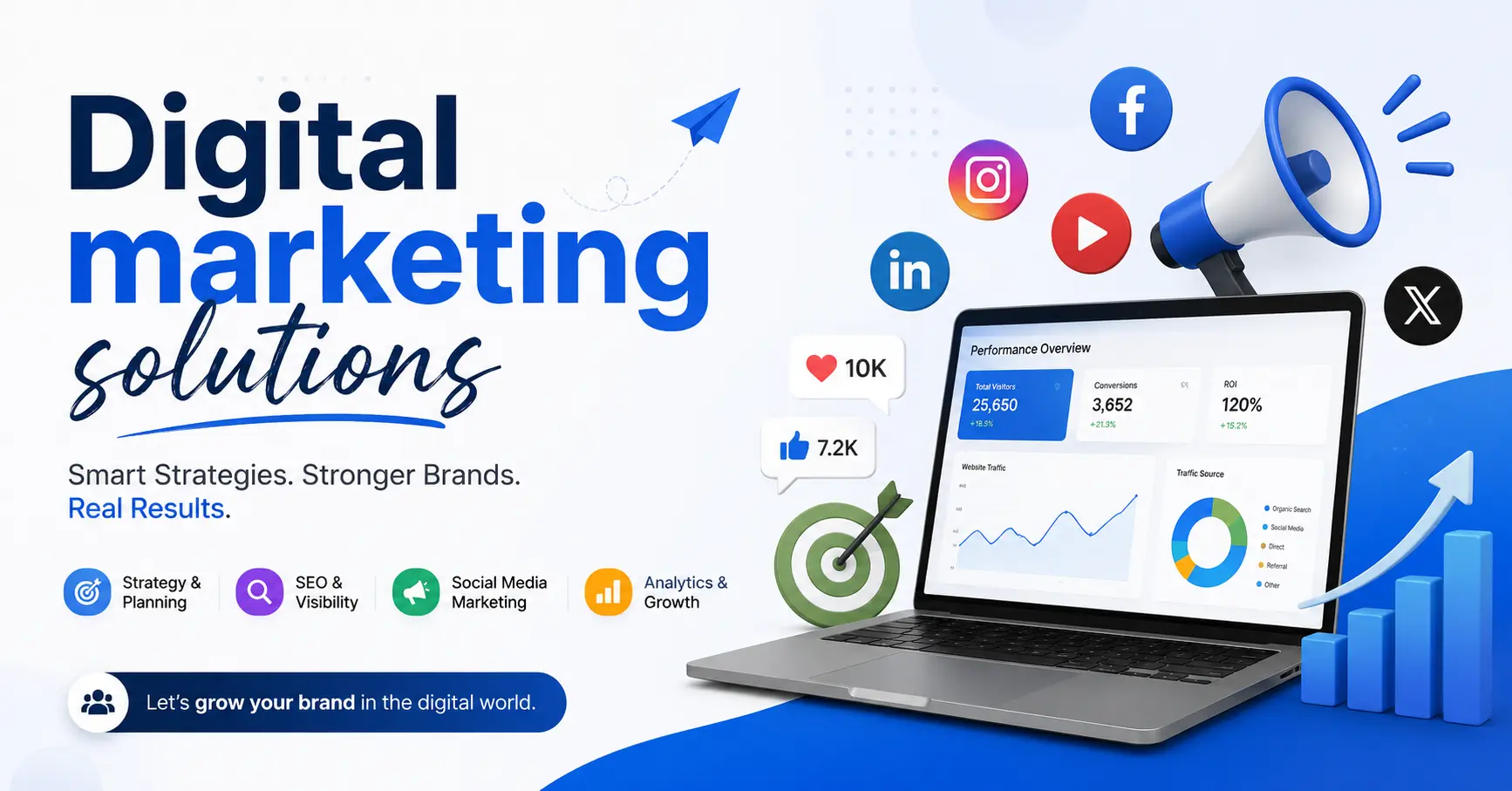

Digital marketing solutions help businesses attract more customers build stronger brands and increase sales through online channels. In today’s competitive online marketplace having a website alone is no longer enough. Businesses must actively connect with potential customers through search engines social media email campaigns and other digital platforms to stay ahead of the competition.
Whether you run a small startup a local business an ecommerce store or a global company the right digital marketing strategy can help you reach the right audience at the right time. Every day millions of people search online for products services and information before making purchasing decisions. Businesses that build a strong digital presence are more likely to earn customer trust generate qualified leads and increase conversions.
Table of Contents
| Section | Topic |
|---|---|
| 1 | What Are Digital Marketing Solutions? |
| 2 | Why Your Business Needs Them in 2025 |
| 3 | Core Digital Marketing Services Explained |
| 4 | How Each Channel Works Together |
| 5 | Choosing the Right Digital Marketing Mix |
| 6 | How to Measure Success |
| 7 | Common Mistakes to Avoid |
| 8 | What to Look for in a Digital Marketing Partner |
| 9 | Getting Started: A Step-by-Step Plan |
| 10 | FAQs |
What Are Digital Marketing Solutions
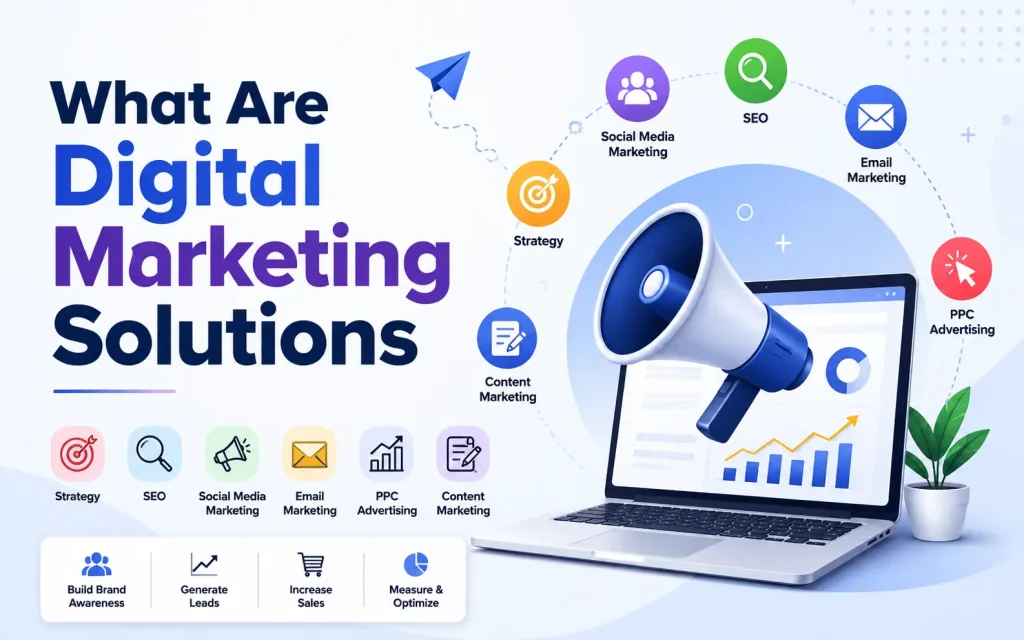
Digital marketing solutions are strategies, tools, and services that help businesses promote their products or services online. Instead of relying on billboards, print ads, or cold calls, digital marketing puts your brand in front of the right people, at the right time, on the right platform.
Think of it this way: your customers are already online. They search Google before they buy. They scroll social media before they decide. They check reviews before they trust. Digital marketing solutions make sure your business shows up when any of those moments happen.
These solutions cover a wide range:
- Search engine optimization (SEO)
- Pay-per-click advertising (PPC)
- Social media marketing
- Content marketing
- Email marketing
- Web design and development
- Video marketing
- Conversion rate optimization (CRO)
- Online reputation management
Together, they form a connected system that attracts visitors, converts them into leads, and turns leads into loyal customers.
Why Your Business Needs Digital Marketing in 2025
Here is what digital marketing solves for your business:
Digital marketing is no longer optional for businesses that want to grow in today’s competitive marketplace. With billions of people using the internet every day, customers now search online before making purchasing decisions.
Businesses that invest in digital marketing can reach more potential customers, generate qualified leads, and build stronger relationships while spending their marketing budget more efficiently.
Here are some of the biggest benefits of digital marketing for your business.
Reach More Customers at a Lower Cost
Digital marketing allows businesses to reach thousands of potential customers at a much lower cost than traditional advertising. Channels such as social media, search engines, and email marketing provide cost-effective ways to promote products and services while maximizing your return on investment.
Target the Right Audience
Unlike traditional marketing, digital marketing lets you reach highly specific audiences. You can target people based on factors such as age, location, interests, online behavior, search intent, and purchasing habits. This improves the quality of your leads and increases conversion rates.
Measure Results in Real Time
One of the greatest advantages of digital marketing is the ability to track performance accurately. You can monitor website traffic, ad clicks, conversions, sales, email performance, and customer behavior in real time. This data helps you make informed decisions and continuously improve your marketing campaigns.
Compete with Larger Businesses
A strong SEO strategy, high-quality content, and a well-optimized website allow small and medium-sized businesses to compete with larger brands. Even companies with limited budgets can improve their online visibility and attract customers through organic search and targeted marketing campaigns.
Build Long-Term Brand Trust
Maintaining a consistent online presence helps establish credibility and trust. Publishing valuable content, engaging with customers on social media, collecting positive reviews, and delivering excellent customer experiences encourage repeat business and strengthen your brand reputation over time.
Core Digital Marketing Services Explained
Search Engine Optimization (SEO)
SEO is the process of improving your website so it ranks higher in Google and other search engines. When someone searches “best accounting software” or “plumber near me,” SEO determines whether your business appears on page one or page five.
SEO includes:
- Keyword research: Finding the exact phrases your audience searches for
- On-page SEO: Optimizing titles, headings, content, images, and internal links on your site
- Technical SEO: Fixing site speed, mobile-friendliness, crawlability, and structured data
- Off-page SEO: Building backlinks from credible websites to boost your domain authority
- Local SEO: Optimizing your Google Business Profile so nearby customers find you first
Results from SEO take time, usually 3 to 6 months. But the payoff is long-lasting. Unlike paid ads, SEO traffic does not stop the moment you stop spending.
Who it is best for: Any business that wants consistent, long-term traffic without paying for every click.
Pay-Per-Click Advertising (PPC)
PPC advertising puts your business at the top of Google search results immediately. You pay only when someone clicks your ad, hence the name pay-per-click.
Google Ads is the most popular PPC platform, but PPC also includes:
- Meta Ads (Facebook and Instagram)
- LinkedIn Ads
- YouTube Ads
- Microsoft Ads (Bing)
- TikTok Ads
Why PPC works:
- You get traffic the same day your campaign goes live
- You control exactly how much you spend
- You can target by keyword, location, device, time of day, and audience demographics
- You can pause, adjust, or scale campaigns instantly
A well-managed PPC campaign typically delivers a return of $2 to $8 for every $1 spent. But the key word is “well-managed.” Poor targeting, weak ad copy, or bad landing pages can burn your budget fast.
Who it is best for: Businesses that need immediate visibility, run seasonal promotions, or want to test new markets quickly.
Social Media Marketing
Social media marketing builds your brand presence on platforms where your audience spends time. It is not just about posting content. It is about building a community, earning trust, and creating conversations around your brand.
The major platforms each serve a different purpose:
| Platform | Best For |
|---|---|
| Building communities, local ads, retargeting | |
| Visual brands, products, lifestyle content | |
| B2B leads, professional authority, recruitment | |
| TikTok | Short video content, younger audiences, organic reach |
| YouTube | Long-form video, tutorials, product demos |
| X (Twitter) | Real-time engagement, news, customer service |
| Home decor, fashion, food, DIY products |
A strong social media strategy includes organic content (regular posts, stories, reels) and paid promotion to amplify your reach.
What most businesses miss: Social media is a two-way channel. Responding to comments, handling complaints quickly, and engaging with your followers builds more loyalty than any amount of posted content.
Content Marketing
What Is Content Marketing
Content marketing is the process of creating and sharing valuable, relevant, and informative content that attracts, engages, and converts your target audience. Common types of content include blog posts, how-to guides, videos, infographics, podcasts, case studies, e-books, and email newsletters.
Why Content Marketing Is Important
Content marketing works because it builds trust before a sale ever happens. When people read your helpful blog posts, watch your tutorials, or download your free resources, they begin to see your business as a reliable source of information. As trust grows, they are more likely to choose your products or services when they are ready to make a purchase.
Benefits of content marketing:
- Drives organic traffic through SEO
- Establishes your brand as an industry authority
- Nurtures leads through the buying journey
- Generates content that can be repurposed across channels
- Reduces long-term customer acquisition costs
Good content marketing requires consistency. One blog post will not transform your business. A library of 50 well-researched articles, each targeting a specific search query, absolutely will.
Formats that perform well in 2025:
- Long-form guides (like this one) that thoroughly answer a question
- Original research and data-driven articles
- Short-form video content
- Comparison posts (e.g., “Tool A vs. Tool B”)
- Case studies showing real results
Email Marketing
Email marketing consistently delivers the highest return on investment of any digital channel, averaging $36 for every $1 spent, according to Litmus research. Yet many businesses either ignore it or use it poorly.
A strong email marketing strategy includes:
- Welcome sequences: A series of automated emails that introduce new subscribers to your brand
- Newsletters: Regular updates that keep your audience engaged between purchases
- Promotional campaigns: Offers, launches, and discounts sent to segmented lists
- Abandoned cart emails: Reminders sent to shoppers who added items to their cart but did not check out
- Re-engagement campaigns: Emails designed to win back inactive subscribers
The secret to effective email marketing is segmentation. Sending the same email to everyone on your list is lazy and ineffective.
Dividing your list by behavior, purchase history, location, or interests, and sending targeted messages to each group, dramatically improves open rates, click rates, and conversions.
Web Design and Development
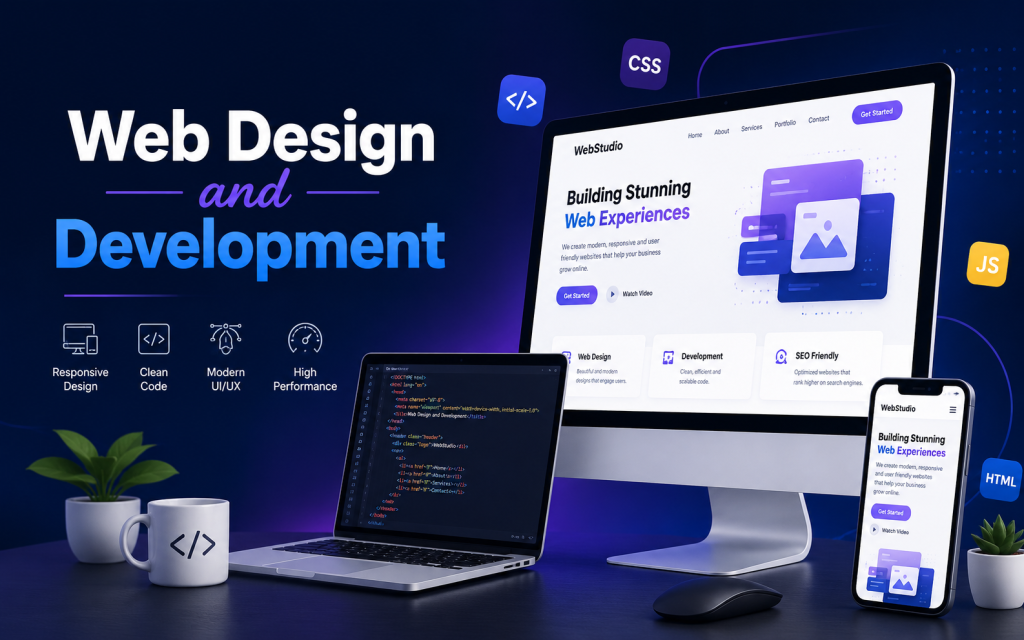
Your website is your most important digital asset. It is open 24 hours a day, 7 days a week. It is often the first impression a potential customer has of your business. A slow, confusing, or outdated website destroys the trust that every other marketing channel works to build.
A high-performing website must be:
- Fast: Pages that load in under 3 seconds. Google uses page speed as a ranking factor.
- Mobile-friendly: Over 60% of web traffic now comes from mobile devices.
- Easy to navigate: Visitors should find what they need within 2 clicks.
- Conversion-focused: Clear calls to action, trust signals, and lead capture forms.
- Secure: HTTPS encryption protects user data and boosts search rankings.
Web design and development is not a one-time project. Your site needs regular updates, security patches, performance optimizations, and content additions to stay competitive.
Video Marketing
Video is no longer optional. It is the dominant content format online. YouTube is the second-largest search engine in the world. Short-form video on TikTok and Instagram Reels generates more organic reach than any other format right now.
Types of video that drive results:
- Explainer videos: What your product does and why it matters
- Product demos: Showing your product in real-world use
- Customer testimonials: Real people sharing real results
- Behind-the-scenes content: Building human connection with your brand
- Tutorial and how-to videos: Establishing expertise and driving SEO traffic
- Live streams: Real-time Q and A, product launches, and events
Video does not require a massive budget. Authenticity outperforms production value on most platforms. A well-lit, clearly spoken video shot on a smartphone can outperform an expensive studio production if the message is more genuine.
Conversion Rate Optimization (CRO)
This is the most overlooked digital marketing solution. CRO is the practice of improving your website so a higher percentage of visitors take the action you want, whether that is buying, signing up, calling, or downloading.
Here is why it matters: if your website converts 1% of visitors into customers and you double that rate to 2%, you have doubled your revenue without spending a single extra dollar on advertising.
CRO techniques include:
- A/B testing headlines, images, and button colors
- Simplifying checkout processes
- Adding social proof (reviews, case studies, trust badges)
- Improving page load speed
- Rewriting weak calls to action
- Reducing form fields
Most businesses obsess over getting more traffic. Smart businesses focus equally on converting the traffic they already have.
Online Reputation Management (ORM)
Your online reputation is what people see when they search your business name. It includes Google reviews, social media mentions, press articles, and forum discussions. ORM is the process of monitoring and shaping that reputation.
Why it matters: 93% of consumers say online reviews influence their purchasing decisions. A single unanswered one-star review can cost you dozens of customers.
ORM includes:
- Monitoring brand mentions across the web
- Responding to negative reviews professionally and promptly
- Encouraging satisfied customers to leave positive reviews
- Suppressing misleading or outdated negative content in search results
- Building a library of positive press, case studies, and testimonials
How Digital Marketing Channels Work Together
One of the biggest mistakes businesses make is treating digital marketing channels as separate activities. In reality, the best results come when every channel works together as part of a single, well-planned strategy. Each channel supports the next, guiding potential customers from discovering your brand to becoming loyal customers.
1. Awareness Stage
At the beginning of the customer journey, people discover your business through channels such as SEO, content marketing, social media, or paid advertising. They may find your website through a Google search, see your Instagram or Facebook ad, or come across one of your blog posts. At this stage, they are learning about your brand for the first time.
2. Consideration Stage
After visiting your website, potential customers begin evaluating your products or services. They may read blog articles, compare solutions, watch product demonstration videos, or browse customer reviews. If they subscribe to your email list or download a resource, you can continue engaging them through email marketing and retargeting campaigns.
3. Decision Stage
When customers are ready to make a purchase, your marketing efforts help reinforce their decision. Retargeting ads, limited-time offers, customer testimonials, product reviews, and clear calls to action encourage them to return to your website and complete their purchase.
4. Retention Stage
The customer journey does not end after a sale. Follow-up emails, loyalty programs, exclusive discounts, helpful content, and ongoing social media engagement encourage repeat purchases and strengthen customer relationships. Satisfied customers are also more likely to leave positive reviews and recommend your business to others.
Why an Integrated Strategy Matters
Every digital marketing channel plays a unique role in the customer journey.
- SEO attracts organic visitors from search engines.
- Content marketing builds trust and answers customer questions.
- Social media increases brand awareness and engagement.
- Email marketing nurtures leads and keeps customers informed.
- PPC advertising reaches new audiences and retargets interested visitors.
- Conversion Rate Optimization (CRO) improves the percentage of visitors who become customers.
- Online reputation management builds credibility through reviews and customer feedback.
When these channels work together, they create a seamless customer experience that generates more traffic, builds trust, increases conversions, and improves long-term customer loyalty.
Choosing the Right Digital Marketing Mix
Not every business needs every channel. Your ideal mix depends on:
- Your budget: SEO and content marketing are lower cost but slower. PPC is faster but requires ongoing spend.
- Your industry: B2B companies often see strong results from LinkedIn and content. E-commerce businesses tend to excel with Google Shopping, Instagram, and email.
- Your target audience: Go where your customers already are. If they are on TikTok, be on TikTok.
- Your timeline: Need results in 30 days Prioritize PPC. Building for the next 3 years? Invest in SEO and content.
A recommended starting point for most small to medium businesses:
- Build a fast, mobile-friendly website (the foundation of everything)
- Set up and optimize your Google Business Profile for local SEO
- Start creating consistent blog content targeting your audience’s questions
- Launch a modest Google Ads or Meta Ads campaign to generate early traffic
- Build an email list and send a monthly newsletter
- Post consistently on 1 to 2 social platforms your audience uses most
- Master these before adding complexity.
How to Measure Digital Marketing Success
Every digital marketing activity should be tied to a measurable outcome. Here are the key metrics you need to track:
| Channel | Key Metrics to Watch |
|---|---|
| SEO | Organic traffic, keyword rankings, backlinks, click-through rate |
| PPC | Cost per click, conversion rate, return on ad spend (ROAS), quality score |
| Social Media | Reach, engagement rate, follower growth, link clicks |
| Content | Page views, time on page, leads generated, social shares |
| Open rate, click rate, unsubscribe rate, revenue per email | |
| Website | Bounce rate, session duration, goal completions, page load speed |
Set up Google Analytics 4 and Google Search Console from day one. These free tools give you a clear picture of what is working and what is not.
One important principle: focus on business outcomes, not vanity metrics. Thousands of Instagram followers mean nothing if none of them become paying customers. Track leads, sales, and revenue, not just likes and impressions.
Common Digital Marketing Mistakes to Avoid
Many businesses struggle to get results from digital marketing because they make avoidable mistakes. By recognizing these common issues early, you can save time, reduce costs, and improve your marketing performance.
Trying to Be Everywhere at Once
Managing every social media platform and marketing channel at the same time often leads to poor results. Instead, focus on two or three channels where your target audience is most active and build a strong presence before expanding.
Ignoring Mobile Users
A large percentage of website traffic comes from mobile devices. If your website is slow, difficult to navigate, or not mobile-friendly, many potential customers will leave before taking any action.
Creating Content Without a Strategy
Publishing blog posts or social media content without researching what your audience is searching for is ineffective. Start with keyword research and create content that answers real customer questions and solves their problems.
Not Retargeting Interested Visitors
Most visitors do not make a purchase during their first visit. Retargeting campaigns help you reconnect with people who have already shown interest in your products or services, increasing the chances of conversion at a lower cost.
Failing to Follow Up with Leads
Many potential customers need multiple interactions before making a buying decision. Relying on a single email or advertisement is rarely enough. Build follow-up sequences using email marketing, remarketing ads, and valuable content to nurture leads over time.
Being Inconsistent
Posting regularly for a short period and then disappearing for weeks or months can reduce your visibility and damage your brand’s credibility. A consistent publishing schedule builds trust, improves engagement, and supports long-term growth.
Not Testing and Optimizing
Running the same advertisements, emails, or landing pages without testing different versions limits your results. Regularly test headlines, images, calls to action, and page designs to discover what performs best and improve your return on investment.
What to Look for in a Digital Marketing Partner
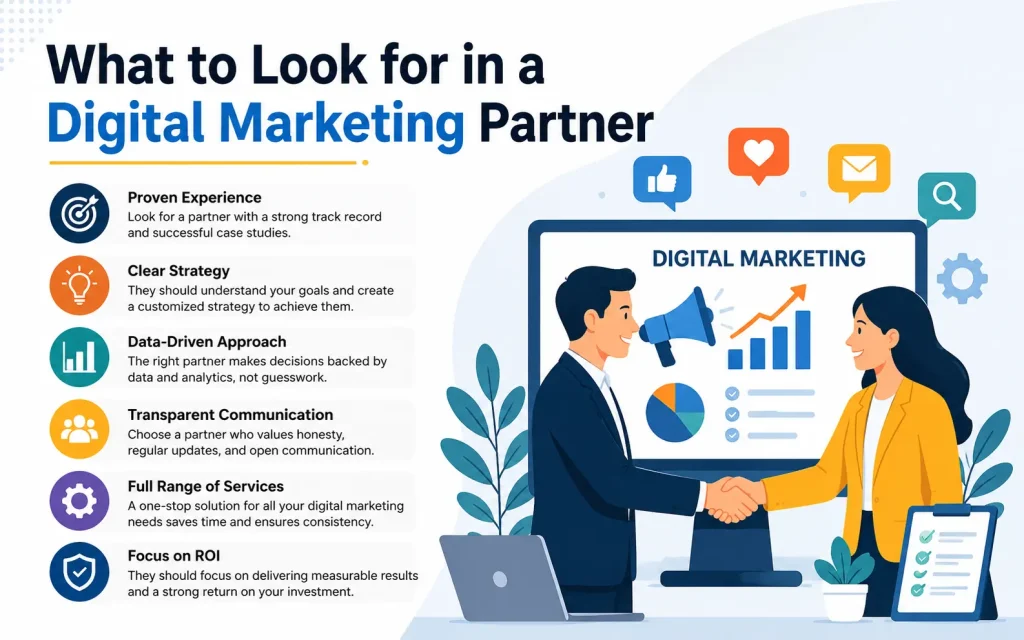
Choosing the right digital marketing agency or freelancer can make a significant difference in your business growth. A reliable partner focuses on long-term success, uses transparent processes, and works toward measurable results. Here are the key qualities to look for.
They Set Realistic Expectations
Be cautious of anyone who promises first-page Google rankings within a few weeks or guarantees a specific number of leads. Digital marketing takes time, and no agency can control search engine algorithms. A trustworthy partner will explain realistic timelines, define achievable goals, and communicate honestly about what is possible.
They Provide Transparent Reporting
A professional agency shares regular performance reports with clear and accurate data. Instead of focusing only on vanity metrics such as impressions or likes, they should report on meaningful results like website traffic, leads, conversions, return on investment, and campaign performance. Access to live dashboards is an added advantage.
They Take Time to Understand Your Business
Effective digital marketing begins with understanding your business, target audience, competitors, and industry. A good agency invests time in learning your goals, challenges, products, and customer journey before creating a customized marketing strategy.
They Have Proven Case Studies
Always ask for examples of previous work and measurable results. A reliable digital marketing partner should be able to show case studies that include real performance metrics such as increased organic traffic, higher conversion rates, improved lead generation, lower cost per acquisition, or increased online sales.
They Offer Flexible Agreements
Avoid agencies that rely on lengthy contracts to keep clients. Confident professionals earn long-term partnerships by delivering consistent results, providing excellent service, and adapting strategies as your business grows.
They Stay Up to Date
Digital marketing changes constantly with new Google algorithm updates, advertising platform features, and consumer trends. A dependable agency continuously updates its knowledge and adjusts strategies to follow the latest industry best practices, ensuring your business remains competitive.
Getting Started: A Step-by-Step Digital Marketing Plan
Step 1: Audit Your Current Presence
Start by reviewing everything you already have in place. Check your website speed using Google PageSpeed Insights. Review your Google Analytics data and make a list of every platform where your business has an online presence including your website social media profiles and business listings.
Step 2: Define Clear Goals
Decide what you want to achieve with your digital marketing. Your goals may include generating more leads increasing online sales driving more visitors to a physical store or improving brand awareness. Clear goals make it easier to choose the right marketing strategy.
Step 3: Understand Your Target Audience
Create a detailed profile of your ideal customer. Identify their age occupation interests challenges goals preferred online platforms and the search terms they use when looking for products or services like yours.
Step 4: Analyze Your Competitors
Search your primary keywords on Google and study the websites that rank on the first page. Review their content backlink profile social media activity and offers. Look for opportunities where you can provide more value or fill gaps they have missed.
Step 5: Build a Strong Foundation
Before investing in paid advertising make sure your website is fast mobile friendly secure and designed to convert visitors into customers. A well optimized website delivers better results from every marketing channel.
Step 6: Select the Right Marketing Channels
Choose two or three marketing channels based on your goals target audience and budget. Whether it is SEO content marketing social media email marketing or paid advertising focus on consistency instead of trying to be everywhere at once.
Step 7: Create a 90 Day Action Plan
Break your strategy into achievable monthly goals.
- Month 1: Improve your website set up analytics and tracking and complete keyword research.
- Month 2: Publish your first five high quality blog posts and launch your initial advertising campaigns.
- Month 3: Analyze performance optimize your campaigns and expand the strategies that produce the best results.
Step 8: Review and Improve Every Month
Digital marketing requires continuous improvement. Review your performance data every month identify what is working eliminate ineffective strategies and invest more in the channels that deliver the strongest results. Consistent optimization leads to better long term growth.
Frequently Asked Questions
What is the difference between digital marketing and traditional marketing?
Traditional marketing uses offline channels like TV, radio, print, and billboards. Digital marketing uses online channels including search engines, social media, email, and websites. Digital marketing allows for precise targeting, real-time measurement, and much lower costs for most businesses.
How long does digital marketing take to show results?
It depends on the channel. PPC can generate traffic within hours. SEO typically takes 3 to 6 months to show meaningful ranking improvements. Content marketing and email list building are 6 to 12-month investments that compound over time.
How much should a business spend on digital marketing?
A common guideline is to allocate 7 to 15% of your revenue to marketing. New businesses or those in competitive markets may need to invest more early on. Start with a budget you can maintain consistently for at least 6 months.
Can small businesses compete with large corporations online?
Yes, often more effectively. Small businesses can move faster, target niche audiences, and create more authentic content. Local SEO, in particular, gives small businesses a strong advantage in their geographic market.=
What is the most important digital marketing channel?
There is no single answer. For most businesses, having a well-optimized website and solid SEO foundation is the highest-leverage starting point because it supports every other channel. But the best channel for your business depends on your industry, audience, and goals.
Final Thoughts
Digital marketing solutions are not magic. They are a structured, data-driven approach to connecting your business with the right customers at every stage of their buying journey. The businesses that win online are not the ones with the biggest budgets.
They are the ones that understand their customers deeply, show up consistently, measure what matters, and improve continuously.
Whether you are just getting started or looking to scale what you already have, the principles in this guide give you a clear roadmap start with the foundation, focus on a few channels, measure relentlessly, and build from there.
You May Also Like It:
Digital Marketing Service Appkod