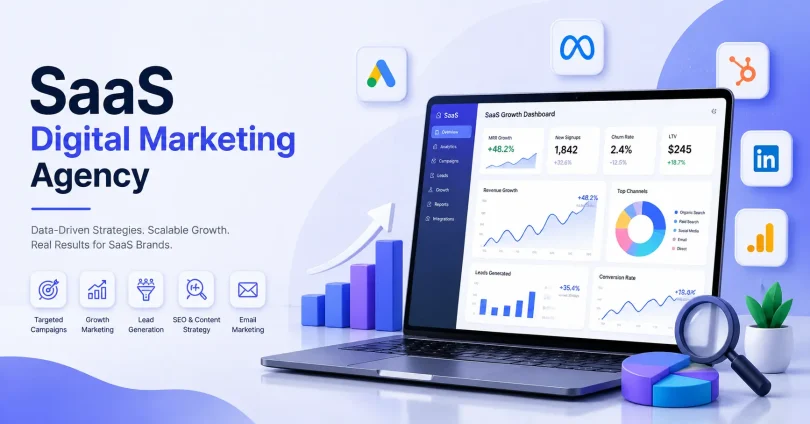

You have built a SaaS product that genuinely solves a problem. Users love it when they try it. But your growth has stalled, your paid ads are burning cash without clear returns, and your content blog reads like every other SaaS blog out there.
This is exactly the gap a specialized SaaS digital marketing agency is designed to close.
But here is the hard truth: not every agency that claims SaaS experience actually has it. Some are glorified generalist shops that have added “SaaS” to their homepage. Hiring the wrong one costs you more than money. It costs you months of lost momentum.
This guide will help you understand what a SaaS marketing agency actually does, how it is different from a standard marketing agency, how to evaluate your options, what to pay, and what questions to ask before you sign anything.
No fluff. No generic lists. Just the practical information you need to make a smart decision.
What Is a SaaS Digital Marketing Agency
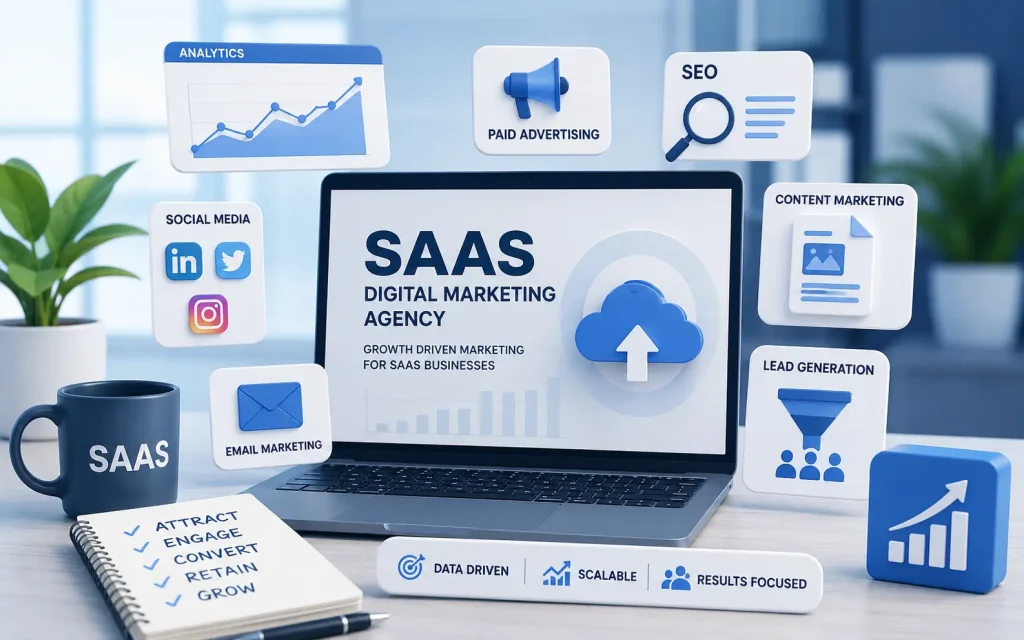
A SaaS digital marketing agency is a firm that specializes in marketing software-as-a-service businesses.
That specialization matters more than it sounds:
SaaS companies operate on subscription revenue. They measure success differently from e-commerce or service businesses. The goal is not just to drive a one-time sale. It is to attract the right users, convert them into paying subscribers, expand their usage over time, and keep churn low enough that the business grows sustainably.
A great SaaS marketing agency understands this model from the inside. They know that a user who churns after month one is worse than no user at all from a unit economics standpoint. They understand product-led growth. They build marketing programs around lifetime value, not just acquisition volume.
A generalist digital marketing agency often does not think this way. They optimize for clicks, impressions, and leads, which looks good in reports but can disconnect entirely from revenue.
How SaaS Marketing Differs from Traditional Digital Marketing
This is a section most competitors skip, and it is one of the most important things to understand before you hire anyone.
Here are the core differences:
The sales cycle is longer and more complex. SaaS buyers, especially in B2B, do extensive research before committing. They compare alternatives, read G2 and Capterra reviews, ask colleagues, and take free trials. Your marketing has to support every stage of that journey, not just generate a click.
The product itself is part of the marketing. In SaaS, a free trial or freemium tier is often the most powerful conversion tool. A good SaaS marketing agency helps you design the acquisition funnel so the product does the selling once users are inside it.
Retention is a marketing problem. In e-commerce, your job ends at checkout. In SaaS, churn is a growth killer. Marketing teams at SaaS companies own onboarding campaigns, lifecycle emails, and re-engagement flows because keeping a customer is as important as acquiring one.
Metrics are fundamentally different. You are not measuring cost per sale. You are measuring customer acquisition cost (CAC), lifetime value (LTV), LTV:CAC ratio, monthly recurring revenue (MRR), annual recurring revenue (ARR), and net revenue retention (NRR). Agencies that do not track these metrics are not really doing SaaS marketing.
Content has to work much harder. SaaS buyers are often technically sophisticated. They will see through shallow content instantly. The bar for quality, depth, and accuracy is much higher than in many other industries.
Core Services a Great SaaS Digital Marketing Agency Should Offer
Not every agency offers every service, and not every SaaS company needs every service.
But the following capabilities are the foundation of effective SaaS marketing:
Search Engine Optimization (SEO): SaaS SEO is a long-term play with compounding returns. The best SaaS marketing agencies combine technical SEO, content strategy, and link building to create sustainable organic traffic that does not disappear when you stop paying for ads.
Content Marketing: This includes blog posts, case studies, comparison pages, landing pages, and thought leadership. Content is how SaaS companies build authority and capture demand from buyers who are actively researching their options.
Paid Advertising (PPC and Paid Social): Google Ads, LinkedIn Ads, Meta Ads, and programmatic display all play a role at different stages. Agencies that understand SaaS know how to balance spend across demand creation and demand capture.
Conversion Rate Optimization (CRO): Driving traffic is half the job. Converting that traffic into free trial signups, demo requests, or paid accounts is the other half. CRO uses A/B testing, landing page design, and user research to improve conversion rates continuously.
Email Marketing and Marketing Automation: Trial nurture sequences, onboarding campaigns, upgrade prompts, and re-engagement flows are all mission-critical in SaaS. A strong agency helps you build these systems, not just run one-off email blasts.
Account-Based Marketing (ABM): For B2B SaaS companies with a defined target account list, ABM aligns marketing and sales efforts on high-value accounts. This is a specialized discipline that not every agency offers well.
Analyst Relations and Review Site Management: Getting listed and ranked on G2, Capterra, and Gartner Peer Insights is a serious growth lever for SaaS. Some agencies manage this proactively. Most do not mention it at all.
Product-Led Growth (PLG) Support. For SaaS products with a freemium or self-serve model, marketing and product overlap significantly. Agencies with PLG experience help optimize the onboarding flow, in-app messaging, and upgrade triggers.
SaaS Marketing Channels at a Glance
| Channel | Time to Results | Cost Level | Best For |
|---|---|---|---|
| SEO and Content | 6 to 12 months | Low to Medium | Long-term organic growth, authority building |
| Google Ads (PPC) | 1 to 4 weeks | Medium to High | Capturing existing demand, bottom-of-funnel |
| LinkedIn Ads | 2 to 6 weeks | High | B2B SaaS with specific job title or company targeting |
| Email and Lifecycle Marketing | 2 to 8 weeks | Low | Trial nurture, onboarding, churn reduction |
| Account-Based Marketing | 2 to 6 months | High | Enterprise SaaS with a named account list |
| Review Site Management | 3 to 6 months | Low to Medium | Building social proof, capturing mid-funnel buyers |
| Paid Social (Meta, X) | 1 to 4 weeks | Medium | Brand awareness, demand creation |
The 6 SaaS Metrics Every Agency Must Track (And Explain to You)
If your agency sends you reports full of clicks and impressions but cannot explain how their work connects to your revenue, that is a serious warning sign.
Here are the six metrics a good SaaS digital marketing agency tracks and reports on:
Customer Acquisition Cost (CAC): This is the total marketing and sales spend divided by the number of new customers acquired in a given period. A great agency works to bring this bnumber down over time while maintaining quality.
Lifetime Value (LTV or CLV): This is the average revenue a customer generates before they cancel. LTV is shaped by pricing, retention, and expansion revenue. Marketing influences it through targeting: if you attract the right customers, they stay longer and spend more.
LTV:CAC Ratio: The gold standard benchmark is 3:1 or higher. If your LTV is three times your CAC, your growth engine is sustainable. Agencies that understand SaaS optimize toward this ratio, not just toward volume.
Monthly Recurring Revenue (MRR): and Annual Recurring Revenue (ARR). These are the bedrock revenue metrics for any SaaS business. New MRR from marketing should be directly attributable to campaign activity.
Net Revenue Retention (NRR): NRR measures whether your existing customers are growing, staying, or shrinking their spend. An NRR above 100% means expansion revenue more than covers churn. Marketing plays a role here through upsell campaigns and lifecycle programs.
Pipeline Contribution. For B2B SaaS, this measures how much of the active sales pipeline was generated by marketing activities. A strong SaaS marketing agency ties their work to pipeline, not just lead volume.
SaaS Metrics Quick Reference
| Metric | Formula | Healthy Benchmark | Marketing Impact |
|---|---|---|---|
| CAC | Total marketing spend divided by new customers | Varies by segment and model | Reduce through better targeting and conversion |
| LTV | Average MRR x average customer lifespan | 3x CAC or higher | Improve through better ICP targeting |
| LTV:CAC Ratio | LTV divided by CAC | 3:1 or better | Core agency performance indicator |
| Churn Rate | Churned customers divided by total customers | Under 5% monthly for SMB | Improved by targeting higher-fit buyers |
| NRR | (MRR start + expansion – churn) divided by MRR start | Over 100% | Marketing drives upsell and expansion campaigns |
| Pipeline Contribution | Marketing-sourced deals divided by total pipeline | 40 to 60% for most B2B SaaS | Direct measure of marketing effectiveness |
Three Types of SaaS Marketing Agencies: Which One Do You Need?
Most articles give you a list of agencies. What they skip is explaining that not all SaaS marketing agencies are the same type.
Knowing the type you need saves you a lot of wasted time:
Full-Service SaaS Marketing Agencies. These agencies handle everything from strategy through execution. They have dedicated teams for SEO, content, paid media, CRO, and email. They work best for companies that want one accountable partner managing the full marketing function. They tend to be more expensive but eliminate the coordination overhead of managing multiple vendors.
Channel-Specialist Agencies. These firms go deep on one or two channels. You might hire a specialist agency for SEO and content while using another for paid media. This model works well when you have an internal marketing team that can coordinate multiple vendors. Specialist agencies often deliver better results in their lane than full-service firms.
Fractional CMO Plus Execution Agency. Some agencies offer a senior strategist, often called a fractional CMO, who builds your marketing strategy and manages execution through a small team. This model is popular with early-stage SaaS companies that do not yet have a full marketing team but need strategic leadership, not just tactical execution.
Knowing which type fits your stage and situation before you start your search will cut your evaluation time significantly.
How to Choose a SaaS Digital Marketing Agency: A Practical
Choosing an agency is not about finding the most impressive website or the longest case study list. It is about finding the right fit for your specific situation.
Here is a practical framework:
Define your growth stage and primary need. Are you pre-product-market fit and need to test messaging? Are you in early growth and need to scale a channel that is already working? Are you at scale and need to expand into new markets? The answer shapes which type of agency you need.
Get clarity on your budget before you talk to anyone. Agencies will try to fit their offering to your budget, but they need to know what that budget is. Going in without a number wastes everyone’s time.
Shortlist agencies that have worked with companies at your exact stage and in your vertical. An agency that has helped enterprise healthcare SaaS companies may not be the right fit for a self-serve productivity tool. Ask specifically about their experience with companies of your size, business model, and target customer.
Ask for attribution methodology, not just results. Any agency can show you impressive MRR numbers. Ask how they attribute marketing to revenue. Ask what their reporting cadence is and what dashboards they use. A credible agency has a clear, honest answer.
Run a paid pilot before committing to a long retainer. A 60 to 90 day paid pilot project lets you evaluate the quality of their work, their communication style, and their ability to deliver on commitments before you sign a longer contract.
What to Expect at Each SaaS Growth Stage
Your marketing needs change dramatically as your company grows. The agency you hire at Series A is probably not the agency you need at Series C.
Here is what to look for at each stage:
Pre-Seed and Seed Stage. At this stage, marketing is mostly about finding product-market fit and identifying your ideal customer profile. You need an agency or advisor who can help you test messaging, validate channels quickly, and avoid wasting budget on scaling something that is not working yet. Look for agencies with product-led growth experience and strong content strategy capabilities.
Series A and Early Growth. This is where you need to start building repeatable acquisition. One or two channels are probably working. You need an agency that can systematize what is working, build the supporting infrastructure (CRM, marketing automation, attribution), and begin scaling spend responsibly. SEO becomes critical here because the content you create now will compound for years.
Series B and Beyond. At this stage, you are likely multi-channel and potentially multi-product or multi-market. You need an agency that can operate at scale, handle ABM programs, manage significant ad budgets, and produce enterprise-grade content. Full-service agencies or agencies with dedicated account management teams tend to fit better here.
Agency Type by Growth Stage
| Growth Stage | Annual Revenue | Primary Need | Best Agency Type |
|---|---|---|---|
| Pre-Seed to Seed | Under $1M ARR | PMF testing, messaging, channel discovery | Fractional CMO or specialist |
| Series A | $1M to $5M ARR | Repeatable acquisition, channel scaling | Full-service or specialist |
| Series B | $5M to $20M ARR | Multi-channel growth, ABM, content at scale | Full-service or specialist |
| Growth and Scale | $20M and above | Market expansion, brand, enterprise GTM | Full-service or in-house plus agency |
How Much Does a SaaS Digital Marketing Agency Cost
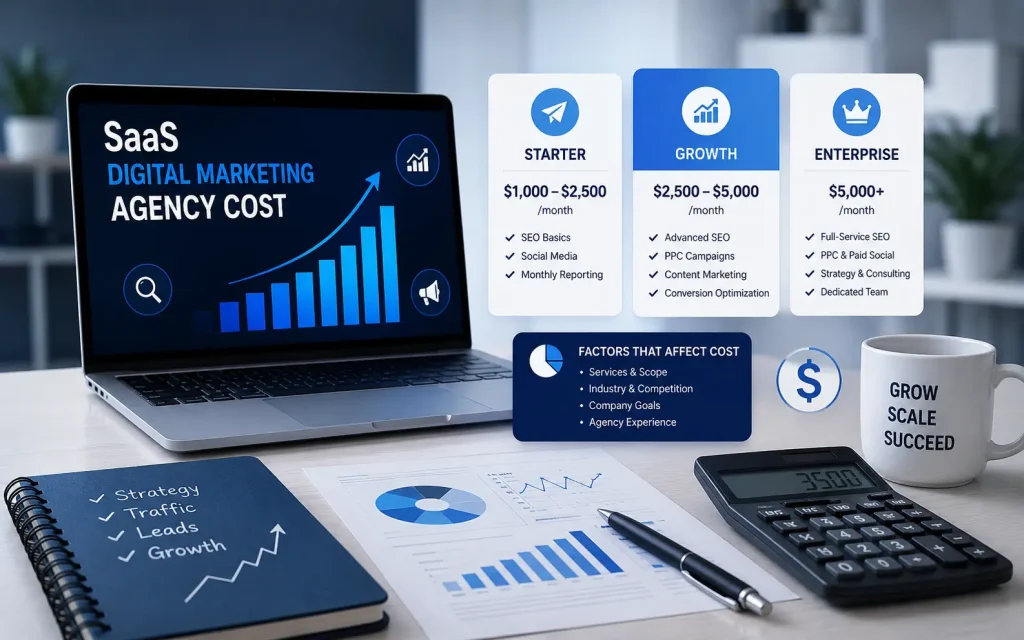
Pricing varies widely based on agency size, experience, service scope, and your company’s stage.
Here is an honest breakdown of what you can expect in 2026:
Retainer-Based Pricing. Most SaaS marketing agencies work on monthly retainers. Entry-level boutique agencies typically start around $3,000 to $5,000 per month for a narrow scope of services. Mid-market agencies with proven SaaS track records usually charge $8,000 to $20,000 per month. Full-service agencies working with Series B and later companies often charge $20,000 to $50,000 or more per month.
Project-Based Pricing. Some agencies offer one-time projects such as a content strategy audit, SEO technical audit, or paid media setup for a fixed fee. These typically range from $5,000 to $25,000 depending on scope.
Performance-Based Models. A small number of agencies offer models tied partly to results, such as a percentage of revenue generated or a cost-per-acquisition arrangement. These can align incentives well but require careful contract design to avoid misaligned metrics.
What you get for the price. At the lower end of retainers, you are typically paying for one or two channels executed by a small team. At the higher end, you are getting a dedicated account team, strategic leadership, multi-channel execution, and sophisticated reporting. The cheapest agency is rarely the most cost-effective one.
Red Flags to Watch Out for When Hiring a SaaS Marketing Agency
This is the section most agencies would prefer you skip. But it is arguably the most valuable one in this entire guide.
Watch out for these red flags before you sign anything:
They cannot explain how their work connects to your revenue. If every agency conversation circles back to traffic, clicks, and impressions but never to pipeline or MRR, the agency is not thinking like a SaaS partner.
They promise results within 30 days for organic or content work. SEO and content take time. Any agency guaranteeing first-page rankings or significant organic traffic within a month is misleading you. Paid channels can show results faster, but even there, meaningful optimization takes 60 to 90 days of data.
They offer the exact same strategy to every client. You should be able to ask how their approach differs based on your business model, target customer, and growth stage. If the answer sounds templated, it probably is.
Their case studies are vague or outdated. Look for specific numbers, named clients (with permission), and clearly explained timelines. “We helped a SaaS company grow 300%” with no context tells you nothing.
They lock you into a long contract on day one. Reputable agencies are confident enough in their work to offer shorter initial engagements or pilot projects. A 12-month lock-in before they have proven anything is a risk you should not take.
They have no experience with your specific business model. PLG SaaS is different from sales-led SaaS. B2C SaaS is different from B2B enterprise SaaS. Ask directly about their experience with your exact model.
Reporting is infrequent or hard to understand. You should get a clear view of performance at least monthly, ideally bi-weekly. If an agency is slow to share data or buries the numbers in confusing charts, that is often intentional.
How to Set Up Your Agency Relationship for Success
Hiring the right agency is only half the job:
The other half is being a good client. Many SaaS founders blame agency performance on the agency when the relationship was set up poorly from the start.
Assign a single internal point of contact. Agencies work best when they have one clear stakeholder to communicate with, not a rotating cast of founders, product managers, and customer success leads with different opinions.
Share everything your agency asks for. This means access to your CRM data, analytics platforms, customer interviews, churn data, and sales call recordings. Agencies that understand your customers deeply do better work. If you guard your data, you limit their effectiveness.
Give honest feedback quickly. If a deliverable misses the mark, say so clearly and promptly. Letting poor work go through to avoid conflict means future work will miss too.
Agree on success metrics before work begins. Write down the specific KPIs you will use to evaluate the engagement in month three, six, and twelve. Having this agreed in writing removes ambiguity and aligns expectations.
Budget for a ramp-up period. Especially on paid channels, the first 60 days are often about learning and testing, not scaling. Expecting peak performance from week one sets everyone up to fail.
The Role of SEO in SaaS Growth: A Long-Term Asset Others Undervalue
Paid ads stop working the moment you stop paying for them. SEO keeps working long after the work is done.
For SaaS companies, a well-executed SEO and content strategy is one of the most durable growth assets you can build. Pages that rank for high-intent queries like “best project management software for remote teams” or “Salesforce alternative for startups” drive qualified organic traffic month after month, with no ongoing cost per click.
The compound effect is powerful. A piece of content that ranks in position three today may generate thousands of monthly visits in 18 months. That same content does not cost more to maintain as traffic grows.
What great SaaS SEO looks like:
- A topic cluster strategy built around your core product categories and buyer intent keywords
- Technical SEO that ensures your pages are fast, indexable, and structured correctly
- Bottom-of-funnel content like comparison pages, alternative pages, and use case pages that capture buyers who are actively evaluating solutions
- A sustainable link-building program that builds domain authority over time
- Regular audits to fix site issues before they erode rankings
Content Marketing for SaaS: What Separates the Leaders from the Noise
The SaaS content landscape is oversaturated. There are hundreds of thousands of blog posts about productivity, project management, HR software, and cybersecurity, most of them thin, templated, and indistinguishable from each other.
The SaaS companies that win with content take a different approach. They create content that cannot be easily replicated because it is built on original research, unique customer data, real practitioner experience, or a genuinely differentiated point of view.
A strong SaaS content program from a specialized agency includes:
Original research and data. State of the industry reports, benchmark studies, and customer surveys create content assets that earn links, generate press coverage, and position your brand as an authority.
Bottom-of-funnel content. Comparison pages comparing your product to competitors, “best tools for X” lists where your product features, and industry-specific use case pages capture buyers at the moment they are closest to a purchase decision.
Case studies that go deep. Not superficial one-pagers with a logo and a quote. Real case studies that explain the customer’s problem in detail, the specific ways your product solved it, and the measurable results with real numbers.
Community and distribution, not just creation. Great SaaS content agencies understand that writing a post is 20% of the work. Getting it in front of the right audience through SEO, social distribution, email, community seeding, and earned media is the other 80%.
Paid Media for SaaS: Getting the Most from Your Ad Budget
Paid advertising is where most SaaS companies waste the most money. It is also where a specialist agency pays for itself fastest when they know what they are doing.
The two most important paid channels for SaaS in 2026 are Google Search Ads and LinkedIn Ads. Each plays a different role.
Google Search Ads capture existing demand. People searching for “CRM software for real estate agents” or “time tracking tool for freelancers” are already looking for a solution. This is the bottom of the funnel, and conversion rates are relatively high when campaigns are structured correctly.
LinkedIn Ads create demand. They reach your target audience before those people are actively searching for a solution. LinkedIn’s targeting, which lets you reach specific job titles, company sizes, industries, and seniority levels, is uniquely powerful for B2B SaaS.
What separates a skilled SaaS paid media agency from an average one:
- They build channel strategy around your full funnel, not just conversion campaigns
- They invest in creative testing as a core discipline, not an afterthought
- They optimize toward pipeline and revenue, not impressions and clicks
- They know when to spend more and when to pause and fix conversion before adding more budget
- They maintain clean attribution so you always know what is working
Building Your Ideal Customer Profile: The Work That Makes Everything Else Work
Every agency conversation focuses on tactics, channels, and campaigns. But the single biggest lever in SaaS marketing is not which channel you use. It is how clearly you understand who you are marketing to.
An ideal customer profile (ICP) is not just a demographic description. It is a detailed picture of the companies and individuals who get the most value from your product, who are most likely to stay, and whose problems your product solves most completely.
A great SaaS marketing agency pushes you to build a precise ICP before spending a dollar on any channel. They look at your existing customer data to find patterns: which company sizes have the lowest churn, which industries have the highest LTV, which roles convert fastest from trial to paid.
Without a sharp ICP, you end up marketing to everyone and converting very few. With a sharp ICP, every channel becomes more efficient because you are targeting and messaging to a specific, well-understood buyer.
If an agency you are evaluating has not asked about your ICP in the first conversation, treat that as a signal about their depth of SaaS marketing understanding.
Common Mistakes SaaS Companies Make When Working with Marketing Agencies
Expecting an agency to replace strategy. Agencies are best at execution within a defined strategy. If you do not have clarity on your ICP, your value proposition, and your growth priorities, even a great agency will struggle to deliver results.
Scaling paid spend before conversion is optimized. Adding more budget to a leaky funnel just accelerates the leak. Before you ask an agency to scale your paid campaigns, make sure your trial-to-paid conversion rate and your landing page conversion rates are healthy.
Judging early results unfairly. Month one and two of any engagement are often about learning, testing, and building infrastructure. Killing an agency relationship at six weeks because you have not seen results yet is rarely the right call.
Ignoring the retention and expansion side. Many SaaS companies hire agencies purely for acquisition and then wonder why NRR is stagnant. The best agencies work across the full customer lifecycle, including the post-signup experience.
Not sharing your roadmap with the agency. If your product is launching a major new feature in three months, your agency needs to know so they can build a launch campaign. Keeping agencies in the dark about product plans means missed opportunities.
How to Measure ROI from Your SaaS Marketing Agency
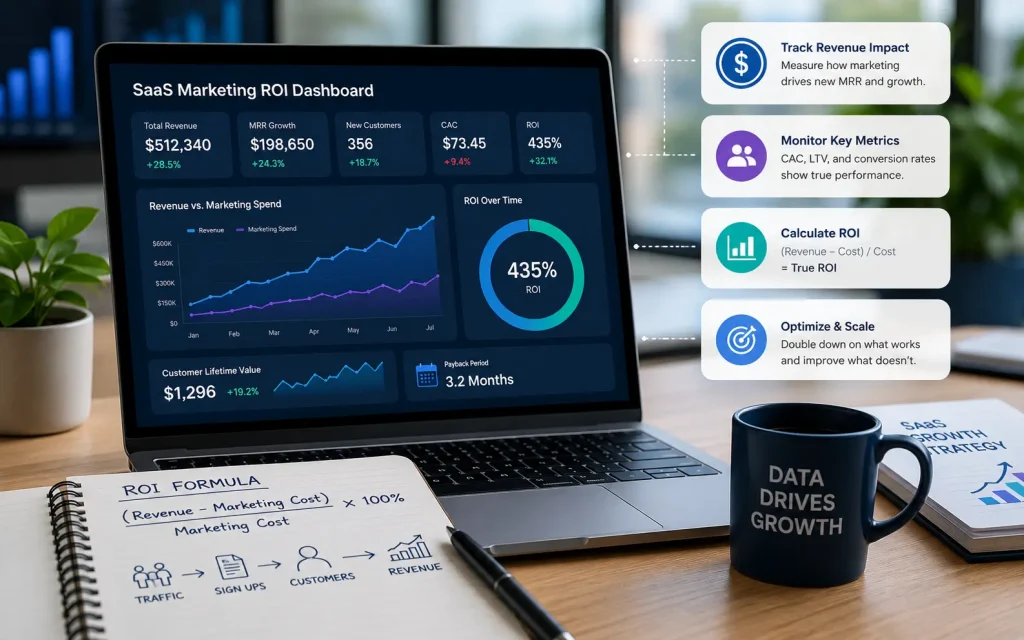
Measuring ROI from a marketing agency is more nuanced than dividing revenue by spend:
Agree on attribution rules upfront. Is a deal credited to marketing if marketing touched the buyer at any point in the journey? Or only if marketing was the first touch? There is no single right answer, but you need a consistent rule that everyone agrees on.
Track pipeline contribution separately from closed revenue. Pipeline is a leading indicator. If marketing is generating a healthy volume of qualified pipeline, closed revenue will follow. Watching only closed revenue means you are always looking in the rearview mirror.
Measure CAC payback period. This is how long it takes the revenue from a new customer to recover the cost of acquiring them. A shorter payback period means the business is compounding faster.
Compare channel efficiency regularly. Your agency should give you a clear view of CAC by channel so you can make informed decisions about where to allocate budget.
Run quarterly business reviews. Every quarter, sit down with your agency for a full review of what worked, what did not, what the plan is for the next quarter, and how the engagement is tracking against the original goals.
The Future of SaaS Marketing: What Is Changing in 2026 and Beyond
AI is changing content creation, but not content strategy. Generalist content produced at high volume by AI tools is already flooding the internet and quickly losing its ability to rank or convert. The agencies and SaaS companies winning with content in 2026 are investing in original research, first-person expertise, and depth that AI cannot replicate.
Generative engine optimization (GEO) is becoming critical. Buyers are increasingly starting their research with AI tools like ChatGPT, Gemini, and Perplexity rather than Google. Forward-looking SaaS marketing agencies are already building strategies to ensure their clients appear in AI-generated answers, not just traditional search results.
Community-led growth is growing alongside product-led growth. SaaS companies that build active user communities through Slack groups, forums, events, or LinkedIn presence are seeing compounding growth effects that paid channels cannot replicate.
First-party data is more important than ever. As third-party cookies disappear and ad platforms make targeting harder, companies with rich first-party data from their own website behavior, product usage data, and direct customer relationships have a significant marketing advantage.
Final Checklist Before Hiring a SaaS Digital Marketing Agency
Use this checklist before making a final decision:
- They have worked with SaaS companies at your stage, in your vertical, or with your business model
- They can articulate how their work connects to revenue, pipeline, and SaaS-specific metrics
- You have met the actual account team, not just the sales team who pitched you
- They have given you references from current or recent clients you can actually call
- You have agreed on KPIs, reporting cadence, and success metrics in writing
- You are starting with a pilot project or short initial engagement rather than a long-term commitment
- You have clarity on who owns the work product, accounts, and creative assets at the end of the engagement
- Their pricing model is transparent, and you understand exactly what is included and excluded
- They asked about your ICP, business model, churn rate, and current funnel before recommending anything
- You have a clear single point of contact on both sides
Frequently Asked Questions (FAQs)
What is a SaaS digital marketing agency?
A SaaS digital marketing agency specializes in helping Software as a Service (SaaS) companies grow through SEO, PPC, content marketing, email marketing, social media, conversion optimization, and customer retention strategies.
Why should I hire a SaaS digital marketing agency?
A SaaS agency understands subscription-based business models, customer acquisition costs (CAC), lifetime value (LTV), and recurring revenue. They create marketing strategies that attract qualified users and increase recurring subscriptions.
What services does a SaaS digital marketing agency offer?
Most SaaS agencies provide SEO, PPC advertising, content marketing, email marketing, product marketing, landing page optimization, conversion rate optimization (CRO), social media marketing, account-based marketing (ABM), and analytics.
How can SEO help a SaaS business?
SEO helps SaaS companies rank higher in search engines, attract qualified organic traffic, increase free trial sign-ups, and generate long-term leads without relying solely on paid advertising.
Is PPC effective for SaaS companies?
Yes. PPC campaigns can quickly drive targeted traffic, promote free trials or demos, and generate qualified leads while supporting long-term growth alongside SEO.
How long does it take to see results from SaaS marketing?
Paid advertising can generate leads within days or weeks, while SEO and content marketing typically take three to six months to produce consistent long-term results.
How do SaaS agencies measure marketing success?
Success is measured using key metrics such as Monthly Recurring Revenue (MRR), Annual Recurring Revenue (ARR), Customer Acquisition Cost (CAC), Customer Lifetime Value (LTV), conversion rate, churn rate, organic traffic, and return on investment (ROI).
Conclusion
A great SaaS digital marketing agency is not a vendor. It is a growth partner that understands subscription economics, thinks in terms of pipeline and lifetime value, and builds programs designed to compound over time.
The difference between a good agency relationship and a bad one is rarely about talent. It is about fit: the right type of agency for your stage, the right scope of services for your needs, clear success metrics agreed on upfront, and a client-agency relationship built on transparency on both sides.
Use this guide to go into your agency search with clear eyes. Know what you need, know what questions to ask, know what to pay, and know what red flags to walk away from.
The right SaaS digital marketing agency will feel less like an external vendor and more like an extension of your team. When you find that fit, the growth that follows tends to be both faster and more durable than anything you could have built alone.
You May Also Like It:
Best Digital Marketing Agency -Detroit