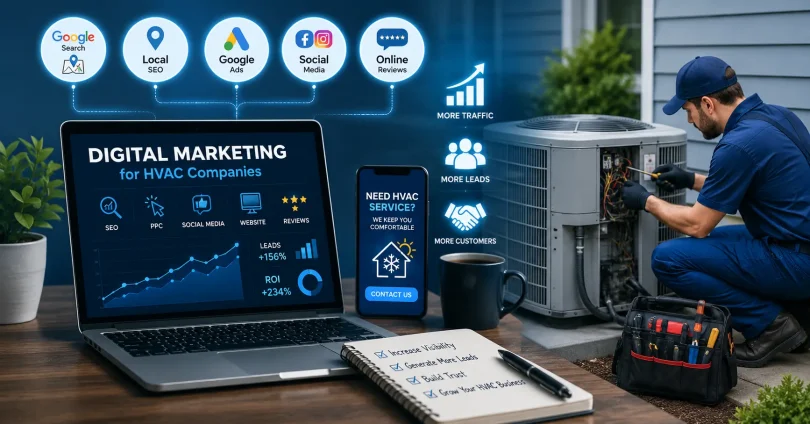

Digital Marketing for HVAC Companies has become essential for business growth in 2026. Referrals and repeat customers are still valuable but they are no longer enough to keep your calendar full throughout the year. Today most homeowners and commercial property managers begin their search online when they need AC repair heating installation or emergency HVAC services. Before making a call they compare Google reviews browse company websites check service offerings and choose the business that appears the most reliable and professional.
A strong digital marketing strategy helps your HVAC company get discovered by customers exactly when they are searching for your services. Whether through search engine optimization local SEO Google Ads content marketing or social media your online presence can generate a steady stream of qualified leads while building trust and credibility. Businesses that invest in digital marketing consistently outperform competitors that rely only on traditional advertising or word of mouth.
This guide covers everything you need to know about digital marketing for HVAC companies in 2026 including the most effective marketing channels proven lead generation strategies common mistakes to avoid and practical tips for attracting more customers increasing bookings and growing your HVAC business for the long term.
Table of Contents
- Why Digital Marketing Is Non-Negotiable for HVAC Companies
- Know Your Numbers Before You Spend a Dollar
- HVAC Website Design: The Foundation of Every Campaign
- SEO for HVAC Companies: Rank Where It Counts
- Local SEO: Dominate Your Service Area
- Google Ads and PPC: Get Leads Fast
- Google Local Services Ads (LSAs): The Underused Goldmine
- Social Media Marketing for HVAC Companies
- Email Marketing and Customer Retention
- Reputation Management and Online Reviews
- Video Marketing: The Untapped Channel
- Seasonal Marketing: Plan Ahead, Win Big
- Marketing Automation and AI Tools
- How to Track What Is Actually Working
- Building Your HVAC Digital Marketing Stack
Why Digital Marketing Is Non-Negotiable for HVAC Companies

Picture this: a homeowner’s AC dies on a July afternoon. They grab their phone and search “AC repair near me.” If your HVAC company does not show up in those first three results, you do not exist to that customer.
That moment is happening thousands of times every day in your service area. And your competitors are fighting for every one of those clicks.
97% of consumers search online before hiring a local service business. For HVAC companies specifically, that number is even higher because HVAC is almost always an urgent, high-intent purchase. Nobody browsers for furnace repair. They need help now, and Google is the first place they look.
Digital marketing for HVAC companies is not a nice-to-have. It is the primary way new customers find you, evaluate you, and decide whether to call. Every dollar you invest in digital marketing should be traceable to real leads, real bookings, and real revenue.
This guide breaks down every major channel, gives you real 2026 benchmark numbers, and tells you exactly where to start.
Know Your Numbers Before You Spend a Dollar
Most HVAC business owners dive into Google Ads or SEO without understanding the math that makes it worth doing.
Before you invest in any channel, you need to know three numbers:
- Your average job value: What is the average revenue per service call or installation?
- Your customer lifetime value (CLV): How much does a single customer spend across their relationship with your company?
- Your target cost per lead (CPL): What is the maximum you can pay for a lead and still profit?
According to SearchLight 2026 data compiled from $14.9 million in HVAC ad spend across 816 contractors, the average HVAC customer has a lifetime value of $15,340. That number changes everything about how you think about marketing spend.
HVAC Marketing Benchmark Table (2026)
| Metric | Industry Average | Top Performers |
|---|---|---|
| Cost per lead (Google Ads blended) | $104 | Under $75 |
| Cost per lead (non-branded search) | $149 | Under $110 |
| Website conversion rate (visitor to lead) | 7.8% | 12%+ |
| Inbound phone lead close rate | 46% | 60%+ |
| Customer lifetime value | $15,340 | $20,000+ |
Source: SearchLight by Hatch, 816 HVAC contractors, January 2026
The key insight from this data: at a $104 cost per lead and a $15,340 CLV, acquiring one HVAC customer through paid ads returns roughly 147x your lead cost over the relationship. The math is overwhelmingly in favor of investment.
The biggest revenue leak for most HVAC companies is not their ad spend. It is their conversion rate. Missed calls, slow follow-up, and poor websites are costing you more than any marketing inefficiency.
HVAC Website Design: The Foundation of Every Campaign
Every digital marketing channel you run, from SEO to paid ads to social media, eventually sends traffic to your website. If your website fails to convert that traffic into calls and form submissions, every dollar you spend on marketing is wasted.
What Your HVAC Website Must Do
Your website has one job: convert a skeptical visitor into a phone call or a booked appointment.
That means it needs to:
- Load in under two seconds (page speed directly affects conversions and Google rankings)
- Display your phone number prominently on every page, especially on mobile
- Show clear calls to action: “Call Now,” “Book Online,” “Get a Free Quote”
- Build immediate trust with licenses, certifications, Google review ratings, and photos of your real team
- Make it dead simple to contact you from any device
Site speed is not a minor detail. One HVAC company in Southern Maryland saw a 45% increase in phone leads after cutting their page load time from 4.2 seconds to 1.4 seconds, along with a 38% jump in organic traffic and a Google 3-Pack placement in their region.
Essential Pages for an HVAC Website
- Homepage with clear service area and primary services
- Individual service pages (AC repair, furnace installation, heat pumps, indoor air quality, etc.)
- City or neighborhood landing pages for every area you serve
- About page with team photos, licenses, and years in business
- Reviews page or embedded Google review feed
- Contact page with a simple form and embedded map
One page per service, one page per city. That is the baseline for an HVAC website that actually ranks and converts.
SEO for HVAC Companies: Rank Where It Counts
Search engine optimization (SEO) is the process of earning organic (non-paid) rankings on Google for the terms your customers are searching. For HVAC companies, SEO is one of the highest-ROI channels because the leads are free once you earn the rankings.
How HVAC SEO Works
Google ranks pages based on three factors:
- Relevance: Does your page directly answer what the user searched for?
- Authority: Do other trusted websites link to yours?
- Experience: Is your website fast, mobile-friendly, and easy to use?
HVAC SEO targets high-intent keywords, meaning search terms used by people who are ready to hire. \
These include:
- “AC repair [city name]”
- “furnace replacement near me”
- “emergency HVAC service [city]”
- “heat pump installation [city]”
- “HVAC company near me”
On-Page SEO Checklist for HVAC Companies
- Include the primary keyword in the page title, H1 heading, and first paragraph
- Write unique, helpful content on every service page (at least 500 words)
- Add schema markup for local businesses (helps Google show your ratings in search)
- Use descriptive image alt text including your location and service
- Link internally between related service pages
- Keep URLs clean and descriptive (example: yoursite.com/ac-repair-dallas)
What competitors miss: Most HVAC SEO content focuses on rankings and ignores user intent. Google’s algorithm increasingly rewards pages that fully answer a user’s question. If someone searches “how much does AC replacement cost,” they want a real answer with a price range, not a generic page that just says “contact us for a quote.” Providing real answers builds trust and earns rankings.
Local SEO: Dominate Your Service Area
For HVAC companies, local SEO is the most valuable form of SEO. The Google Local Pack, the map with three business listings that appears at the top of local searches, drives more leads for home service companies than any other organic placement.
Optimizing Your Google Business Profile
Your Google Business Profile (formerly Google My Business) is the core of your local SEO.
Here is how to optimize it:
- Claim and verify your listing if you have not already
- Choose “Heating and Air Conditioning Contractor” as your primary category
- Add all your services with accurate descriptions
- Upload real photos of your team, trucks, and completed jobs (at least 20)
- Post weekly updates, seasonal offers, and tips
- Answer every question in the Q and A section
- Respond to every review, positive and negative, within 24 hours
Building Local Citations
A local citation is any online mention of your business name, address, and phone number (NAP). Consistent citations across directories like Yelp, Angi, HomeAdvisor, the Better Business Bureau, and local chamber of commerce sites signal to Google that your business is real, established, and trustworthy.
Audit your existing citations first. Inconsistent NAP information (abbreviations, old addresses, wrong phone numbers) actively hurts your local rankings.
Google Ads and PPC: Get Leads Fast
Pay-per-click (PPC) advertising on Google puts your business at the top of search results immediately. Where SEO takes months to build, Google Ads can generate calls the same day you launch a campaign.
HVAC Google Ads Benchmarks (2026)
| Campaign Type | Average Cost Per Lead | Best Use Case |
|---|---|---|
| Branded search | $40-$60 | Protect your brand, capture warm traffic |
| Non-branded search | $149 | New customer acquisition |
| Performance Max | $72 | Broad reach, Google-managed placements |
| Display retargeting | $20-$40 | Re-engage website visitors |
Source: SearchLight by Hatch, $14.9M HVAC ad spend, 2026
How to Run HVAC Google Ads That Actually Convert
- Separate campaigns by service: One campaign for AC repair, one for furnace installation, one for maintenance agreements. This lets you control bids and budgets by profitability.
- Use call extensions and call-only ads: HVAC customers want to call, not fill out forms. Make calling as easy as possible from the ad itself.
- Target by zip code, not radius: Radius targeting can waste spend on areas you do not serve or do not want. Zip code targeting gives you precision.
- Bid on emergency keywords: “Emergency AC repair” and “24-hour HVAC service” have higher CPLs but close at much higher rates.
- Match your landing page to your ad: If your ad says “Same-Day AC Repair,” the page it lands on must say the same thing. Mismatched messaging kills conversions.
The Most Common PPC Mistake HVAC Companies Make
Running one broad campaign with a single budget and letting Google decide where to spend it. Google will default to the lowest-cost clicks, which are often the lowest-quality leads. Segment your campaigns, set negative keywords (exclude “DIY,” “parts,” “how to”), and review your search term reports weekly.
Google Local Services Ads (LSAs): The Underused Goldmine
Google Local Services Ads appear above regular Google Ads in search results. They show your star rating, number of reviews, years in business, and a “Google Guaranteed” badge. You only pay per lead, not per click.
For HVAC companies, LSAs are one of the most efficient paid channels available. The Google Guaranteed badge significantly increases consumer trust, and because you pay per lead rather than per click, you are not paying for browsers who never call.
To qualify for LSAs, you need:
- A verified Google Business Profile
- Background checks for all technicians and owners
- Proof of licensing and insurance
- A minimum number of Google reviews (typically 3 or more)
If you are not running LSAs yet, this is the single fastest win available in HVAC paid advertising.
Social Media Marketing for HVAC Companies
Social media is not where people go to find an HVAC company in an emergency. But it is where they form opinions about brands, see ads from companies they have encountered before, and share recommendations with neighbors.
The Right Platforms for HVAC Companies
- Facebook: The best paid social platform for HVAC. Facebook and Instagram ads let you target homeowners by zip code, age, homeownership status, and even household income. Use it for seasonal promotions, maintenance reminders, and retargeting website visitors.
- Nextdoor: Extremely underused by HVAC companies. Nextdoor is where homeowners ask neighbors for contractor recommendations. Create a business page, respond to mentions, and run neighborhood-targeted ads.
- YouTube: More on this in the video section below. YouTube is powerful for trust-building content and long-term SEO value.
- Instagram: Works for brand awareness and showcasing before-and-after installation photos. Less direct for lead generation but useful for brand building.
What to Post on Social Media as an HVAC Company
- Seasonal tips (“5 ways to prep your AC for summer”)
- Before-and-after installation photos
- Team member spotlights and introductions
- Customer testimonials (with permission)
- Maintenance reminders before peak seasons
- Educational content (“Why your energy bill spikes in August”)
Avoid posting generic stock photos or promotional content that looks like advertising. Posts that help, inform, or entertain earn engagement. Posts that just sell get ignored.
Email Marketing and Customer Retention
Most HVAC companies focus 100% of their marketing on acquiring new customers and almost nothing on keeping the ones they have.
This is a costly mistake:
Returning customers cost significantly less to serve than new customers. They are more likely to refer you, more likely to sign up for maintenance agreements, and more likely to call you first in an emergency.
HVAC Email Marketing Campaigns That Work
- Seasonal tune-up reminders: Send a reminder in March for AC season and September for heating season. Include a special offer for existing customers.
- Maintenance agreement renewal notices: 60 days before a contract expires, send a renewal campaign with the value clearly stated.
- Post-service follow-up: 48 hours after a service call, send a follow-up email asking how everything went. Include a direct link to leave a Google review.
- Equipment age reminders: If you tracked when a customer had equipment installed, send a friendly note when it reaches 10-12 years (“Your system is reaching the age where replacement planning makes sense. Here is what to know.”).
- Emergency preparedness tips: Before summer and winter, send content-focused emails with actionable prep advice. These build goodwill without selling.
Email marketing has one of the highest ROIs of any digital channel, typically $36 returned for every $1 spent, because it targets people who already know and trust you.
Reputation Management and Online Reviews
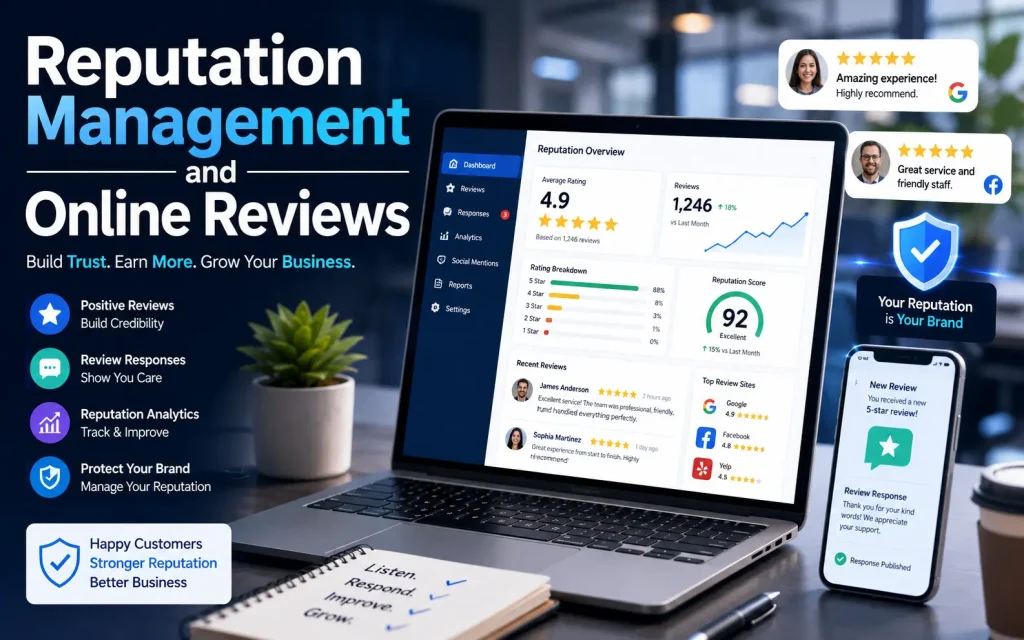
For local HVAC companies, your Google star rating is one of the most powerful lead generation tools you have.
Studies consistently show that:
- 88% of consumers trust online reviews as much as personal recommendations
- Moving from a 3.5-star to a 4.5-star rating can increase lead volume by 30% or more
- Businesses with 100 or more reviews generate significantly more leads than those with fewer than 25
How to Get More 5-Star Reviews Consistently
The key to review generation is timing and ease. Ask for a review at the peak of the customer’s happiness, which is immediately after a successful service call, and make it as easy as possible.
The most effective approach: train every technician to say, at the end of a job, “If everything looks good today, it would really help us out if you left us a quick Google review. I can text you the link right now.” A direct link to your Google review page, sent via text, converts dramatically better than email requests.
Respond to every review. Positive reviews deserve a genuine thank-you. Negative reviews require a calm, professional response that acknowledges the issue and offers to resolve it. Potential customers read your responses to negative reviews more closely than the reviews themselves.
Video Marketing: The Untapped Channel
Most HVAC companies completely ignore video. That is a significant competitive advantage for those who use it.
YouTube is the second-largest search engine in the world. Homeowners search YouTube for answers to questions like “how do I know if my AC needs refrigerant,” “what size furnace do I need,” and “how to change HVAC filter.” A well-optimized YouTube video for these searches can drive qualified local traffic to your website for years.
HVAC Video Ideas That Earn Views
- “How to change your HVAC filter” (step-by-step)
- “Signs your AC needs to be serviced before summer”
- “What to do when your furnace stops working”
- “How to read your thermostat settings”
- “Why is my energy bill so high? HVAC causes explained”
- “[City] HVAC company: meet our team” (trust-building content)
You do not need expensive production. A smartphone, decent lighting, and a technician willing to explain things clearly is enough. Authentic, helpful videos outperform polished promotional content on YouTube because people are there to learn, not to watch ads.
Important: Always include your city and service area in video titles, descriptions, and tags. “How to know if your AC needs refrigerant – Dallas HVAC tips” will rank locally and attract exactly the right audience.
Seasonal Marketing: Plan Ahead, Win Big
HVAC demand is intensely seasonal. Most of your competitors react to seasons. The companies that win plan for them three months in advance.
Seasonal HVAC Marketing Calendar
| Season | Focus | Recommended Channels |
|---|---|---|
| January to February | Heating emergencies, furnace repair, system age awareness | Google Ads (emergency keywords), email to existing customers |
| March to April | Pre-season AC tune-ups, new system consultations | Local SEO, Google LSAs, Facebook ads to homeowners |
| May to June | AC repair, emergency AC, new installations | Full budget on Google Ads + LSAs, social media |
| July to August | Peak demand, emergency service, financing offers | Maximize all paid channels, review generation |
| September to October | Fall furnace tune-ups, pre-winter preparation | Email marketing, Google Ads (heating keywords) |
| November to December | Furnace emergencies, heating system replacement | Google Ads emergency campaigns, retargeting |
The smartest HVAC marketers increase their Google Ads budgets two to three weeks before peak demand, not during it. Ad costs spike when every competitor turns their budgets up simultaneously. Getting in early means lower CPLs and more visibility when the rush hits
Marketing Automation and AI Tools
AI and automation tools are changing how HVAC companies manage leads and follow-up. The single biggest revenue opportunity for most HVAC companies is not getting more leads. It is responding to existing leads faster.
Research consistently shows that calling back a lead within 5 minutes versus 30 minutes increases the chance of conversion by 400%. Most HVAC companies call back in hours, not minutes.
Tools Worth Using in 2026
- CRM with automated follow-up: ServiceTitan, Jobber, and HouseCallPro all include automated text and email follow-up for missed calls and form submissions. If a lead submits a form at 11 PM, they should receive an automatic text within seconds confirming receipt and setting expectations for a morning call.
- AI chat widget: A live chat widget powered by AI can answer common questions (pricing ranges, service areas, booking availability) and capture lead information 24 hours a day. HVAC companies lose a significant number of leads who visit after hours and find no way to connect.
- Call tracking software: Tools like CallRail let you see exactly which marketing channel generated every phone call. Without call tracking, you are flying blind on which campaigns are actually producing leads.
- Reputation automation: Tools like Podium and NiceJob automate the review request process, texting customers a review link automatically after a job is marked complete in your CRM.
How to Track What Is Actually Working
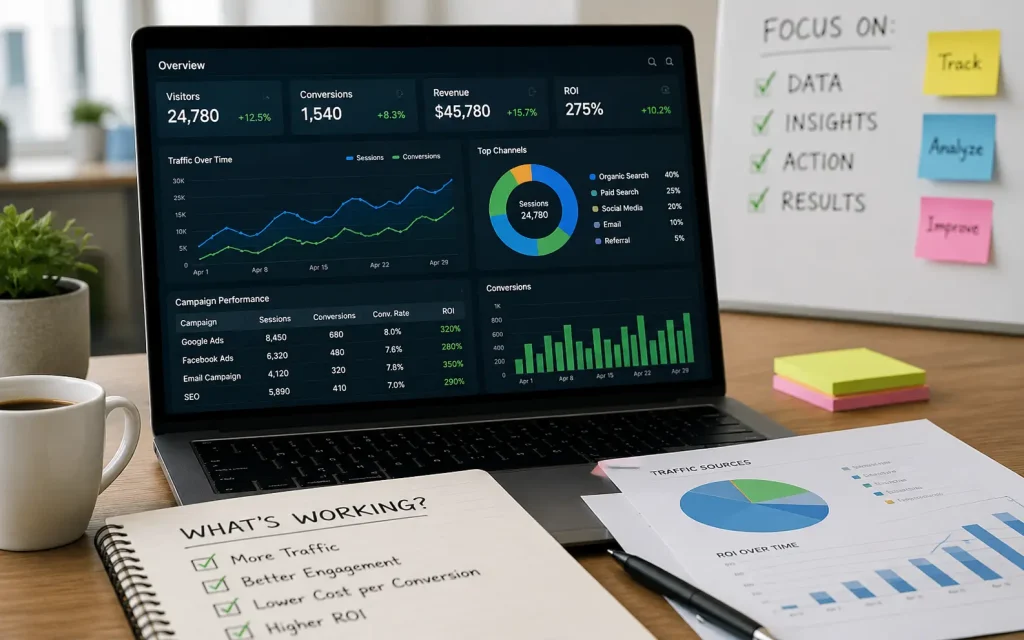
The most common complaint from HVAC business owners about digital marketing is that they cannot tell what is actually working. This is almost always a setup problem, not a marketing problem.
A properly set up tracking stack for an HVAC company includes:
- Google Analytics 4 on your website, with conversion events set up for phone click-throughs, form submissions, and booking completions
- Google Search Console to see which search terms bring people to your site
- Call tracking numbers for every major marketing channel (one for Google Ads, one for organic search, one for your truck wraps, etc.)
- UTM parameters on all your paid and social links so Google Analytics can separate traffic sources accurately
- A monthly report that ties leads back to revenue, not just to clicks or impressions
The goal is not to track everything. The goal is to know, with confidence, which channels are producing profitable customers and which are not.
Building Your HVAC Digital Marketing Stack
If you are starting from scratch or auditing your current marketing, here is a prioritized order of investments based on ROI and urgency:
Phase 1: Foundation (Months 1 to 2)
- Professional, fast, mobile-first website
- Optimized Google Business Profile
- Google Local Services Ads (fast to launch, pay per lead)
Phase 2: Paid and Organic Growth (Months 2 to 4)
- Google Ads campaigns segmented by service
- Local SEO work (citations, on-page optimization, city pages)
- Call tracking and Google Analytics setup
- Review generation system
Phase 3: Retention and Expansion (Months 4 to 6 and beyond)
- Email marketing for existing customers
- Facebook and Instagram ads for retargeting and seasonal promotions
- YouTube channel with educational content
- Marketing automation and CRM integration
You do not need to do everything at once. You need to do the right things in the right order. A fast website with a strong Google Business Profile and active LSAs will outperform a company spending five times more on fragmented, untracked campaigns.
Frequently Asked Questions (FAQs)
What is digital marketing for HVAC companies?
Digital marketing for HVAC companies uses online channels like SEO, Google Ads, local SEO, social media, email marketing, and content marketing to attract customers and generate more service calls.
Why is digital marketing important for HVAC businesses?
It helps HVAC companies reach customers who are actively searching for heating and cooling services, increase brand visibility, build trust, and generate consistent leads.
Which digital marketing strategy works best for HVAC companies?
A combination of local SEO, Google Business Profile optimization, SEO, Google Ads, customer reviews, and a fast, mobile-friendly website delivers the best results.
How long does HVAC SEO take to show results?
Most HVAC businesses begin seeing noticeable improvements within 3 to 6 months, although highly competitive markets may take longer.
Is Google Ads worth it for HVAC companies?
Yes. Google Ads can generate qualified leads quickly, especially for emergency HVAC services, AC repair, furnace repair, and seasonal promotions.
How can local SEO help an HVAC company?
Local SEO improves your visibility in Google Maps and local search results, making it easier for nearby customers to find and contact your business.
What type of content should HVAC companies publish?
HVAC companies should create blogs, maintenance guides, seasonal tips, energy-saving advice, FAQs, and troubleshooting articles to attract organic traffic and build authority.
Final Thoughts
Digital marketing for HVAC companies works best when it is built on clear numbers, consistent execution, and a genuine commitment to serving customers well.
The companies that dominate local markets are not always the ones with the biggest budgets. They are the ones who respond fastest, earn the most trust, and show up where their customers are looking.
Start with your website and your Google Business Profile. Add Local Services Ads. Build a review system. Track everything. Then expand into the channels that make sense for your market.
The homeowner with a broken AC is searching right now. Make sure they find you first.
You May Also Like It:
Fintech Digital Marketing Agency