
Digital Marketing Agency Japan services require a very different approach from most global markets. Japan is the world’s third-largest advertising market, and it does not play by Western rules. Google still matters, but LINE, Yahoo Japan, and a culture built on trust and detail can quietly decide whether your campaign succeeds or falls flat..
Most articles on this topic are just ranked lists of agency names. This one is different. Instead of only telling you who to call, it explains how the market actually works, what a fair price looks like, which questions expose a weak agency in one meeting, and how to measure whether your investment is paying off.
Whether you are a global brand entering Japan for the first time or a local business ready to scale, this guide gives you the full picture before you sign anything.
What Is a Digital Marketing Agency in Japan
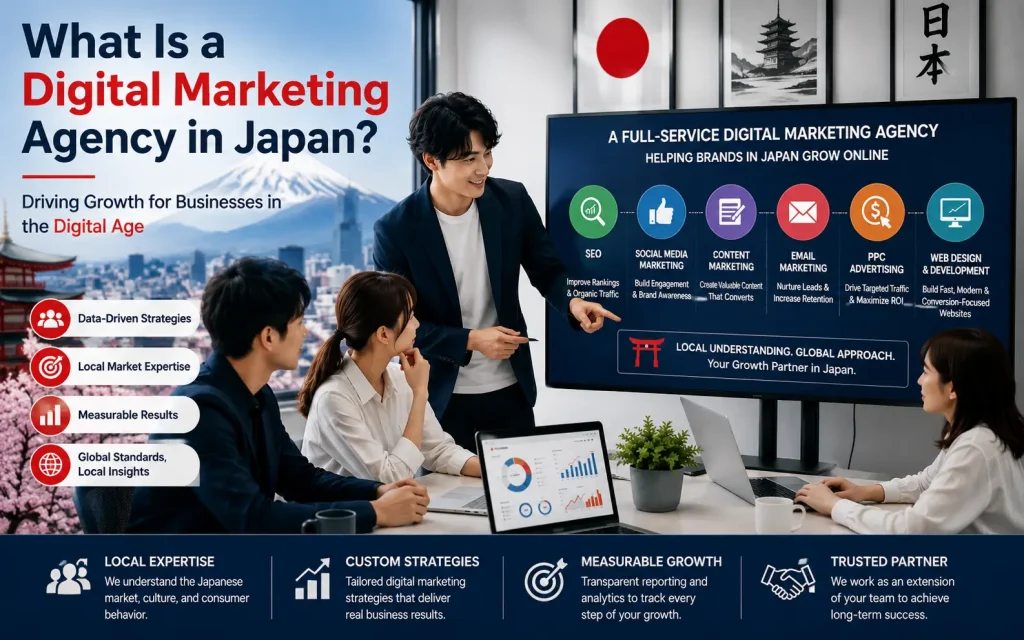
A digital marketing agency in Japan is a company that plans, builds, and runs online campaigns for brands targeting Japanese consumers or businesses. That covers search engine optimisation, paid advertising, social media, content, e-commerce, and increasingly, localisation and cultural adaptation.
The term is broad on purpose. Some agencies are massive advertising conglomerates like Dentsu or Hakuhodo, with roots going back over a century. Others are lean, ten-person teams in Shibuya or Osaka that specialise in one channel, such as LINE ads or Amazon Japan storefronts. Both categories fall under the same search term, so it pays to know which type actually fits your goals before you start comparing names.
Why Japan’s Digital Market Is Different From the West
Japan has one of the most technologically advanced populations on earth, yet its digital habits do not mirror the US or Europe.
A few structural differences change how marketing works here:
- Trust before transaction. Japanese consumers research heavily before buying and lean on brand reputation, reviews, and word of mouth more than flashy discounts.
- Group harmony over individualism. Messaging that highlights personal achievement often lands worse than messaging built around belonging, reliability, and shared values.
- High design and language standards. Typos, awkward machine translation, or cluttered layouts damage credibility fast, even if the product itself is strong.
- Mobile-first, but through different apps. LINE, not WhatsApp or Messenger, is the daily communication hub for over 90 million users in Japan.
An agency that has only run Western-style playbooks in Japan will usually underperform one that understands these behavioural differences from day one.
The State of Digital Marketing in Japan in 2026
Japan’s digital ad spend has climbed past traditional media (TV, print, radio, outdoor) combined for several years running, and that gap keeps widening.
A few numbers worth knowing before you budget:
- Search and social still take the largest share of digital ad budgets, with video and retail media growing the fastest.
- Smartphone penetration sits above 90 percent, but a meaningful share of e-commerce and banking still happens through desktop, especially among older, higher-income consumers.
- Yahoo! Japan remains a genuinely major search and portal player, unlike most other markets where Yahoo has faded.
- LINE is used by the vast majority of the population daily, for messaging, payments, news, and increasingly, shopping.
These figures matter because they shape channel strategy. A media plan copied from a US or UK campaign, without adjusting for LINE and Yahoo! Japan, is likely leaving reach and conversions on the table.
Types of Digital Marketing Agencies Japan You’ll Find in Japan
Not every agency does everything well. Here is how the market typically splits.
| Agency Type | Best For | Typical Client Size |
|---|---|---|
| Full-service agency | Brands needing strategy, media, and creative under one roof | Mid-size to enterprise |
| SEO or SEM specialist | Businesses focused purely on search visibility and paid search | Small to mid-size |
| Social and influencer agency | Brands building awareness on Instagram, TikTok, YouTube, and LINE | All sizes |
| E-commerce specialist | Sellers on Amazon Japan, Rakuten, or Yahoo! Shopping | Retail and D2C brands |
| Localisation and cultural adaptation firm | Foreign brands adapting content, not just translating it | First-time market entrants |
| PR and communications agency | Reputation building, media relations, crisis response | Mid-size to enterprise |
Many agencies blend two or three of these, so ask directly which category their core team actually specialises in, rather than assuming from their homepage.
Key Services Offered by Japanese Digital Marketing Agencies
Beyond the agency type, most reputable providers offer some combination of:
- Search engine optimisation for both Google and Yahoo! Japan
- Paid search and programmatic display advertising
- Social media management across Instagram, X, YouTube, TikTok, and LINE Official Accounts
- Content marketing and Japanese copywriting, not machine translation
- Influencer marketing and talent partnerships
- Web design and development built for Japanese UX conventions
- E-commerce marketplace management
- Marketing analytics, attribution, and reporting
The strongest agencies do not just execute these services, they explain how each one supports a measurable business outcome, not just activity.
Full Service vs Specialist Agencies – Which Should You Choose
This is one of the first real decisions you will make, and it depends entirely on where your business is today.
Choose a full-service agency if you need one accountable partner managing strategy, budget allocation, and creative across every channel. This suits brands entering Japan for the first time with limited internal marketing headcount.
Choose a specialist agency if you already have a strategy and simply need deep execution in one channel, such as SEO, paid social, or influencer outreach. Specialists often deliver stronger results per channel because their teams are not stretched across five disciplines at once.
A common and effective middle path: hire a full-service agency or in-house lead to own strategy, then bring in specialists for the channels where deep expertise matters most.
How Much Does a Digital Marketing Agency in Japan Cost
Pricing in Japan varies more by agency size and client scope than by service type. Here is a realistic range based on typical market retainers.
| Service Scope | Monthly Retainer (Approx. USD) | Notes |
|---|---|---|
| Small SEO or social package | $1,000 to $3,000 | Common minimum for boutique or freelance-led teams |
| Mid-size multi-channel campaign | $5,000 to $15,000 | Includes strategy, ad management, and reporting |
| Full-service enterprise account | $20,000 and up | Dedicated team, custom creative, cross-channel media buys |
| Project-based work (website, single campaign) | $3,000 to $50,000+ | Depends heavily on scope and creative complexity |
Two things worth knowing that most guides skip entirely:
- Many Japanese agencies still bill in yen and prefer bank transfer over card payment, so factor in currency fluctuation for ongoing retainers.
- Ask whether the quote includes media spend or only agency fees. Some proposals bundle both, which inflates the number and makes comparisons misleading.
Local Agency vs International Agency With a Japan Office
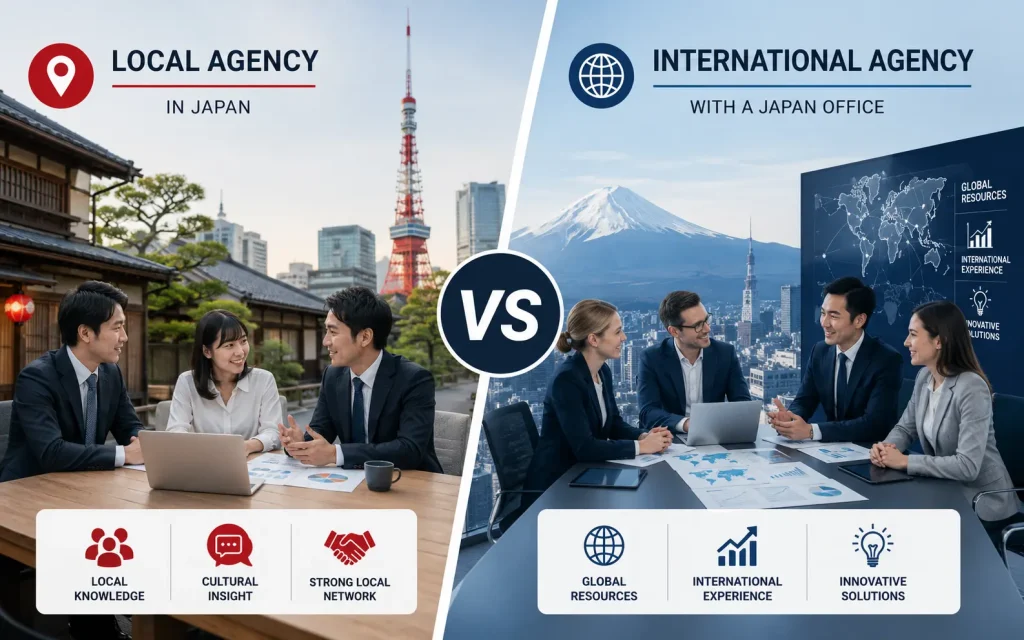
Foreign brands often assume a global network name guarantees better local execution. That is not always true.
Local, Japan-founded agencies typically bring deeper cultural fluency, stronger relationships with Japanese media and influencers, and better instincts for what resonates locally. The trade-off can be less experience managing complex, multi-market reporting for global headquarters.
International agencies with a Tokyo office usually offer smoother communication with your home office, familiar reporting formats, and consistency if you are running campaigns across several countries. The risk is that the Tokyo office is sometimes small relative to the parent company, so ask exactly who will be working on your account day to day.
Neither option is automatically superior. The right choice depends on whether your priority is deep local resonance or global consistency.
Must Have Platforms – LINE Yahoo Japan and Beyond
If your media plan does not include these platforms, it is not really a Japan strategy yet.
- LINE functions as messaging, news, payments, and shopping in one app. LINE Official Accounts and LINE Ads are close to essential for consumer brands.
- Yahoo! Japan still commands meaningful search share and hosts Yahoo! Shopping, a real e-commerce competitor to Amazon Japan and Rakuten.
- X (formerly Twitter) remains unusually popular in Japan compared to its decline elsewhere, especially for real-time conversation and fandom culture.
- YouTube is dominant for long-form and creator content, with strong crossover into product research behaviour.
- Instagram and TikTok drive discovery for fashion, beauty, food, and lifestyle brands, particularly with younger demographics.
A good agency will explain why a specific platform mix fits your product, rather than recommending the same five channels for every client.
SEO in Japan – Why Google Still Rules But Differently
Google holds the largest share of search in Japan, so core SEO fundamentals still apply: technical health, backlinks, and helpful content. What changes is execution.
- Japanese has no spaces between words, which affects keyword research tools and requires proper handling of kanji, hiragana, and katakana variations of the same term.
- Mobile-first indexing matters even more, since the majority of searches happen on smartphones.
- E-E-A-T signals carry extra weight in Japan because consumers actively check credentials, company history, and third-party validation before trusting a brand online.
- Yahoo! Japan’s search results are powered by Google’s algorithm but surfaced inside a different portal experience, so on-page optimisation for Google largely benefits both.
Avoid any agency that proposes running your Japanese SEO through auto-translated content. Search engines and readers both notice, and rankings suffer for it.
The Cultural Nuances Every Foreign Brand Must Understand
Marketing that works in New York or London can misfire badly in Tokyo if it ignores these patterns:
- Politeness levels matter. The tone of Japanese copy (keigo, formal, or casual) needs to match your brand’s positioning and audience precisely.
- Seasonality drives campaigns. Cherry blossom season, Golden Week, and year-end greetings are marketing moments, not just calendar dates.
- Visual restraint often outperforms bold claims. Overt superlatives (“the best,” “number one”) can read as untrustworthy unless backed by clear proof.
- Customer service expectations are high. Slow response times or generic chatbot replies damage brand perception more than in many other markets.
A strong agency will flag these nuances proactively during onboarding, not after a campaign underperforms.
How to Vet and Choose the Right Agency
Use this checklist before shortlisting any provider:
- Do they have verifiable case studies with real, named brands and measurable results?
- Is there a native Japanese speaker on the account team, not just a project manager relaying messages?
- Can they show reporting dashboards from past clients, not just screenshots in a pitch deck?
- Do they specialise in your industry, or at least your customer type (B2B versus B2C)?
- Are their reviews spread across independent platforms, not only their own website?
- Will you have a single accountable point of contact, or will requests bounce between departments?
Agencies that answer these questions clearly and specifically, rather than with vague reassurance, are worth prioritising.
Questions to Ask Before Signing a Contract
Bring these questions into your first two or three calls:
- What does a typical 90-day plan look like for a client in my industry?
- Who exactly will work on my account, and what is their experience level?
- How do you report results, and how often?
- What happens if results underperform the agreed targets?
- What is the minimum contract length, and what is the exit process?
- Do you subcontract any part of the work, such as content or media buying, to third parties?
Clear, direct answers here usually predict how the actual working relationship will go.
Red Flags to Watch Out For Digital Marketing Agency Japan
Some warning signs are consistent across the market:
- Guarantees of “number one ranking” or a fixed follower count within a set timeframe. No legitimate agency controls search engines or platform algorithms that precisely.
- Pricing that is dramatically below market average with no clear explanation of scope.
- Reluctance to share client references or past performance data.
- Proposals built entirely from templates, with no visible research into your specific brand or industry.
- Communication that is only in English with no Japanese-fluent staff involved in strategy or content review.
If two or more of these appear during your evaluation, treat it as a reason to keep looking rather than negotiate harder.
The Onboarding Process – What to Expect in Your First 90 Days

A well-run engagement usually follows a predictable rhythm:
- Weeks 1 to 2: Discovery, audits of existing assets, competitor research, and goal alignment.
- Weeks 3 to 6: Strategy presentation, channel selection, content and creative production begins.
- Weeks 7 to 10: Campaigns go live, initial data collection starts, early optimisation based on real performance.
- Weeks 11 to 13: First full performance review, adjustments to budget allocation, and a longer-term roadmap presented.
If an agency skips the discovery and audit phase entirely and jumps straight to running ads, that is usually a sign of a templated approach rather than a strategy built for your business.
How to Measure ROI and KPIs With Your Agency
Vague reporting is one of the most common complaints brands have after hiring an agency in any market, Japan included.
Set these expectations early:
- Agree on two or three primary KPIs before work starts (leads, revenue, cost per acquisition, or brand search volume, for example).
- Ask for monthly reporting that ties spend directly to outcomes, not just impressions and clicks.
- Request access to raw analytics platforms (Google Analytics, ad accounts, LINE Official Account manager) rather than relying only on agency-built summaries.
- Set a checkpoint at 90 days to formally review whether the relationship should continue as-is, scale up, or shift direction.
Agencies confident in their own performance are usually the ones most willing to give you direct platform access.
Top Cities in Japan for Digital Marketing Talent
Talent and agency density vary meaningfully by city, which matters if in-person collaboration is a priority.
| City | Strength | Good Fit For |
|---|---|---|
| Tokyo | Largest talent pool, most agencies, strongest enterprise experience | Global brands, complex multi-channel campaigns |
| Osaka | Strong regional consumer brand and retail expertise | Businesses targeting Kansai region shoppers |
| Fukuoka | Growing tech and startup ecosystem, lower costs | Startups and lean-budget SMEs |
| Yokohama | Close to Tokyo talent with a slightly lower cost base | Mid-size businesses wanting Tokyo access without Tokyo pricing |
Remote collaboration has made location less critical than it once was, but local presence still helps with influencer relationships, event marketing, and in-person client trust building.
Common Mistakes Foreign Brands Make When Entering Japan
Learn from these recurring missteps before they cost you a campaign cycle:
- Translating instead of localising. Direct translation often misses tone, humour, and cultural context entirely.
- Ignoring LINE. Brands that build a strategy around Instagram and Facebook alone miss one of the most-used platforms in the country.
- Underestimating research time. Japanese consumers often take longer in the decision journey, so short-term campaign windows can undersell true performance.
- Choosing an agency based on price alone. The cheapest option frequently lacks the native-language strategic input that actually drives results.
- Skipping a soft market test. Running a small pilot campaign before a full launch reveals messaging issues early, when they are cheap to fix.
Avoiding these five mistakes alone puts a foreign brand ahead of a large share of competitors entering the market each year.
Frequently Asked Questions
What does a Digital Marketing Agency Japan do?
A Digital Marketing Agency Japan helps businesses grow online through SEO, PPC advertising, social media marketing, content marketing, email marketing, web design, and localized digital strategies tailored to the Japanese market.
Why should I hire a Digital Marketing Agency Japan?
A local agency understands Japanese consumer behavior, language, cultural preferences, and platforms like LINE and Yahoo! Japan, helping you achieve better campaign performance.
Which digital marketing channels work best in Japan?
The most effective channels include Google Search, Yahoo! Japan, LINE Ads, YouTube, Instagram, X (formerly Twitter), and localized content marketing.
Can a Digital Marketing Agency Japan help international businesses?
Yes. Many agencies specialize in helping international brands enter the Japanese market by localizing websites, translating content, and creating culturally relevant marketing campaigns.
How much does it cost to hire a Digital Marketing Agency Japan?
Pricing depends on the services you need, campaign size, and business goals. Monthly retainers, project-based pricing, and custom packages are commonly available.
How long does it take to see results from digital marketing in Japan?
Paid advertising can generate traffic almost immediately, while SEO and content marketing typically take 3 to 6 months to deliver consistent long-term results.
Does a Digital Marketing Agency Japan offer multilingual marketing?
Yes. Many agencies provide marketing in both Japanese and English, making it easier for international businesses to connect with local audiences.
Final Thoughts
Choosing a digital marketing agency in Japan is less about finding the biggest name and more about finding the right fit for your goals, budget, and industry. Use the checklists, pricing ranges, and red flags in this guide to run a sharper evaluation process than a simple top-10 list can offer.
The brands that succeed in Japan are usually the ones that treat the market as genuinely different, not just a translated version of home.