
In today’s digital world businesses are no longer limited to traditional marketing methods. Customers spend more time online searching for products services and solutions. This shift has made Digital Marketing Growth one of the most important strategies for businesses that want to increase visibility attract new customers and achieve long term success.
Digital marketing growth is not just about getting more website visitors or social media followers. It is about building a strong online presence creating meaningful customer connections and using data driven strategies to increase leads sales and brand awareness.
Whether you are a small business startup or an established company a well planned digital marketing strategy can help you compete in a crowded market and unlock new growth opportunities.
What Is Digital Marketing Growth and Why It Matters Today
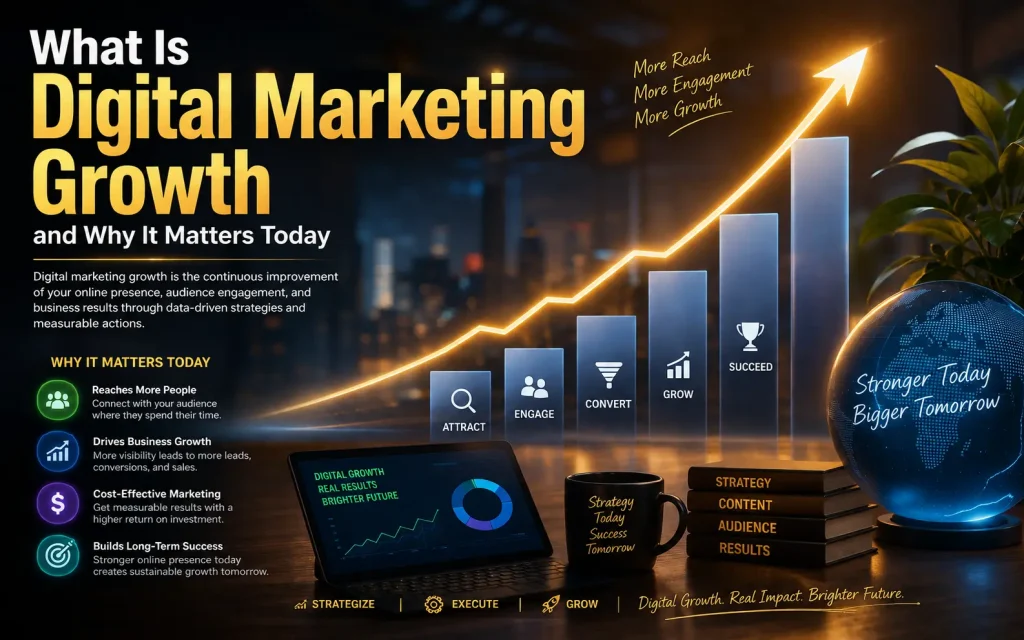
Digital marketing growth refers to the steady rise in how much business invest in, and rely on, online channels such as search, social media, email, and video to reach customers. It also describes the expanding size of the digital marketing industry itself, measured in ad spend, adoption rates, and market value.
This matters because customer attention has permanently shifted online. People research products on Google before buying, scroll social feeds during breaks, and check reviews before trusting a brand. A business that ignores this shift is not just missing a trend. It is missing where its customers actually spend their time.
For business owners, marketers, and students alike, understanding digital marketing growth means understanding where to place your next dollar, hour, or hire for the best possible return.
Digital Marketing Market Size- How Big Has It Really Gotten
Numbers tell the story better than opinions do. According to IMARC Group, the global digital marketing market was valued at USD 456.7 billion in 2025 and is expected to reach USD 1,200.3 billion by 2034, growing at a CAGR of 10.99% from 2026 to 2034.
That growth is not evenly spread. North America currently holds the largest share of the market, at over 38.7% in 2025, largely due to strong internet infrastructure and heavy digital ad spend from US businesses.
Behind these figures sit real shifts in behavior. Roughly 67% of the global population used the internet in 2023, and that number keeps climbing every year. More internet users simply means more people who can be reached, converted, and retained through digital channels.
Here is a quick snapshot of the core figures:
| Metric | Figure |
|---|---|
| Market size (2025) | USD 456.7 billion |
| Projected market size (2034) | USD 1,200.3 billion |
| Growth rate (CAGR, 2026-2034) | 10.99% |
| Leading region | North America (38.7% share) |
| Largest channel segment | Social network marketing (30% share) |
Key Drivers Behind Digital Marketing Growth
A few forces are consistently pushing this growth forward:
- Rising internet and smartphone use. More connected devices mean more digital touchpoints for brands to reach.
- The shift to online shopping. Global e-commerce keeps expanding, and mobile devices now account for the majority of online orders worldwide.
- Data-driven decision making. Businesses that analyze customer behavior can spend smarter and see better returns.
- Cheaper entry costs than traditional media. A small business can run a targeted social ad for a fraction of what a TV spot would cost.
- Measurable results. Unlike a billboard, a digital campaign shows exactly how many people clicked, bought, or signed up.
None of these drivers work in isolation. Together, they create a feedback loop: more data leads to better targeting, better targeting leads to higher returns, and higher returns lead to bigger budgets.
Regional Growth Snapshot: Where Digital Marketing Is Growing Fastest
Growth patterns look different depending on where you are in the world. This is one detail most competitor articles skip entirely, but it matters if you are marketing to a specific region or planning international expansion.
| Region | Growth Highlights |
|---|---|
| North America | Largest market share (38.7%); strong programmatic ad adoption and AI-driven personalization |
| Europe | High internet penetration (90%+); GDPR shaping data-driven, privacy-first marketing |
| Asia Pacific | Fastest-growing user base with 2.5+ billion internet users; mobile and video-first campaigns |
| Latin America | Rising smartphone use and e-commerce; heavy reliance on social platforms like WhatsApp and Instagram |
| Middle East & Africa | Growing internet access (around 60%); high social media adoption in UAE and Saudi Arabia |
If your business targets a specific region, this table alone can shape your channel priorities. A campaign built for Europe, for example, needs to bake in privacy compliance from day one, while a campaign for Asia Pacific should lean heavily into mobile and short-form video.
Top Digital Marketing Channels Driving Growth
Not every channel contributes equally to overall growth. Knowing where the money and attention are flowing helps you allocate your own budget more wisely.
| Channel | Role in Growth |
|---|---|
| Social network marketing | Largest single segment, driven by reach, targeting, and influencer partnerships |
| Search engine optimization (SEO) | Long-term, low-cost channel for consistent organic traffic |
| Email marketing | High ROI channel; remains a top communication preference for consumers |
| Online video marketing | Strong engagement rates, especially on YouTube and TikTok |
| Mobile marketing | Growing fast as mobile devices dominate web traffic and online orders |
| Digital out-of-home (DOOH) | Increasingly measurable and performance-driven, not just for awareness anymore |
A common mistake is treating these channels as separate silos. The businesses seeing the strongest growth are the ones connecting these channels into one consistent customer journey, rather than running each in isolation.
How AI Is Reshaping Digital Marketing Growth
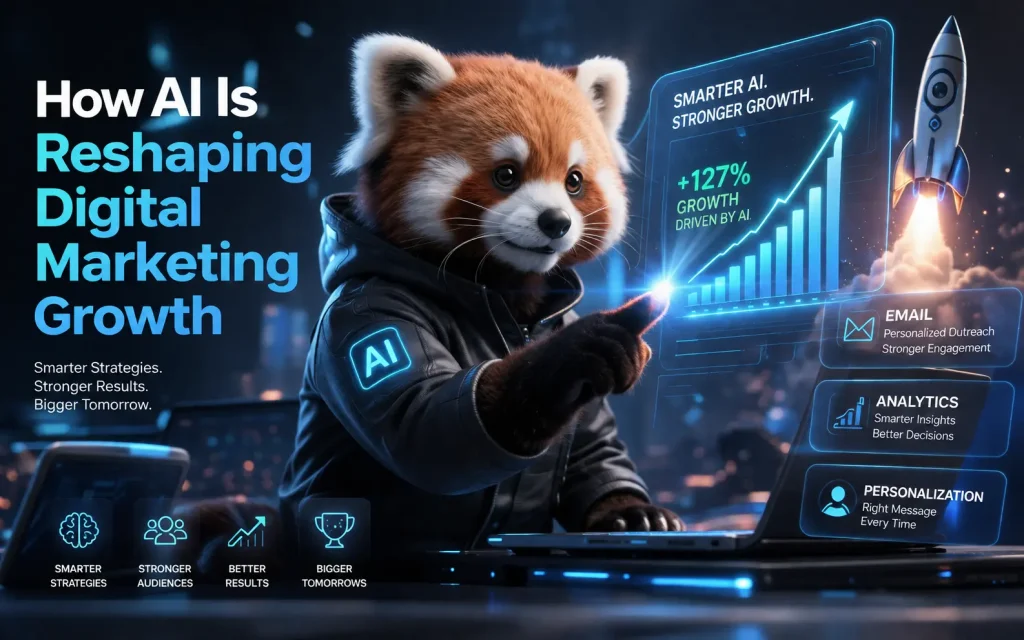
Artificial intelligence has moved past the experimental stage. It now touches nearly every part of a modern marketing workflow, from writing ad copy to predicting which customers are about to churn.
Industry surveys show that a large majority of agencies have already integrated AI into their operations, and most professionals expect it to be the single biggest force shaping the next decade of digital advertising.
AI is being used for:
- Audience targeting and lookalike modeling
- Dynamic creative optimization, where ad content adjusts automatically per viewer
- Predictive analytics for customer lifetime value
- Chatbots and conversational marketing for instant support
The takeaway for smaller businesses is simple: you do not need a data science team to benefit. Many affordable tools now bake AI features directly into email platforms, ad managers, and CRM software, so you get the advantage without the technical overhead.
The End of Third-Party Cookies- Why First-Party Data Rules Now
Here is a shift many competitor articles mention briefly but rarely explain well. As third-party cookies disappear and privacy laws tighten worldwide, businesses can no longer rely on tracking customers across the entire internet. Instead, growth now depends on first-party data: information customers give you directly, such as email sign-ups, purchase history, and on-site behavior.
Businesses investing in customer data platforms, loyalty programs, and direct email relationships are proving more resilient to these privacy changes.
If you run any kind of online store or service, start collecting first-party data now through:
- Email newsletter sign-ups with a clear value exchange (discounts, guides, early access)
- Loyalty or rewards programs that track repeat purchases
- On-site quizzes or preference centers that let customers self-identify their interests
This is one of the quiet decisions separating brands that will keep growing from those that will struggle once old tracking methods stop working entirely.
Video Content and Social Commerce: The New Growth Engines
Video is not a passing trend. Platforms like YouTube and TikTok continue to drive the highest engagement rates of any content format, and short-form video in particular has become the default way younger audiences discover new brands.
Social commerce, buying directly through a social media app, is growing alongside this. Instagram, TikTok, and Facebook have all built in-app checkout features, cutting out the extra step of visiting a website.
For product-based businesses, this means the sales funnel is shrinking: a customer can now go from “seeing a video” to “completing a purchase” in under a minute.
Brands that treat video as an afterthought are increasingly at a disadvantage compared to those building it into their core content strategy from the start.
Voice Search and Mobile-First Marketing
Mobile devices now account for the majority of website traffic and online orders worldwide, and voice assistants are changing how people search. More than one in five internet users in some regions now regularly use voice search, which tends to favor natural, conversational phrases over short keyword fragments.
Practical steps to prepare for this shift:
- Write content that answers questions the way people speak them, not just the way they type them
- Make sure your website loads quickly and displays cleanly on a phone screen
- Claim and optimize your Google Business Profile, since many voice searches are local (“find a bakery near me”)
Ignoring mobile and voice search does not just cost you rankings. It costs you the moment a customer is ready to buy.
Data-Driven Marketing- From Guesswork to Precision
Marketing used to rely heavily on instinct. Today, the businesses growing fastest treat every campaign as a source of data, not just a one-off effort. A large majority of organizations using data-driven marketing report clear improvements in customer engagement and insight, and many executives credit analytics directly with driving business innovation.
In practice, this means:
- Testing two versions of an ad or email before rolling out the winner at scale
- Tracking customer lifetime value, not just first-purchase conversion
- Using analytics dashboards to catch underperforming campaigns early, instead of waiting until the budget is spent
You do not need enterprise software to start. Even free tools like Google Analytics and built-in social media insights can reveal patterns that immediately improve your next campaign.
Full-Funnel Marketing- Balancing Brand Building with Performance
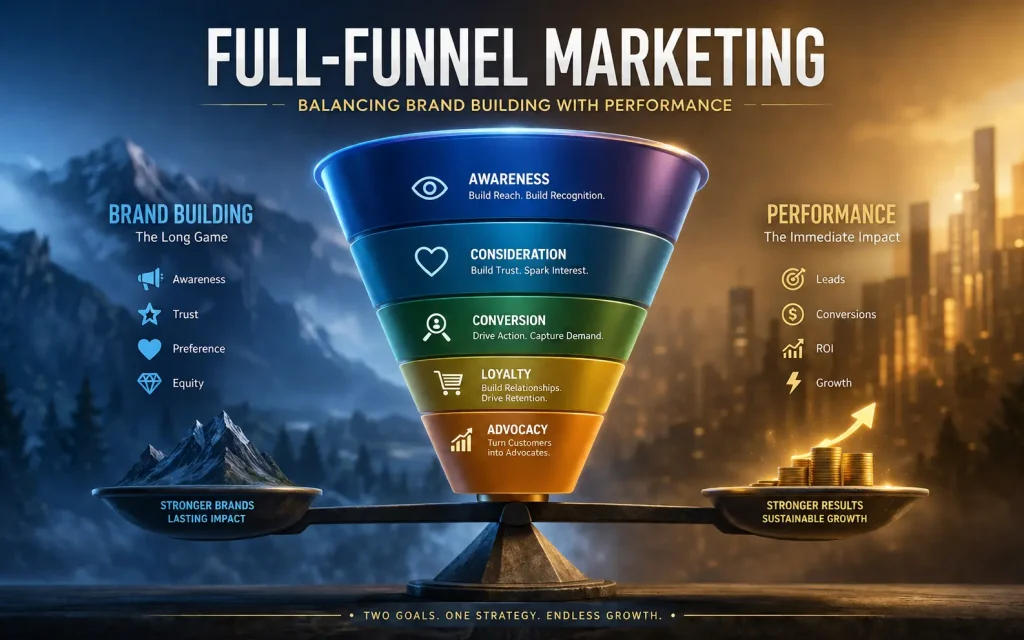
Many businesses fall into one of two traps: spending everything on brand awareness with no clear path to sales, or chasing quick conversions while never building lasting brand trust. The strongest growth comes from balancing both.
A full-funnel approach means:
- Top of funnel: Building awareness through content, video, and social reach
- Middle of funnel: Nurturing interest through email, retargeting, and useful resources
- Bottom of funnel: Converting through clear offers, testimonials, and simple checkout experiences
When these three stages connect and share data with each other, marketing stops feeling like guesswork and starts working like a system.
Industries Leading the Digital Marketing Growth Curve
Some industries are adopting digital marketing faster and more aggressively than others. Understanding where your own industry sits can help you benchmark your efforts realistically.
| Industry | How Digital Marketing Is Used |
|---|---|
| Retail and e-commerce | Personalized recommendations, retargeting ads, influencer partnerships |
| Healthcare | Patient education content, appointment booking ads, local SEO |
| BFSI (banking, financial services, insurance) | Personalized email offers, social customer support, trust-building content |
| Education | Enrollment campaigns, SEO for course pages, social media engagement |
| Media and entertainment | Video marketing, influencer collaborations, fan community building |
If your industry appears further down this list in terms of digital adoption, that is not a warning sign. It is an opportunity. Lower competition in digital channels often means lower ad costs and easier organic visibility for the businesses that move first.
Common Mistakes That Hold Businesses Back
Even with a growing market, plenty of businesses fail to see results from digital marketing.
The most common mistakes include:
- Spreading budget too thin across every platform instead of mastering one or two
- Ignoring mobile experience, which quietly drives away most modern traffic
- Skipping analytics, so the same mistakes repeat campaign after campaign
- Treating SEO as optional, even though it remains one of the most cost-effective long-term channels
- Copying competitors instead of building a strategy around your own customer data
Fixing even one of these mistakes often produces a bigger jump in results than adding an entirely new marketing channel.
Practical Steps for Small Businesses to Grow Through Digital Marketing
Big market statistics are useful, but they mean little without a clear starting point. If you run a small or mid-sized business.
here is a realistic sequence to follow:
- Start with one channel you can commit to consistently, whether that is SEO, email, or a single social platform.
- Set up basic analytics before you spend a single dollar on ads, so you can measure what actually works.
- Build an email list early. It remains one of the highest-return channels and protects you from platform algorithm changes.
- Create short-form video content, even with simple tools, since it currently delivers the strongest organic reach.
- Review performance monthly, and shift budget away from what underperforms rather than adding more spend to fix it.
Growth rarely comes from doing everything at once. It comes from doing a few things consistently and improving them over time.
Frequently Asked Questions About Digital Marketing Growth
What is Digital Marketing Growth?
Digital Marketing Growth is the process of expanding a business using online marketing strategies such as SEO content marketing social media advertising and email marketing. It focuses on increasing visibility attracting customers and improving business revenue.
Why is Digital Marketing Growth important for businesses?
Digital Marketing Growth helps businesses reach more customers build brand awareness and compete in the online marketplace. It allows companies to connect with targeted audiences and achieve measurable results through data driven strategies.
How long does it take to see results from digital marketing growth?
The time required to see results depends on the strategy used. SEO and content marketing usually take several months while paid advertising can provide faster traffic and lead generation.
Can small businesses benefit from Digital Marketing Growth?
Yes small businesses can greatly benefit from digital marketing growth. Online strategies allow small companies to compete with larger brands by targeting specific customers improving visibility and generating more sales opportunities.
How does SEO support Digital Marketing Growth?
SEO improves website rankings on search engines which helps businesses attract organic traffic. Higher visibility in search results can increase website visitors leads and potential customers over time.
What role does content marketing play in Digital Marketing Growth?
Content marketing helps businesses educate customers build trust and establish authority. Valuable blogs guides videos and other content can attract audiences and support long term online growth.
Final Thoughts
Digital Marketing Growth has become one of the most important factors for businesses that want to succeed in today’s competitive online environment. As customer behavior continues to shift toward digital platforms businesses need effective strategies that help them reach the right audience build trust and create long term relationships.
A successful digital marketing approach is not based on a single technique. It requires a combination of SEO content marketing social media marketing paid advertising email campaigns and data driven optimization. When these strategies work together businesses can increase online visibility attract qualified leads improve customer engagement and create consistent revenue opportunities.