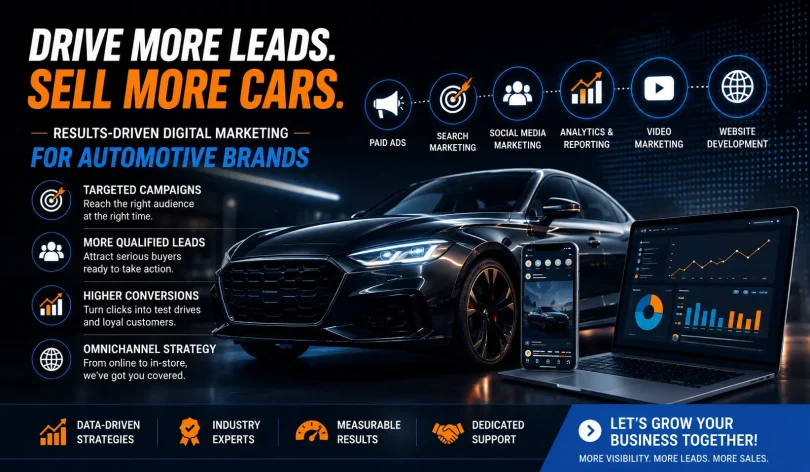

An automotive digital marketing agencies specialises in driving qualified buyers to car dealerships, OEMs, and aftermarket brands through channels like paid search, SEO, social media, and vehicle-specific ad formats.
The best ones differ from general agencies because they understand purchase intent cycles, offline attribution, and compliance requirements specific to the automotive industry.
In Australia, the top performers are typically certified with Google’s Automotive digital marketing agency tier and carry direct integrations with platforms like Facebook Automotive Inventory Ads and Google Vehicle Ads.
Why General Marketing Agencies Usually Fail Car Dealerships
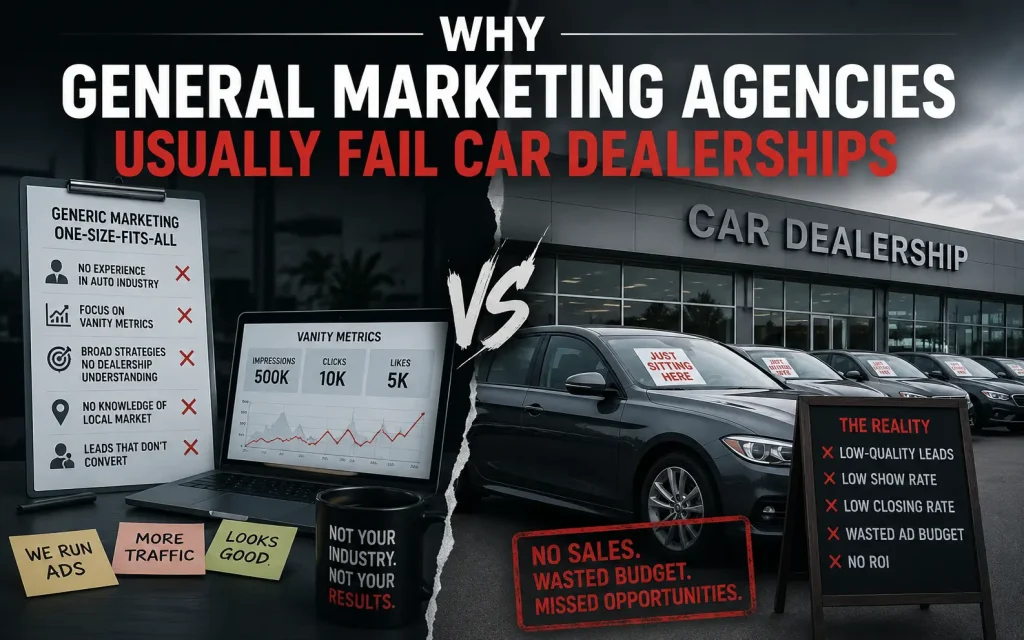
Automotive is one of the few industries where a buyer researches for weeks, then converts in person. That gap between click and sale breaks most standard marketing funnels.
A general agency optimises for online conversions. An automotive specialist optimises for showroom walk-ins, test drive bookings, and phone enquiries – events that happen offline. Without a system to close that loop, you’re paying for traffic and guessing at outcomes.
There’s also the inventory dynamic. Car stock changes daily. A campaign running last Tuesday might be advertising a model that sold out on Wednesday. Agencies without live inventory feed integration keep wasting your budget on unavailable vehicles.
The agencies worth hiring have built or adopted Dynamic Inventory Ads infrastructure. This means your ad creative automatically updates to reflect what’s actually on your lot, with real pricing and real stock.
The Australian Automotive Market – Context Most Articles Ignore
Most articles on this topic are written for the US or UK market. The Australian context is meaningfully different in several ways.
New car sales are cyclical and EOFY-driven
The June end-of-financial-year period drives an outsized spike in purchase decisions, particularly for commercial buyers chasing depreciation benefits. An agency that hasn’t run Australian automotive campaigns won’t anticipate this or build campaigns around it.
Dealer margin pressure is tighter here
Average gross profit per vehicle is lower in Australia than in the US, which means CAC (cost to acquire a customer) thresholds are stricter. A campaign that delivers acceptable ROI in Dallas might be unprofitable in Brisbane.
The used car market behaves differently
Post-COVID, used car prices in Australia remained elevated longer than most markets. Agencies that hadn’t tracked this were still using pre-2020 CPC benchmarks and underbidding in a more competitive environment.
EV transition complexity
The shift toward electric vehicles is reshaping search intent. Queries like “range anxiety”, “home charging installation”, and “EV running costs” are entering the customer research journey. Agencies not building content and campaign infrastructure around this are leaving a growing segment of buyers unaddressed.
Core Services That Actually Matter for Automotive (and What to Watch For)
Paid Search – The Engine Room
Google Vehicle Ads (formerly called Vehicle Listing Ads) and Performance Max with vehicle signals are now essential. These pull directly from your inventory feed and show relevant vehicles with pricing in search results. Any agency calling themselves automotive specialists in 2025 should be running these, not just standard text ads.
What to probe: Ask whether they run Smart Bidding with offline conversion imports. This means your CRM data, specifically closed deals, feeds back into Google’s algorithm so it learns to value leads that actually result in sales, not just form fills. Most agencies skip this because the setup is technically involved.
Red flag: An agency that reports on form fills and call clicks but can’t show you a cost-per-vehicle-sold calculation.
SEO for Dealerships: Local Is Everything
Search intent for car buyers is hyper-local. “Toyota HiLux dealer near me” or “used Mazda CX-5 Parramatta” are the queries that convert.
Ranking for these requires:
- Properly structured Google Business Profiles (one per physical location, not one for the group)
- Location-specific landing pages with real content, not duplicated templates
- Schema markup for vehicle listings (using the Car schema type and AutoDealer schema)
- Consistent NAP (name, address, phone) data across directories
The agencies that outperform here treat local SEO as an ongoing operation, not a one-time setup. Rankings for geo-modified vehicle queries erode quickly when competitors maintain fresher content.
Social Media and Meta Automotive Inventory Ads
Facebook and Instagram’s Automotive Inventory Ads (AIA) allow you to serve dynamic ads showing specific in-stock vehicles to users who’ve shown purchase signals. Unlike generic brand awareness campaigns, AIA targets people in the active buying window.
But the technical setup is where many agencies stumble. A correctly configured AIA campaign requires:
- A live, correctly formatted vehicle catalogue feed (Facebook’s spec is strict)
- Custom audience segments built from CRM data and website visitors
- Separate ad sets for in-market (active searchers) vs conquest (competitor’s customers) audiences
Ask any agency you’re evaluating to show you an example of a catalogue feed setup they’ve managed and how they handle feed errors when stock changes.
Reputation and Review Management
This is consistently underinvested in. Google reviews directly influence both local search rankings and click-through rates. A dealership sitting at 3.8 stars loses search clicks to a competitor at 4.4 even if the underdog ranks higher.
Good agencies build automated post-purchase review request workflows (typically via SMS or email) and have a documented escalation process for negative reviews. Mediocre ones add “reputation management” to their service list and do nothing systematic about it.
The Attribution Problem Nobody Talks About Openly
Here’s what most articles skip entirely: automotive attribution is genuinely hard, and agencies that claim to have it solved completely are overstating their capabilities.
The average car buyer uses 12+ touchpoints before purchasing. They might first see a YouTube pre-roll, then do organic research, click a paid search ad, visit the showroom, leave without buying, get a retargeting ad a week later, then walk in and sign contracts.
Most agencies track one or two of those touchpoints and call it attribution. The result is that paid search often gets “last click” credit for a sale that was actually driven by organic content or brand awareness video.
A more honest and useful approach is data-driven attribution combined with offline conversion imports.
This requires:
- Your CRM exporting deal-close events (with hashed customer data for privacy compliance)
- Google Ads or Meta ingesting those events to adjust its attribution model
- Monthly reconciliation between CRM records and ad platform conversions
This setup is technically involved and requires cooperation between your agency, your CRM provider, and your DMS (Dealer Management System). Ask prospective agencies specifically how they handle this integration.
How to Actually Evaluate an Automotive Agency – 10 Questions
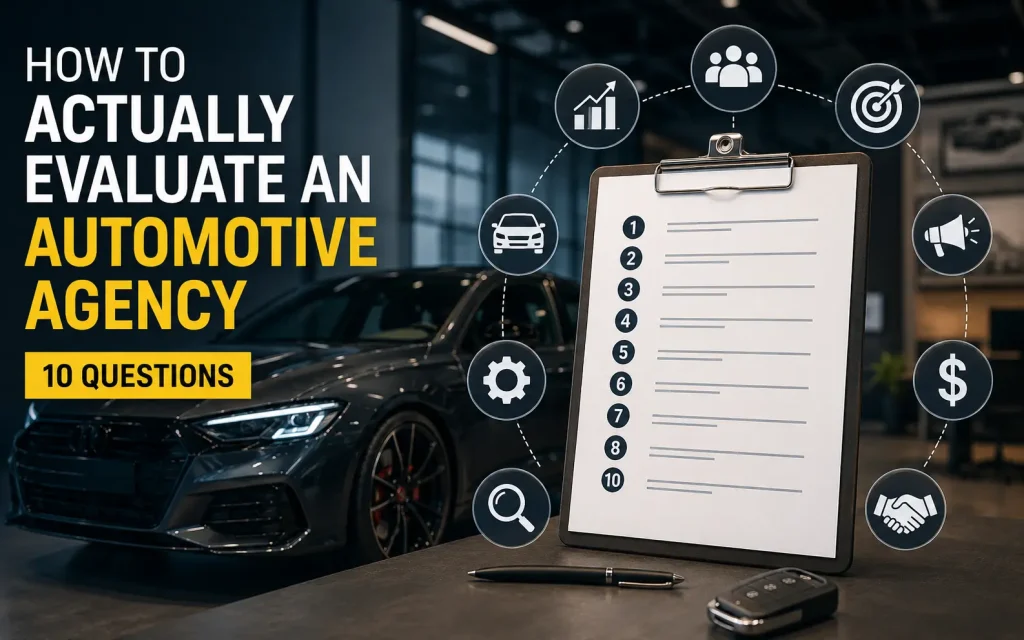
Worth Asking
- What DMS platforms have you integrated with? (Reynolds & Reynolds, CDK Global, DealerSocket, Pentana are common in Australia)
- How do you handle inventory feed management when stock changes mid-campaign?
- What’s your average cost-per-test-drive-booking across your dealership clients?
- How do you track offline conversions back to specific ad campaigns?
- Are you a Google Automotive Certified Partner? (This is a specific certification tier, different from the standard Premier Partner badge)
- How do you approach campaigns during the EOFY selling period versus the rest of the year?
- What’s your process when a campaign underperforms in the first 30 days?
- Do you use AI-generated ad copy and creative? If so, how is it reviewed?
- How do you handle compliance with ACCC guidelines on advertised pricing? (Driveaway pricing requirements, finance comparison rate disclosures)
- Can you provide a reference from a dealership in a similar-sized market to ours?
These aren’t trick questions. They’re baseline competency checks. An agency that hesitates or gives vague answers on any of these probably isn’t a strong operational fit.
Pricing – What Automotive Digital Marketing Actually Costs in Australia
Competitors rarely publish real numbers. Here’s a realistic picture based on current market rates.
| Service | Typical Monthly Investment (AUD) | What You Should Expect |
|---|---|---|
| Google Ads management (single dealership) | $1,500 – $4,000 (management fee, excluding ad spend) | Full campaign management, monthly reporting, conversion tracking |
| SEO (local/dealership) | $1,500 – $3,500 | Monthly content, citation management, local ranking reports |
| Social Media Advertising | $1,200 – $3,000 (management fee) | AIA setup, creative production, audience management |
| Full-service retainer (all channels) | $5,000 – $12,000+ per month | Integrated strategy, dedicated account management, advanced attribution |
| Ad spend (Google/Meta combined) | $5,000 – $30,000+ per month | Varies significantly by market size and competition |
Dealerships in metro markets (Sydney, Melbourne, Brisbane) typically require higher ad spend to remain competitive. Regional dealerships can achieve strong results with lower budgets because competition for local queries is less intense.
Watch out for: Agencies bundling ad spend into their fee without transparency. Always know how much of your monthly payment is going to the agency versus the ad platforms. Request platform-level access to your own accounts.
The Cookie Deprecation Issue – What Changes for Automotive Ads
Third-party cookie deprecation (Google delayed the full rollout, but the direction is clear) is particularly disruptive for automotive because cross-site retargeting has been central to reaching in-market buyers.
The agencies preparing their clients correctly are doing three things:
Building first-party data assets
This means capturing emails, phone numbers, and vehicle interest data through website interactions, finance calculator tools, and trade-in appraisal widgets. First-party audiences are more durable than pixel-based retargeting.
Investing in contextual targeting
Placing ads on automotive research content (review sites, comparison pages, enthusiast forums) based on content context rather than user cookies. Less precise, but future-proof.
Adopting the Google Automotive framework
Google has released automotive-specific solutions, including Vehicle Ads and their integration with dealer feeds, which rely on first-party dealer data rather than third-party tracking.
Ask any agency you’re speaking with: “How are you preparing your clients for a cookieless targeting environment?” Their answer tells you a lot about their long-term thinking.
Red Flags That Signal an Agency Isn’t Automotive-Specific
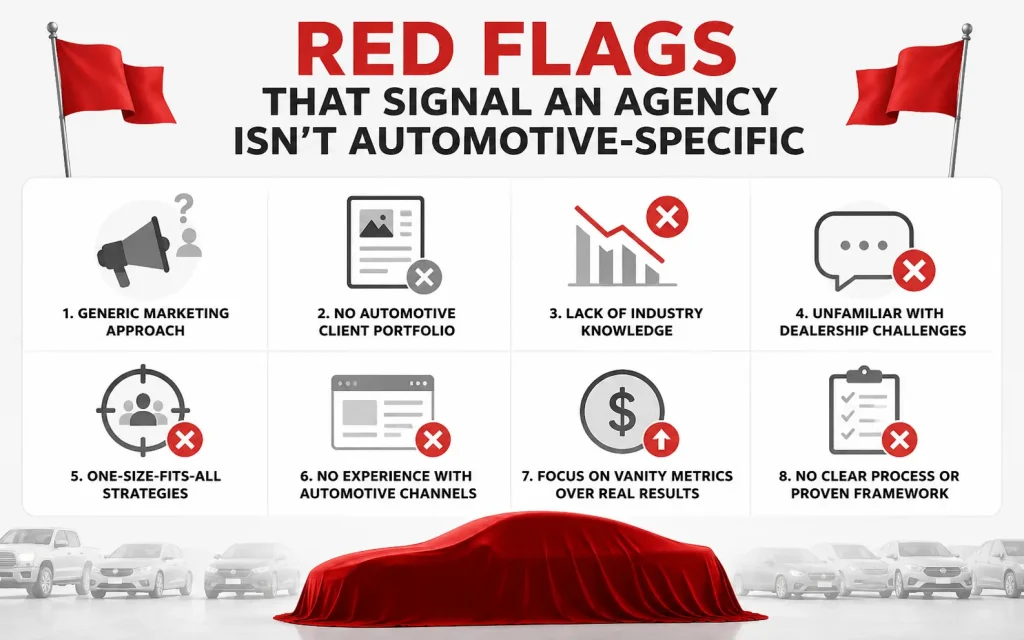
- They show you “impressions” and “reach” as primary success metrics
- They don’t ask about your DMS or CRM in the first conversation
- Their case studies are for fashion, hospitality, or B2B tech
- They quote you a fixed number of “social media posts per month” as a key deliverable
- They can’t explain the difference between Google Vehicle Ads and standard Search ads
- They don’t mention feed management at all
- Their reporting doesn’t include a CAC (Customer Acquisition Cost) or cost-per-lead by vehicle model
Aftermarket and Auto Services – The Overlooked Segment
A lot of “automotive digital marketing” content defaults to new car dealerships. But there’s a large and distinct market: tyre shops, mechanical workshops, panel beaters, parts retailers, and accessories brands.
For these businesses, the strategy differs substantially. Local service search intent (“mechanic near me”, “tyre fitting [suburb]”) dominates over research intent. Google Business Profile optimisation, local service ads, and review velocity matter more than national SEO or vehicle-specific inventory ads.
Aftermarket brands selling through retail channels face a different challenge again: competing with major eCommerce players on product listing ads, while building enough brand presence to support dealer/distributor relationships.
If your business falls into these categories, make sure any agency you speak with has specific experience here. Ask for case studies from service businesses or aftermarket brands, not just franchise dealerships.
FAQ
What does an automotive digital marketing agency actually do day-to-day?
Day-to-day operations include monitoring and adjusting bid strategies in paid search platforms, updating inventory feeds to reflect current stock, responding to review escalations, producing and scheduling social content, pulling weekly performance reports, and communicating changes in campaign strategy based on market shifts or stock availability. The best agencies also spend time in your CRM data looking at which lead sources are actually closing at the lot.
How long does it take to see results from automotive SEO?
Local SEO improvements can show up in 2-4 months for less competitive geographic markets. In dense metro markets competing against large dealer groups with established domain authority, meaningful ranking improvements typically take 6-12 months. Paid search and social can show results within weeks, which is why a combined strategy usually makes sense while SEO builds.
Should I manage my own Google Ads or hire an agency?
If you have someone in-house with Google Ads certification and specific automotive campaign experience, in-house management can work. But the complexity of feed-based Vehicle Ads, offline conversion imports, and multi-channel attribution usually justifies agency involvement. The risk isn’t the management cost, it’s the wasted ad spend from campaigns that aren’t set up correctly.
What is a reasonable cost-per-lead benchmark for an Australian automotive dealership?
Benchmarks vary significantly by brand, location, and campaign type. For new vehicles via Google paid search, cost-per-enquiry typically ranges from $40-$150. For used vehicles, the range is often $25-$80. Test drive bookings specifically tend to cost more in competitive markets. These figures shift with market conditions and should be validated against your own historical data.
How do I know if an automotive agency’s results are real or cherry-picked?
Ask for a 12-month performance summary, not just a highlight period. Look at trends: did performance drop off after the first few months when the agency stopped putting in setup effort? Request to speak with two or three existing clients who are similar in size and market to you. Ask those clients whether the agency communicates proactively when performance drops, not just when it’s strong.
What’s the difference between an OEM agency and a dealer agency?
OEM (original equipment manufacturer) agencies work at the brand level, managing national campaigns for manufacturers like Toyota, Ford, or Hyundai. Dealer agencies work at the local dealership level, focusing on driving buyers to specific locations. Some agencies work at both levels, and there can be conflicts of interest: OEM mandates sometimes limit what individual dealers can say or promote in local campaigns.
Do I need separate agencies for SEO and paid advertising?
Not necessarily, but make sure whoever handles both genuinely integrates the two channels. The most common failure point is agencies managing SEO and paid search in silos, leading to situations where you’re bidding on keywords you already rank organically for. A good integrated agency will suppress paid spend on terms with strong organic positions and redirect that budget toward competitive gaps.
How should I handle digital marketing compliance for advertised vehicle pricing?
In Australia, ACCC guidelines require that any advertised vehicle price be achievable by the consumer without hidden conditions. Driveaway pricing (including registration, CTP, and dealer delivery) is generally the safest format to advertise. Finance comparison rates must be disclosed if finance products are featured. Your agency should understand these requirements and flag any creative or copy that risks non-compliance. If they’re not raising compliance questions, that’s a gap worth addressing directly.
Final Thoughts
Choosing the right automotive digital marketing agencies can have a significant impact on your dealership or automotive business. The best agency will do more than increase website traffic. It will help you attract qualified leads improve your online reputation boost local search visibility and turn more visitors into paying customers.
Before making your decision compare each agency’s experience pricing services reporting and proven results. Look for a partner that understands the automotive industry and creates customized strategies instead of using a one size fits all approach.
As the automotive market becomes more competitive investing in a trusted digital marketing agency is one of the smartest ways to stay ahead grow your brand and achieve long term business success.