
Digital marketing for architectural products works by targeting the full specification funnel: creating technically rich content that earns trust with architects and specifiers, optimizing for the search terms they actually use, and maintaining visibility across every stage from awareness to final product specification. The goal is not just to generate website traffic but to become the brand that gets written into project specifications.
Why Architectural Products Are a Different Marketing Beast
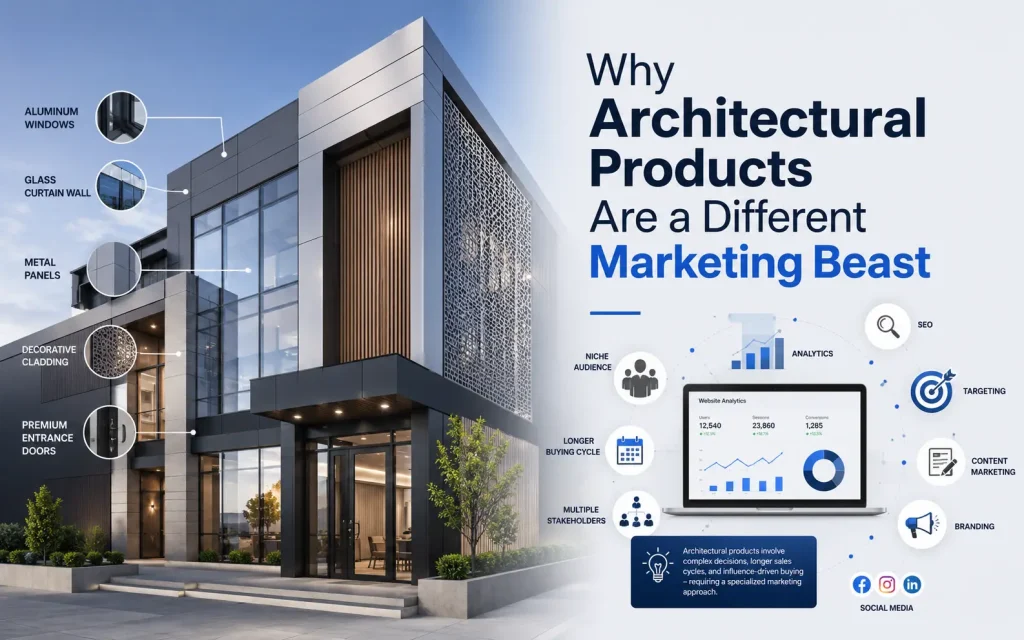
Most digital marketing guides treat architectural products the same as any other B2B product.
When someone buys a laptop, one person usually makes the call. When an architectural product gets specified into a commercial building, you are dealing with at least four decision layers: the architect or specifier who writes the spec, the contractor who purchases, the developer or owner who approves the budget, and often a sustainability consultant who vets environmental credentials. Your marketing has to work at every layer simultaneously, or the sale can fall apart at any stage.
The other reality nobody talks about: specification is the conversion event, not the sale. A product written into a spec sheet is 70-80% of the way to a purchase, often before a contractor has even been engaged. Your digital marketing must target that specification moment, not just the eventual transaction.
The Specification Funnel: What Competitors Rarely Explain
This is the core strategic framework that separates successful architectural product marketing from generic B2B tactics.
The specification funnel has four stages that are distinct from a normal sales funnel:
- Awareness: The architect sees your brand in a project case study, a product directory, or a CPD session.
- Research: They download your technical data sheet, request a sample, or add your BIM object to their library.
- Specification: Your product gets written into the project spec, either as a named brand or a performance equivalent.
- Purchase: The contractor buys the specified product, sometimes after value engineering that tries to swap it out.
Your digital content, SEO strategy, and advertising spend should be mapped against these four stages explicitly. Running Instagram ads at contractors makes little sense if architects are the ones writing the spec.
BIM Objects: The Most Underused Marketing Channel in the Industry
Here is a channel that almost no competitor article mentions, yet it is one of the highest-conversion tactics available to architectural product manufacturers.
BIM Building Information Modeling
objects are digital representations of your physical products that architects plug directly into their design software, most commonly Autodesk Revit, ArchiCAD, and Vectorworks. When an architect downloads your Revit family from a platform like BIMobject, NBS Source, or Manufacturer’s BIM Library, they are essentially pre-specifying your product. It goes into their model, it appears in their documentation, and it becomes the reference product for the project.
What this means practically:
- A BIM object download is a warmer lead than a product page visit by a significant margin.
- BIM platforms show you which firms are downloading your objects and for which project types, giving real market intelligence.
- Manufacturers who publish high-quality, parametrically rich BIM objects consistently report shorter sales cycles because the product is already embedded in the project before a sales conversation begins.
The bar for quality matters here. A poor BIM object with wrong dimensions, missing data, or clunky parameters frustrates architects and creates a negative brand impression. Invest in professionally authored objects with accurate geometry, correct material properties, and embedded specification data.
CPD Content: Getting Paid Attention in a Trusted Context
Architects in most countries, including the UK, Australia, the US (AIA members), and Canada, are required to complete accredited Continuing Professional Development hours each year. This creates a structured, recurring opportunity that product manufacturers can use to get genuine face time with their audience.
A CPD session hosted by your brand is not a sales pitch. It is educational content that earns CPD points and happens to showcase your expertise, your product application, and your technical depth.
Formats that work:
- Online webinars registered with the relevant professional body (RIBA in the UK, AIA in the US, ACA in Australia)
- PDF learning modules hosted on your website and submitted for CPD accreditation
- Short-form video courses on product installation, performance standards, or sustainable specification
When you host accredited CPD, architects actively seek you out rather than the reverse. That inversion of attention is rare in any marketing channel.
Technical Documentation as an SEO and Trust Asset
One of the most consistent gaps across competitor articles is the failure to recognize technical documents as first-class SEO content.
Architects and specifiers search for things like “acoustic ceiling tile NRC rating 0.90,” “aluminium cladding panel fire rating AS1530,” or “glass partition STC 45 specification.” These are highly specific, low-competition queries with high commercial intent. A product data sheet or technical specification sheet that is properly indexed by Google is a direct answer to these searches.
What to do:
- Publish PDFs and HTML versions of all technical data sheets with proper metadata.
- Create dedicated landing pages for each product family that include performance data, compliance certifications, installation guides, and sustainability credentials such as EPDs (Environmental Product Declarations) and LEED contribution documentation.
- If your product holds BREEAM, LEED, or WELL certification credits, create dedicated pages for each certification angle. Specifiers search for “products contributing to LEED credits” more often than most brands realize.
The content types that generate specification-stage leads are almost always technical, not lifestyle or brand-driven.
The Multi-Stakeholder Content Map
Since different stakeholders in the specification and purchase process have different priorities, your content library needs to address each one without muddying your messaging.
| Stakeholder | Primary Concern | Content That Works |
|---|---|---|
| Architect / Specifier | Technical performance, design aesthetics, project precedent | BIM objects, case studies, technical data sheets, CPD content |
| Contractor | Ease of installation, availability, price competitiveness | Installation guides, distributor locator, lead time information |
| Developer / Owner | Cost, durability, warranty, sustainability credentials | ROI guides, maintenance cost data, sustainability certificates, project case studies with outcomes |
| Sustainability Consultant | EPDs, carbon data, recycled content, certifications | EPD documents, LCA summaries, compliance tables for rating systems |
Most brands only produce content for architects. The contractors who buy the product and the developers who approve the budget are largely ignored. Filling those gaps gives you an advantage when value engineering threatens to swap your specified product for a cheaper alternative.
SEO for Architectural Products: Beyond Basic Keyword Research
SEO for architectural products requires a different keyword hierarchy than most industries. The highest-value queries are rarely the most searched ones.
Three tiers of architectural product SEO:
Technical specification queries
These are searches like “mineral fibre ceiling tile 600×600 Class A fire,” “powder coated aluminium window frame U-value,” or “recycled rubber flooring slip resistance rating.” Low search volume, high commercial intent, high conversion. Build dedicated technical landing pages for these.
Application-based queries
Searches like “best facade cladding for coastal environments,” “acoustic panels for open plan office,” or “anti-slip flooring for hospital corridors.” These sit between research and specification. Long-form guides and comparison content work well here.
Brand and product name queries
Once a specifier knows your brand exists, they search directly. This is the easiest traffic to capture and also the most important to protect from competitors bidding on your brand terms in paid search.
Schema markup specific to products matters here: Product schema with technical attributes, FAQs on product pages, and How-to schema for installation content all help Google and AI tools surface your content accurately in both standard results and AI-generated overviews.
Architecture-Specific Digital Platforms You Should Be Listed On
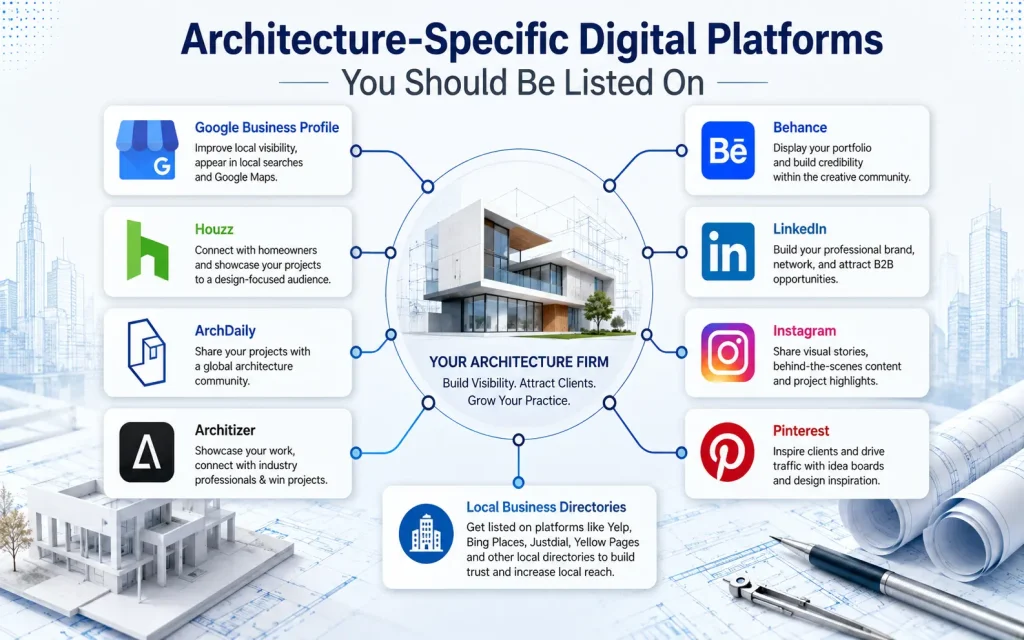
Most digital marketing guides focus exclusively on Google, Facebook, and LinkedIn. But architectural products have a distinct ecosystem of platforms where your buyers spend significant time.
- ArchDaily Product Listings: ArchDaily is the most visited architecture publication in the world. Their product directory is actively browsed by architects in specifier mode, not casual browsing mode.
- Architizer: A portfolio and project platform used heavily by US-based architecture firms. Their A+Product Awards generate significant media coverage and brand credibility.
- Dezeen’s Showroom: A product showcase tied to one of the most influential design publications globally. Relevant for premium and design-forward products.
- Sweets Network (US): A product specification database built into many architectural workflows. Being listed here puts your product data directly in front of specs writers.
- ARCAT: A free building product directory used by US contractors and specifiers. CSI MasterSpec formatted data is particularly valuable here.
- NBS Source (UK): The primary specification writing platform in the United Kingdom. If you sell into UK projects, having NBS-formatted specification clauses is essential.
Being listed on these platforms is not optional if you are selling to the specification market. They are where the conversion actually happens.
The Sample Request Funnel: A Conversion Point Nobody Optimizes
Sample requests are one of the most significant intent signals in architectural product marketing, and almost no competitor article treats them as a digital marketing opportunity.
When an architect requests a physical sample, they are actively considering your product for a real project. This is a high-intent lead. Yet most brands ship the sample with a generic packing slip and never follow up digitally.
A better approach:
- Build a dedicated, frictionless sample request flow on your website with intelligent form fields that capture project type, project stage, and decision timeline.
- Trigger an automated email sequence after a sample ships: first a confirmation with technical documentation attached, then at seven days a follow-up with a relevant case study, then at 21 days a check-in offering a CPD session or a product consultation call.
- Track sample requests by product, region, and firm type to understand which products are generating specification interest and from which market segments.
The sample request is a bridge between digital discovery and physical product experience. Treating it as a digital touchpoint rather than a logistics task can meaningfully improve your conversion rate.
LinkedIn for Architectural Products: How to Use It Correctly
LinkedIn is consistently mentioned in competitor articles, but usually with vague advice about “posting regularly” and “engaging with your audience.” The specifics matter more than the general advice.
What actually works for architectural product manufacturers on LinkedIn:
- Target by job title, not industry alone. Filter by “Architect,” “Interior Designer,” “Specification Writer,” “Project Manager,” and “Building Consultant” for sponsored content. Industry targeting on its own is too broad.
- Post project case studies with outcome data. A post showing a completed project with your product installed, alongside acoustic performance test results or energy efficiency improvements, outperforms generic brand posts by a significant margin.
- Engage technical discussions. Comment meaningfully on conversations about fire safety standards, sustainability certifications, or building regulation updates. This positions your brand as technically credible, not just present.
- Company page consistency. Architects and specifiers research supplier brands before specifying them. A LinkedIn company page with active, technical content reinforces credibility at the research stage.
LinkedIn advertising for architectural products works best for remarketing to people who have visited your technical pages or downloaded your resources, not for cold awareness.
Trade Show Digital Amplification: Before During, and After
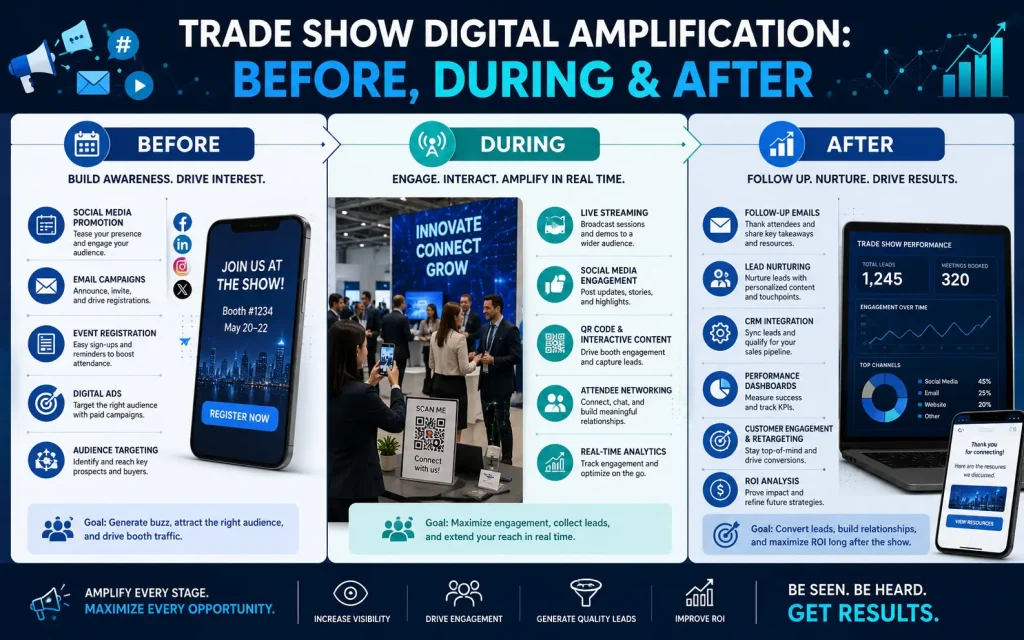
Architectural product brands invest heavily in trade shows like NeoCon, AIA Expo, Greenbuild, EcoBuild, and regional industry events. Most treat digital marketing as separate from the trade show presence. That disconnect wastes money.
Before the show (2-4 weeks out):
- Publish a dedicated blog post or landing page about what you are launching or showcasing.
- Run LinkedIn and Google ads targeting people who follow the show’s hashtag or are registered attendees (LinkedIn Event targeting).
- Email your existing contacts and sample requestees inviting them to your stand.
During the show:
- Post real-time content from the stand: product demonstrations, short video interviews with your technical team, polls asking which product visitors want to see first.
- Use the show hashtag consistently for organic reach within the event audience.
After the show (within two weeks):
- Send a targeted email to show attendees with a summary of what you launched plus a sample request CTA.
- Publish a post-show roundup with photos and technical highlights.
- Retarget website visitors from the pre-show campaign period with product-specific ads.
A trade show presence without a digital amplification strategy is a missed opportunity at every stage.
Measuring What Actually Matters
Standard digital marketing metrics like impressions, clicks, and page views are incomplete for architectural products because the sales cycle is so long. You need metrics that track specification-stage progress, not just website activity.
Metrics worth tracking:
- BIM object downloads by firm (most BIM platforms provide this)
- Technical data sheet downloads and sample requests as conversion events in Google Analytics
- CPD session attendance and post-session sample requests
- Time-on-page for technical specification content (low dwell time suggests the technical depth is insufficient)
- Specification-to-purchase rate (requires CRM integration with your sales team’s won-deal data)
- Product name searches in Google Search Console (indicates brand awareness growth)
The further down the specification funnel your metrics sit, the more useful they are for making real marketing decisions.
FAQ
How long does it take for digital marketing to generate architectural product specifications?
Realistically, 6 to 18 months before digital marketing activity translates into confirmed specifications, depending on your product category and sales cycle. Content and SEO investment compounds over time: a well-ranked technical page from month four continues generating leads in month 24 without additional spend.
Do architectural product manufacturers need a separate B2B and B2C marketing strategy?
Most architectural products are specified B2B, but some categories (floor coverings, kitchen hardware, interior cladding) also reach end consumers or interior designers working on residential projects. If your product sits in both markets, the technical content library serves the B2B specification audience, while lifestyle imagery and application inspiration serve the B2C segment. Keep the audiences separated in your advertising targeting.
What is the most cost-effective digital marketing channel for a small architectural product manufacturer?
SEO and technical content, combined with BIM object publishing, deliver the highest long-term ROI relative to budget. They require upfront time investment but generate sustained organic traffic and specification-stage leads without ongoing ad spend. Paid social and Google Ads make sense for product launches or trade show amplification, but they are less efficient as a standalone lead generation channel for small budgets.
How do I get my product specified by large architecture firms?
The most direct path is through CPD-accredited educational content, attending or sponsoring events those firms’ architects attend, and ensuring your BIM objects are available in the libraries those firms use. Large firms often have preferred supplier lists; being visible during the research stage of multiple projects is how you earn a place on those lists over time.
Should architectural product manufacturers invest in video marketing?
Yes, but with a focus on technical application rather than brand storytelling. Installation videos, product performance testing footage, and project fly-through animations featuring your product in situ consistently outperform generic brand videos on both engagement and lead quality. Short-form video (under 90 seconds) on LinkedIn and YouTube works well for reaching architects in the research stage.
Is Instagram useful for architectural products, or is it too consumer-focused?
Instagram is relevant for products with strong visual impact: facades, surfaces, lighting, flooring, and interior systems. Architects do use Instagram for visual inspiration and project discovery, particularly in the early concept stage. It is not the right platform for technical specification content but works well for building brand visibility and directing traffic to your website for further research.
What is an EPD and why does it matter for digital marketing?
An EPD (Environmental Product Declaration) is a standardized, third-party verified document that quantifies a product’s environmental impact across its lifecycle. As sustainability credentials become mandatory in green building certification schemes (LEED v4.1, BREEAM, Green Star), specifiers actively search for products with verified EPDs. Publishing your EPD prominently on product pages and creating content that explains your environmental data attracts specification-stage traffic from sustainability-focused firms.
How important is Google Business Profile for an architectural product manufacturer?
More important than most manufacturers realize. Architects searching for local or regional product suppliers, or looking up a brand they have seen at a trade show, frequently use Google’s local search and Maps results. A complete, regularly updated Google Business Profile with product photos, technical documentation links, and responses to reviews reinforces credibility at the brand research stage.
Final Thought
Digital marketing for architectural products is about more than generating website traffic. It helps manufacturers distributors and suppliers connect with architects designers contractors and builders who are actively searching for trusted products and technical solutions.
By combining SEO content marketing paid advertising and lead generation strategies your business can build credibility attract qualified prospects and create long term growth in a highly competitive industry. Investing in the right digital marketing approach today positions your brand as the preferred choice for tomorrow’s construction and design projects.
You May Also Like It:
Financial Services Digital Marketing Agency