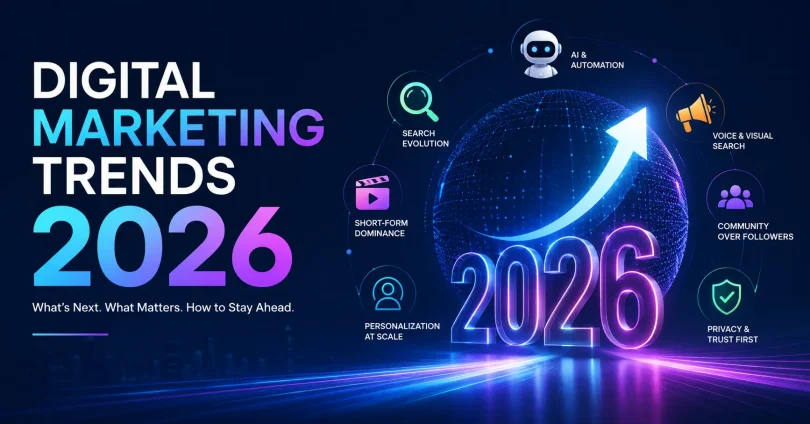

The most impactful Digital Marketing Trends 2026 are the rise of agentic AI that autonomously manages campaigns, the fragmentation of search across five or more platforms beyond Google, and the shift toward first-party data ecosystems as cookie-based targeting collapses. Brands that adapt their content, measurement, and audience strategy to this new landscape will widen their lead. Those still running 2023-era playbooks are already losing ground.
The 2026 Marketing Landscape Is Not What Most Guides Describe
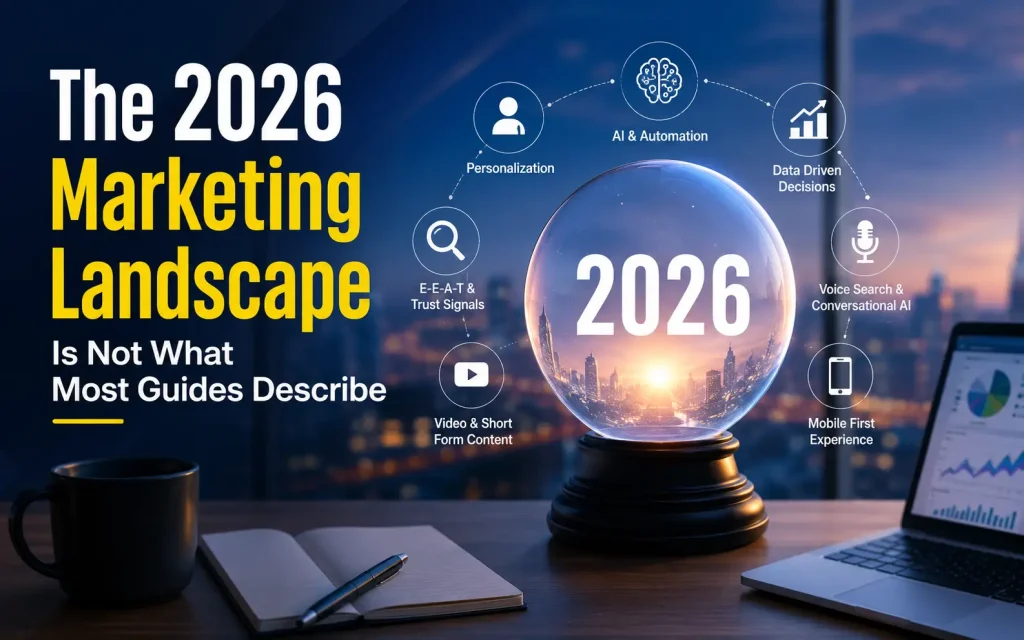
Every year, the same trends get recycled with a fresh coat of paint. “AI is changing everything.” “Video is king.” “Personalization matters.”
Sure. But that surface-level coverage misses what’s actually happening on the ground, inside real campaigns, with real budgets. What follows is a practical breakdown of the trends reshaping digital marketing in 2026, including several that most industry articles have not touched.
Agentic AI: The Shift from AI Tools to AI That Does the Work
Most articles talk about AI as a content assistant. That’s 2023 thinking.
In 2026, the real story is agentic AI: systems that don’t just generate a caption or suggest a keyword, but autonomously plan, execute, test, and iterate on marketing campaigns. Google’s Performance Max, Meta’s Advantage+, and platforms like Jasper Campaigns are early versions of this. You give the system a goal and a budget. It does the rest.
This matters because it fundamentally changes what marketers need to be good at. Creative direction, audience strategy, and brand judgment become more valuable. Repetitive execution tasks are increasingly handled by the AI layer.
The practical edge case most brands miss: Agentic AI systems optimize toward the goal you define. If you define that goal poorly (e.g., “maximize clicks”), the system will find clicks, but not necessarily customers. Getting clear on your objective function is now a core marketing skill.
What to do right now:
- Audit your campaign goals across every platform. Are they optimizing for the signal you actually want?
- Start learning the AI campaign interfaces on Meta and Google, not just the creative tools.
- Keep a human in the loop for brand safety. Agentic systems can technically be “correct” and still produce content your brand shouldn’t publish.
Search Has Splintered. There Is No Longer One Search Engine.
Competitors are still writing about “SEO” as though Google is the only place people find information. It isn’t.
In 2026, your customers are using:
- Google (including AI Overviews, now on by default for most queries)
- ChatGPT and Perplexity for research, comparisons, and recommendations
- TikTok as a product and lifestyle discovery engine, particularly for under-35s
- YouTube for how-to, review, and evaluation content
- Reddit and Quora for peer validation and real opinions
- Instagram and Pinterest for visual and aesthetic discovery
Each of these has different ranking signals, different content formats, and different user intent. A brand that only optimizes for Google is invisible on the platforms where a meaningful portion of their audience starts their buying journey.
What no competitor article covers: The fragmentation is not uniform across industries. A B2B SaaS company still gets the majority of its research traffic from Google and LinkedIn. A skincare brand may get more discovery from TikTok and Pinterest combined than from Google. Map your customer’s actual discovery path before deciding where to invest.
GEO: How to Optimize for AI-Generated Answers (Not Just Rankings)
Generative Engine Optimization, or GEO, is the practice of making your content the source that AI systems cite and summarize. It is different from traditional SEO in meaningful ways.
Traditional SEO gets you a blue link. GEO gets your content used as the basis for an AI-generated answer, sometimes without a link to your site at all. That sounds bad, but it also means reaching people who would never have clicked through anyway.
The tactics that actually move the needle for GEO:
- Write in direct answer format. AI systems are trained to extract clean, declarative sentences. “X causes Y because Z” will be pulled into an AI answer far more reliably than “there are several reasons why X might relate to Y.”
- Use structured data aggressively. Schema markup for FAQs, How-Tos, Products, and Reviews gives AI crawlers a structured signal. Most SMBs still skip this.
- Build topical authority, not just keyword volume. AI systems favor sources that cover a topic comprehensively and consistently over time. A brand that has 40 deep articles on email marketing is more likely to be cited than one with 200 shallow posts across multiple topics.
- Get cited by other authoritative sources. Backlinks still matter, but for GEO, being mentioned in authoritative industry publications without a link also builds signal.
- Use natural language in headings. “What is the best CRM for small business?” performs better in AI contexts than “Top CRM Tools 2026.”
The zero-click concern is real. Google’s own data shows that AI Overviews suppress click-through rates for informational queries. The strategic response is not to avoid those queries, but to own them so thoroughly that your brand is the source being cited, which builds awareness even without the click.
The ROI Measurement Crisis and What to Do Instead
This is the most underreported story in digital marketing right now.
Multi-touch attribution, the practice of assigning credit across touchpoints on the path to conversion, is breaking down.
Here’s why:
- iOS privacy changes removed click-based tracking on Apple devices (roughly 55-60% of mobile in most Western markets).
- Chrome’s eventual phase-out of third-party cookies removes the last cross-site tracking mechanism most ad platforms relied on.
- AI-generated search results are creating “ghost impressions”: brand exposure that influences decisions but never appears in any attribution model.
The result: your data is underreporting effectiveness by a significant margin. Brands that cut spend based on attributed ROAS are, in many cases, cutting campaigns that are actually working.
The practical fix: shift to incrementality testing and media mix modeling (MMM).
Incrementality testing compares outcomes in markets or cohorts where a campaign ran versus where it didn’t. It measures real business lift, not modeled attribution. MMM uses statistical regression across time and spend data to estimate channel contribution without relying on individual tracking.
Neither is perfect. But both are more accurate than last-click attribution in a privacy-first world.
Brands also need to get comfortable with blended metrics: total revenue per dollar spent, customer acquisition cost by cohort, and organic traffic lift during paid campaigns. These are messier than a clean ROAS number, but they reflect reality more honestly.
Short-Form Video Is Maturing. The Winners Are Playing a Different Game.
Competitors are correct that short-form video dominates. But the framing of “post more Reels and TikToks” misses the more important shift happening underneath.
The brands winning on short-form video in 2026 are not just posting consistently.
They are treating their social channels as mini media companies, with:
- A clear editorial angle (not just “tips and tricks”)
- Characters or faces the audience returns to see
- Narrative arcs that reward long-term followers
- Content designed for the algorithm’s micro-behavior signals (watch time per second, replay rate, saves), not just likes
The data point most articles skip: Save rate and share rate are now significantly stronger algorithmic signals than like rate on both TikTok and Instagram. Content that gets saved or sent to a friend tells the algorithm this is genuinely useful. A video with 200 saves and 1,000 likes will often outperform one with 50 saves and 10,000 likes in terms of long-term reach.
Design your video content to be reference-worthy, not just entertaining. “How to do X in 60 seconds” will get saved. A funny brand moment will get liked and forgotten.
The AI Content Paradox: Deploy It, But Hide the Seams
Here is the uncomfortable tension no one is being direct about.
Brands are using AI to produce more content faster. Consumers are simultaneously developing a finely-tuned radar for AI-generated writing and are penalizing brands that sound robotic.
HubSpot’s 2026 State of Marketing data confirms that authentic content significantly outperforms AI-generated content in trust metrics. Yet the same report shows most marketing teams are using AI tools across their workflow.
The resolution is not “use AI less.” It is use AI differently:
- Use AI for research, outline generation, data analysis, repurposing, and drafts.
- Use human judgment and voice for the final layer: the specific anecdote, the honest opinion, the counterintuitive take.
- Audit your content for what Copyblogger calls “the tells”: lists of three, overuse of “it’s important to note,” unspecific language, and transitions that feel like summaries.
The brands that will win on content in 2026 are those that use AI to scale their output while investing in a distinctive editorial voice that the AI cannot fully replicate.
First-Party Data Ecosystems: Building the Asset Your Competitors Can’t Copy
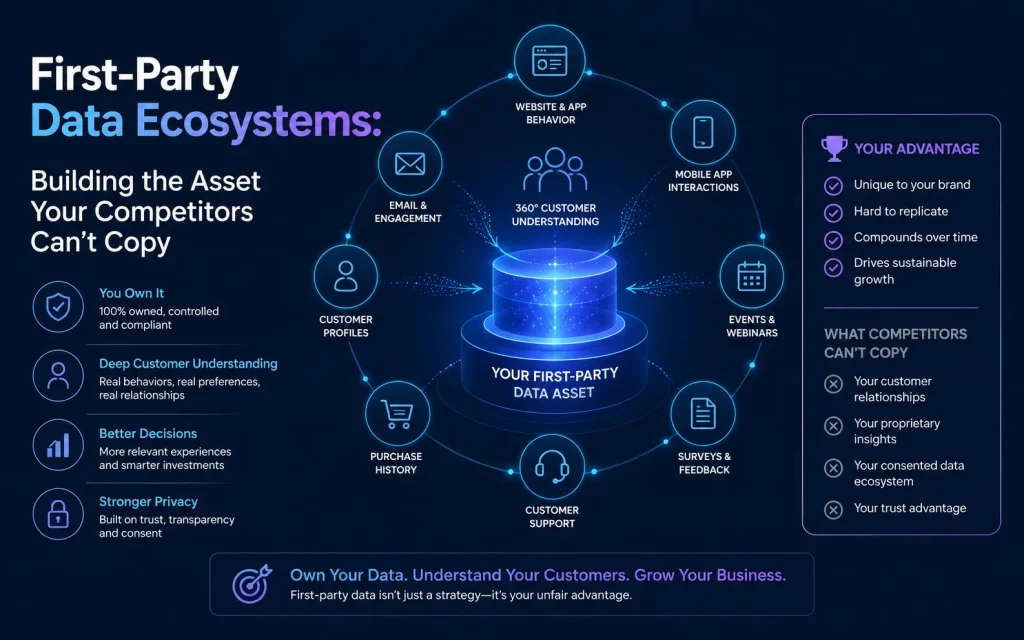
With third-party data access eroding, the most durable competitive advantage in 2026 is a rich, permissioned first-party data asset.
First-party data is information your customers give you directly: email addresses, purchase history, survey responses, onsite behavior. It requires no third-party platform. It doesn’t disappear with a privacy regulation update.
What most articles miss: It’s not enough to collect email addresses. A first-party data ecosystem means:
- A preference center where customers actively tell you what they want to hear about and how often
- Behavioral signals from your own site and app (which products do people browse repeatedly before buying?)
- Post-purchase data that feeds back into acquisition targeting via lookalike modeling
- Zero-party data: information customers voluntarily share, like quiz results, style preferences, or product configurator inputs
Brands like Glossier and Patagonia built their first-party data assets over years, which is why they are relatively insulated from platform changes that devastate brands who built their audience on rented social media land.
Start now, even if you’re small. Your email list, your SMS subscribers, your loyalty program members: these are the owned assets that will be most valuable as external tracking continues to degrade.
Social Commerce Is No Longer Optional for Product Brands
Social commerce, where the discovery, consideration, and purchase all happen within a single social platform, is generating real revenue at scale in 2026.
TikTok Shop, Instagram Shopping, and Pinterest’s direct checkout have matured. The friction between “I saw it” and “I bought it” is nearly gone on these platforms.
The nuance most brands get wrong: Social commerce is not just about listing your products on TikTok Shop. The content that converts is native commercial content, meaning it looks and feels like organic content, not an ad.
The formats that work:
- Live shopping events, particularly for fashion, beauty, and food
- Creator haul and review videos with embedded purchase links
- Product demonstration videos under 30 seconds with an immediate CTA
The brands that treat social commerce as “just another sales channel with different creative” tend to underperform. The brands that build a genuine creator-commerce hybrid strategy, commissioning authentic reviews from creators with real audiences, tend to see strong conversion rates.
Predictive Segmentation Is Replacing Demographic Targeting
“Women aged 25-45 interested in fitness” is a demographic segment. It tells you almost nothing about whether someone will buy.
In 2026, the most sophisticated brands are replacing demographic targeting with behavioral and predictive segmentation:
- Predictive LTV modeling: identifying which customers are likely to become high-value repeat buyers based on early behavioral signals (what they browse, how long they spend, what they add to cart and abandon)
- Churn propensity scoring: identifying at-risk existing customers early enough to intervene with retention offers
- Look-alike modeling on first-party data: feeding your best customer profiles into ad platform AI to find similar audiences, without relying on third-party interest data
Tools like Klaviyo for e-commerce, Salesforce Einstein for enterprise, and even Meta’s Advantage+ Audiences are enabling this for brands at various budget levels.
The practical result is more efficient ad spend. Instead of broad demographic campaigns, you are targeting people whose behavioral patterns match those of your existing high-value customers.
LinkedIn Is Having Its Creative Moment. Most Brands Are Sleeping On It.
Hootsuite’s 2026 Social Trends report flagged this, but no competitor article covered it with any depth.
LinkedIn is undergoing a genuine creative evolution. The platform’s algorithm is now rewarding:
- Longer-form personal narratives from founders and senior leaders
- Short-form video (LinkedIn video is getting serious algorithmic prioritization for the first time)
- Contrarian or counterintuitive takes on industry norms, not just tips and insights
- Behind-the-scenes company content that humanizes teams
The reason this matters: LinkedIn’s audience is professional and high-intent. Organic reach on LinkedIn is still meaningfully higher than on Meta for B2B content. And the platform is significantly less crowded with high-quality creative content than Instagram or TikTok.
For B2B brands, founding team LinkedIn presence is now a distribution channel that rivals paid ads in cost-per-engaged-lead. The executives who are posting consistently and authentically are building audiences that email newsletters and blog traffic cannot match.
Contextual AI Targeting: The Practical Replacement for Behavioral Cookies
When third-party cookies were the backbone of ad targeting, behavioral data drove placement decisions. As that tracking infrastructure erodes, contextual AI targeting is filling the gap.
Contextual targeting serves ads based on the content someone is currently consuming, not on their tracked browsing history. It is GDPR-friendly, iOS-resistant, and, with AI-powered context analysis, now more precise than it ever was in its pre-programmatic form.
Modern contextual AI goes beyond “show fitness ads on fitness articles.” It reads the semantic meaning, emotional tone, and intent signals of content at page level. An article about marathon training in an anxious, injury-worry tone signals a different audience than one in an aspirational, goal-setting tone, even though both are “fitness content.”
Why this matters now: Brands that are still waiting for a clean cookie replacement before shifting strategy are losing reach. Contextual AI targeting is available today, on most programmatic platforms, and it works well enough to warrant serious testing.
The Trends That Are Overhyped in 2026 (Honest Take)
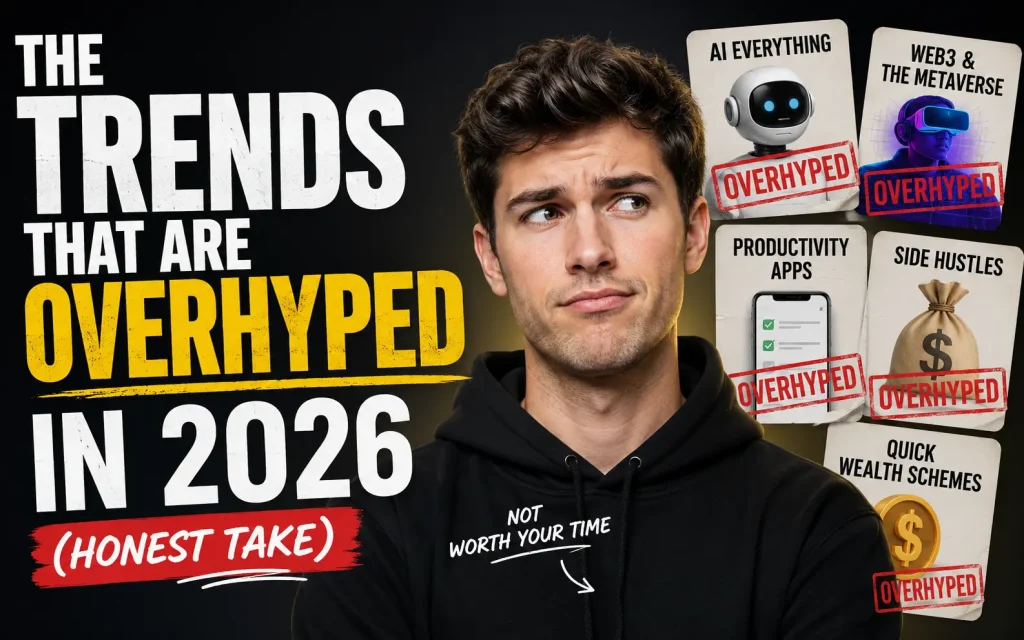
Not every trend deserves your budget. A few that are getting more attention than they deserve for most brands:
- The metaverse and VR marketing: Still a niche channel with a tiny addressable audience outside gaming. Not worth significant investment unless your brand specifically serves that community.
- NFTs and Web3 loyalty programs: The consumer appetite is not there. The friction is too high.
- Chatbot-only customer service: Works well for simple queries, but brands replacing human support with bots for complex issues are paying for it in satisfaction scores and retention.
Trend chasing is expensive. The brands that win are usually the ones who get very good at a small number of channels rather than spread thin across every new format.
How 2026 Trends Stack Up at a Glance
| Trend | Primary Benefit | Readiness Level | Best Suited For |
|---|---|---|---|
| Agentic AI Campaigns | Scale + efficiency | Available now (Google, Meta) | All business sizes |
| GEO / AI Search Optimization | Organic visibility in AI answers | Available now | Content-heavy brands |
| First-Party Data Ecosystems | Audience ownership, ad efficiency | Build over 12-24 months | E-commerce, SaaS |
| Short-Form Video | Discovery + reach | Available now | B2C, D2C, personal brands |
| Social Commerce | Reduced purchase friction | TikTok, Instagram, Pinterest | Product brands |
| Contextual AI Targeting | Cookie-independent reach | Available now | All paid advertisers |
| Predictive Segmentation | Higher-efficiency ad spend | Mid-large budgets | E-commerce, subscription |
| LinkedIn Creative Content | B2B organic reach | Available now | B2B, professional services |
Your 90-Day Action Checklist
- Audit your search presence across Google, TikTok, YouTube, and ChatGPT. Search your brand and your core product queries on each. What do you find?
- Restructure at least five existing content pieces in direct-answer format to improve GEO capture.
- Run one incrementality test on a channel where you’re uncertain about ROI. Compare a test market against a holdout.
- Identify your top 20% of customers and build a behavioral lookalike audience from that cohort on Meta and Google.
- Set up a preference center for your email list and segment based on declared interests, not just open history.
- Brief one short-form video that is genuinely save-worthy, not just entertaining.
- Start or revive a LinkedIn content cadence for at least one senior voice in your business.
FAQ
Q: Is SEO still worth investing in for 2026?
Yes, but the definition of SEO has expanded. Classic on-page and technical SEO still matters for Google rankings. What’s changed is that you also need to optimize for AI search systems like ChatGPT and Perplexity, which pull from authoritative, clearly written sources. Topical depth and structured content format are now as important as keyword optimization.
Q: How do small businesses compete with large brands using AI at scale?
Small brands have an advantage that AI cannot replicate: genuine human voice, local credibility, and speed of decision-making. The most effective small business strategy is to go narrow and deep. Own a specific topic, community, or geography with genuine expertise. AI tools amplify what you bring, so bring something real.
Q: What is GEO and how is it different from SEO?
SEO gets you a clickable ranking in search results. GEO (Generative Engine Optimization) gets your content used as the source for AI-generated answers, in tools like Google’s AI Overviews, ChatGPT, and Perplexity. The tactics overlap but differ in emphasis: GEO rewards direct answer format, topical authority, and structured data more than it rewards keyword density.
Q: Which social platform should I prioritize in 2026?
It depends entirely on where your audience discovers new things. For B2C product brands under 40s: TikTok and Instagram. For B2B and professional services: LinkedIn. For home, food, and fashion discovery: Pinterest still performs strongly. For community validation: Reddit. Run a small discovery audit before doubling down on any platform.
Q: Is influencer marketing still effective, or is it oversaturated?
Macro-influencer saturation is real. Engagement rates for celebrity-tier creators have dropped significantly. Micro-influencers (10,000 to 100,000 followers) with highly engaged, niche audiences consistently outperform larger creators on cost-per-conversion. The shift is toward long-term creator partnerships and performance-based deals rather than one-off sponsored posts.
Q: How should I handle AI-generated content if Google is penalizing it?
Google has stated it penalizes low-quality, unhelpful content regardless of how it was produced. AI content that is accurate, useful, and well-edited is not being targeted. The practical standard: would a real expert sign their name to this? If yes, publish it. If it reads like it was produced in 30 seconds with no editorial judgment, do not publish it.
Q: What is the best alternative to third-party cookie tracking in 2026?
The best single alternative is incrementality testing combined with media mix modeling (MMM), which measures real business lift rather than modeled attribution. In parallel, build your first-party data asset (email, SMS, loyalty data) and use contextual AI targeting for upper-funnel paid media. There is no one-to-one replacement for cookie tracking, but this combination covers most of what it was used for.
Q: How do I know which 2026 trends are relevant to my specific business?
Start with your customer’s discovery path: how do they actually find businesses like yours? Survey your existing customers, look at your referral traffic data, and search your own category across different platforms. The trends that intersect with where your customers already are should get your attention first. Trends that apply mainly to a different audience or business model can wait.
Final Thoughts
Digital Marketing Trends 2026 are reshaping how businesses connect with customers in an increasingly competitive online world. Artificial intelligence personalized marketing voice search video content automation and privacy focused strategies are no longer optional. They are becoming essential for long term success.
Business that embrace these trends early will be better positioned to increase brand visibility build stronger customer relationships and generate sustainable growth. The key is to stay flexible monitor industry changes and continuously adapt your marketing strategy to meet evolving customer expectations. By investing in the right digital marketing techniques today your business can remain competitive and continue growing throughout 2026 and beyond.
You May Also Like It:
Agencia de Marketing Digital SEO