
A financial services digital marketing agency is a specialist marketing firm that builds and executes digital campaigns for banks, financial advisors, mortgage brokers, insurance companies, superannuation funds, fintech startups, and investment managers. Unlike a generalist agency, these firms understand the regulatory boundaries, the long buyer consideration cycles, and the trust dynamics that make financial marketing categorically different from retail or e-commerce.
Why Generic Agencies Consistently Underdeliver for Financial Brands
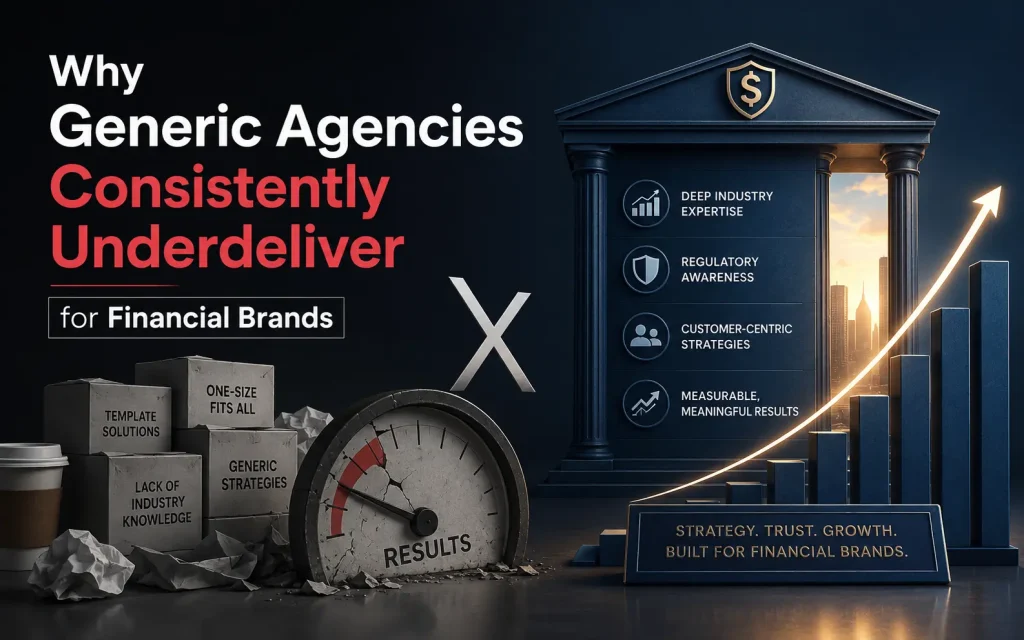
Most generalist marketing agencies are built around fast-feedback loops: run an ad, measure clicks, optimise, repeat. That playbook breaks down the moment you enter financial services.
Here is why. A consumer shopping for a mortgage typically takes 60 to 90 days from first search to settlement. Someone looking for a financial advisor may spend six months researching before a single contact form is filled in. And throughout that entire journey, every piece of content your brand publishes sits under regulatory scrutiny.
Generalist agencies rarely account for this. They optimise for cost-per-click when the real metric is cost-per-qualified-appointment. They produce “engaging content” without checking whether it crosses into personal financial advice territory. The result is campaigns that generate noise, not pipeline.
A specialist financial services digital marketing agency is structured around these realities from day one.
The Regulatory Layer That Changes Everything
This is the piece that almost no competitor article covers properly.
In Australia, the Australian Securities and Investments Commission (ASIC) distinguishes sharply between general financial information and personal financial advice. That line matters enormously for marketing content. An article on “how superannuation works” is fine. An article that says “if you are over 50, you should move into this type of fund” edges into advice territory, which requires an Australian Financial Services Licence (AFSL) and specific disclosure requirements.
A skilled financial services digital marketing agency understands these distinctions at a content strategy level. Their copywriters know the language to avoid. Their compliance review process is built into the production cycle, not tacked on at the end.
Specific areas where this regulatory awareness shows up in practice:
- Testimonials and social proof: ASIC has specific rules about client testimonials for financial products. Not every positive review can be published without context.
- Performance claims: Past returns cannot be presented in a way that implies future performance. This rules out entire categories of ad copy that would work fine in another industry.
- Comparison content: Comparing financial products carries its own disclosure obligations.
- Influencer and affiliate marketing: Requires careful structuring to avoid creating unlicensed advice relationships.
A generalist agency typically discovers these constraints after a campaign is built. A specialist agency builds the campaign around them.
The Trust Gap: Why Financial Brands Cannot Just “Run Ads”
Trust is the fundamental currency in financial services, and it takes longer to earn than in almost any other category. Consumers are being asked to share sensitive information, hand over significant assets, or commit to long-term financial products. The cost of a wrong decision is not a bad shopping experience; it is financial harm.
This changes the entire channel and content strategy.
What actually builds trust in financial services:
- Consistent educational content over time. A financial advisor who has published 80 articles on retirement planning before a prospect even makes contact has a relationship that a Google Ad cannot replicate.
- Third-party signals. Reviews on Google, features in credible financial media, awards and accreditations from recognised bodies. These carry far more weight than branded claims.
- Transparent credentials. AFSL numbers, Professional Year completions, membership of professional associations. Smart financial services agencies surface these prominently, not buried in a footer.
- Demonstrated process. Showing how a firm operates, what a client engagement looks like, and what to expect removes the uncertainty that blocks conversions.
Paid ads work in financial services, but they work best when they bring people into a content and nurture system, not when they point directly to a “contact us” page.
What a Financial Services Digital Marketing Agency Actually Does: Channel by Channel
Search Engine Optimisation (SEO)
SEO is the highest-ROI long-term channel for most financial services businesses, because high-intent searches happen constantly. “Best mortgage broker Sydney,” “how to set up an SMSF,” “financial advisor fees Australia” these are people who have already decided they have a need and are actively researching solutions.
The challenge in financial services SEO is that Google places financial content in the YMYL (Your Money or Your Life) category, which means it applies significantly higher quality standards before ranking a page. Thin content, content without clear author credentials, or content that makes unsubstantiated claims will simply not rank, regardless of backlink profile.
Effective financial services SEO requires:
- Expert authorship. Content attributed to credentialed professionals (CFPs, CPAs, mortgage brokers) performs measurably better in this category.
- Depth over volume. One 3,000-word, genuinely useful article on self-managed super funds outperforms ten 400-word listicles.
- Local SEO for advice businesses. “Financial advisor near me” searches have strong local intent. Google Business Profile optimisation, local landing pages, and location-specific reviews are critical for practices with physical offices.
Google Ads and Paid Search
Paid search is competitive and expensive in financial services. Keywords like “financial advisor” or “home loan rates” can cost $15 to $40 per click in Australian metro markets. That makes landing page quality and conversion rate non-negotiable a mediocre landing page at $25 per click is a fast way to burn budget.
What works: narrowly targeted campaigns built around specific services and specific buyer stages. A campaign targeting people searching for “SMSF setup costs” will outperform a broad campaign targeting “investment advice” every time, because the former signals a much clearer intent and a much more specific need.
Content Marketing and Thought Leadership

This is where most financial services businesses have the biggest gap and the biggest opportunity.
Educational content does three things simultaneously: it builds organic search visibility, it positions a firm as credible, and it creates a reason for prospects to engage before they are ready to buy. A well-run content program means your firm is in front of potential clients for months before they even make contact.
The content types that consistently perform in financial services:
- Explainer articles that answer specific questions (these capture YMYL search intent)
- Annual guides that update with regulatory and rate changes (these attract backlinks)
- Video content featuring advisors or founders (this builds personal trust)
- Case studies with specific outcomes (these convert prospects who are close to deciding)
Email Nurture Sequences
Given the long consideration cycles in financial services, email remains one of the most effective conversion tools. A prospect who downloads a guide to first home buyer grants is telling you exactly where they are in their journey. A well-designed sequence delivers relevant content over the following weeks, builds familiarity, and surfaces conversion prompts at the right moment.
Most financial services businesses have lists they are not using well. A specialist agency will typically audit the existing database and find significant revenue sitting dormant.
LinkedIn for B2B Financial Services
For B2B financial firms (wealth management platforms, financial technology providers, wholesale investment managers), LinkedIn is often the primary demand generation channel. Decision-makers in finance are active on LinkedIn in ways they are not on other platforms.
Thought leadership posts from named individuals at a firm consistently outperform company page content. An agency with financial services experience will coach and ghostwrite for founders and senior staff, not just post from a corporate account.
Social Media for B2C Financial Services
Instagram and Facebook are viable for mortgage brokers, insurance advisors, and financial planners targeting retail consumers, particularly for awareness and community building. These platforms are not strong direct-response channels for financial services, but they are effective for staying visible to warm audiences and generating referrals.
The compliance note here: sponsored posts promoting financial products require proper disclosure, and some platform ad policies add additional restrictions on financial content.
How the Sales Cycle Should Shape Your Agency Brief
| Buyer Stage | What They Need | Right Channel |
|---|---|---|
| Awareness | Education, problem framing | SEO content, social media, YouTube |
| Consideration | Comparison, trust signals, credentials | Detailed content, reviews, retargeting |
| Decision | Social proof, clear next step, low friction | Case studies, landing pages, email, calls |
| Post-purchase | Retention, referral activation | Email, events, community |
This table matters because many financial services businesses invest almost entirely at the decision stage, running ads to people who are ready to buy. That works for some high-intent keyword campaigns. But ignoring the awareness and consideration stages means competitors who are present throughout the journey will own the relationship before prospects even see your ad.
The Real Difference Between a Good Agency and an Expensive Disappointment
Here is what to look for when evaluating a financial services digital marketing agency.
They ask about your compliance setup before they ask about your budget. An agency that does not ask about your AFSL obligations, your compliance officer, or your content review process in the first meeting has not done this before. Compliance is not an afterthought; it is the foundation.
They can explain your conversion funnel, not just your traffic. Traffic metrics are easy. What is harder, and far more valuable, is understanding what happens between a first website visit and a signed client agreement. An agency should be able to map that journey and show you where the drop-off points are.
They have worked with businesses of a similar regulatory profile. A mortgage broker and an investment management firm both operate in financial services, but they have different ASIC obligations, different target audiences, and different competitive landscapes. Experience in one does not automatically transfer to the other.
They set realistic timelines. SEO in financial services YMYL categories takes longer than in most other industries. Google is cautious about newly published financial content. An agency that promises page-one rankings in 60 days for competitive keywords is either inexperienced or not being straight with you.
They report on business outcomes, not vanity metrics. Impressions and reach tell you almost nothing in a high-consideration category. Qualified inquiries, cost per appointment, lead-to-client conversion rate, and return on ad spend by channel are the numbers that matter.
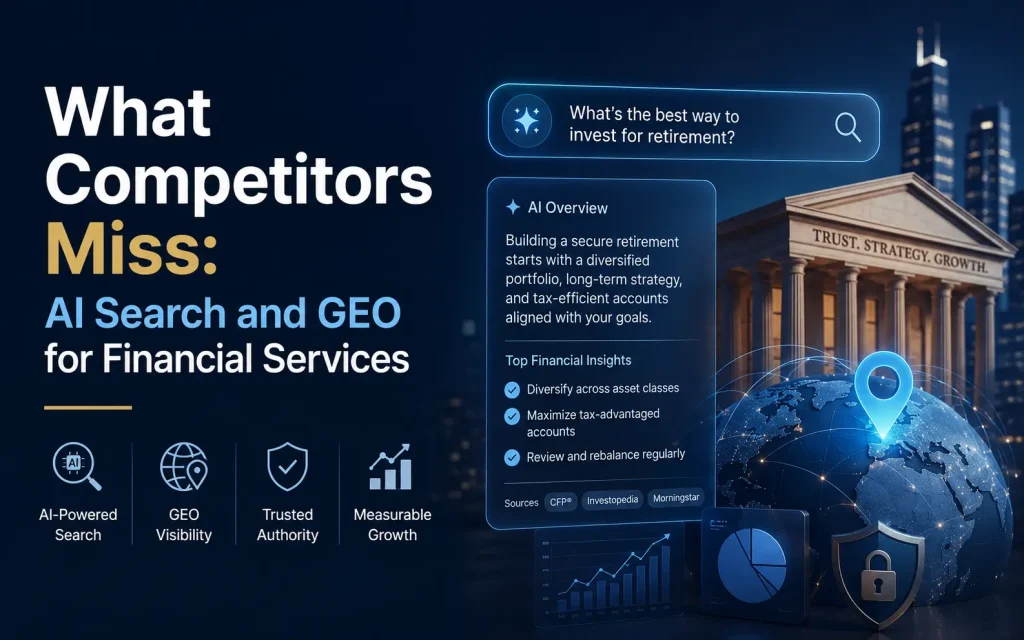
What Competitors Miss: AI Search and GEO for Financial Services
This is a major gap in the current competitive landscape, and it is moving fast.
AI-powered search tools (Google AI Overviews, Perplexity, ChatGPT search, Claude) are increasingly how people research financial questions. When someone asks “what should I look for in a financial advisor?” or “is a fixed rate or variable rate better right now?” they may see an AI-generated answer before they click a single result.
For financial services businesses, this creates both a risk and an opportunity.
The risk: if your competitors’ content is being cited in AI answers and yours is not, you are invisible at a critical moment of consideration.
The opportunity: financial services content that is structured for AI extraction, written by credentialed experts, and answers specific questions clearly is well-positioned to be cited by AI systems. This is sometimes called Generative Engine Optimisation (GEO), and forward-thinking financial services agencies are already building this into their content strategies.
Practically, this means:
- Writing in clear question-and-answer formats
- Including explicit author credentials and affiliations
- Citing data and primary sources
- Covering a topic comprehensively in a single, structured piece rather than spreading thin content across multiple pages
Red Flags That Should End the Conversation
- The agency cannot name the specific ASIC marketing guidelines that apply to your category
- They propose running ads before conducting any audit of your existing assets
- They cannot explain what happens to your data and how attribution is tracked
- Their case studies are from completely unrelated industries
- They charge based on percentage of ad spend with no accountability for results beyond click metrics
- They promise guaranteed rankings or guaranteed lead volumes
FAQ
What does a financial services digital marketing agency charge?
Retainer arrangements typically range from $3,000 to $15,000 per month depending on scope, with ad spend managed separately. Project-based work (website redesign, SEO audit, content strategy) is usually priced per project. Be cautious of very low-priced options in this category; financial services content requires experienced writers and compliance-aware processes that have a real cost.
How long before we see results from SEO in financial services?
For competitive keywords in a YMYL category like finance, expect 6 to 12 months before meaningful ranking improvements appear. Early wins often come from lower-competition, long-tail keywords. Businesses that expect 90-day SEO results in this space are consistently disappointed.
Do financial services businesses need a specialist agency, or can a generalist handle it?
Technically, a generalist can run ads and publish content. Practically, the compliance risk and the nuanced understanding of buyer psychology in financial services make specialists significantly more effective. The cost of a compliance mistake, in regulatory penalties or reputational damage, far exceeds the cost of hiring the right people from the start.
What channels work best for mortgage brokers specifically?
Google Ads on high-intent search terms, combined with a strong Google Business Profile and local SEO, generates the most consistent inquiry volume for mortgage brokers. Referral systems and email nurture sequences have very high ROI because the existing client base is an underused asset. Social media (Facebook and Instagram) supports brand awareness in local areas.
Can financial services businesses use influencer marketing?
Yes, but carefully. ASIC requires that sponsored content is clearly disclosed and that influencers are not providing personal financial advice without the appropriate licence. Using influencers to drive awareness for educational content or general brand exposure is relatively low-risk. Using them to recommend specific financial products or providers is considerably more complex.
How do we measure ROI on financial services marketing?
The most meaningful metrics are: cost per qualified inquiry, lead-to-client conversion rate, average client lifetime value attributed to each channel, and return on ad spend by campaign. Avoid agencies that report primarily on impressions, reach, or website traffic without tying those to pipeline and revenue.
What is the difference between financial services SEO and regular SEO?
YMYL classification means Google evaluates financial content more rigorously than most other categories. Author credentials, site authority, depth of content, accuracy of information, and transparency of the publishing entity all carry more weight. Thin or uncredentialed financial content will not rank, regardless of backlink volume. This is why content strategy in financial services requires more investment and more expertise than in most other industries.
Should we run Google Ads or focus on SEO first?
Run both if the budget allows. Google Ads generates immediate inquiry volume while SEO compounds over 6 to 12 months. If budget is constrained, prioritise based on your sales cycle: if you need leads this quarter, weight toward paid search. If you are building for 12 to 24 months out, SEO and content marketing deliver the better long-term return for most financial services businesses.
Final Thought
In financial services, trust is earned through every interaction, and digital marketing helps create those meaningful connections. A well-planned strategy improves your online visibility, attracts qualified leads, and builds long-term credibility.
By combining SEO, high-quality content, paid advertising, and conversion-focused optimization, your firm can stay competitive, reach the right audience and achieve sustainable business growth in an increasingly digital marketplace.