
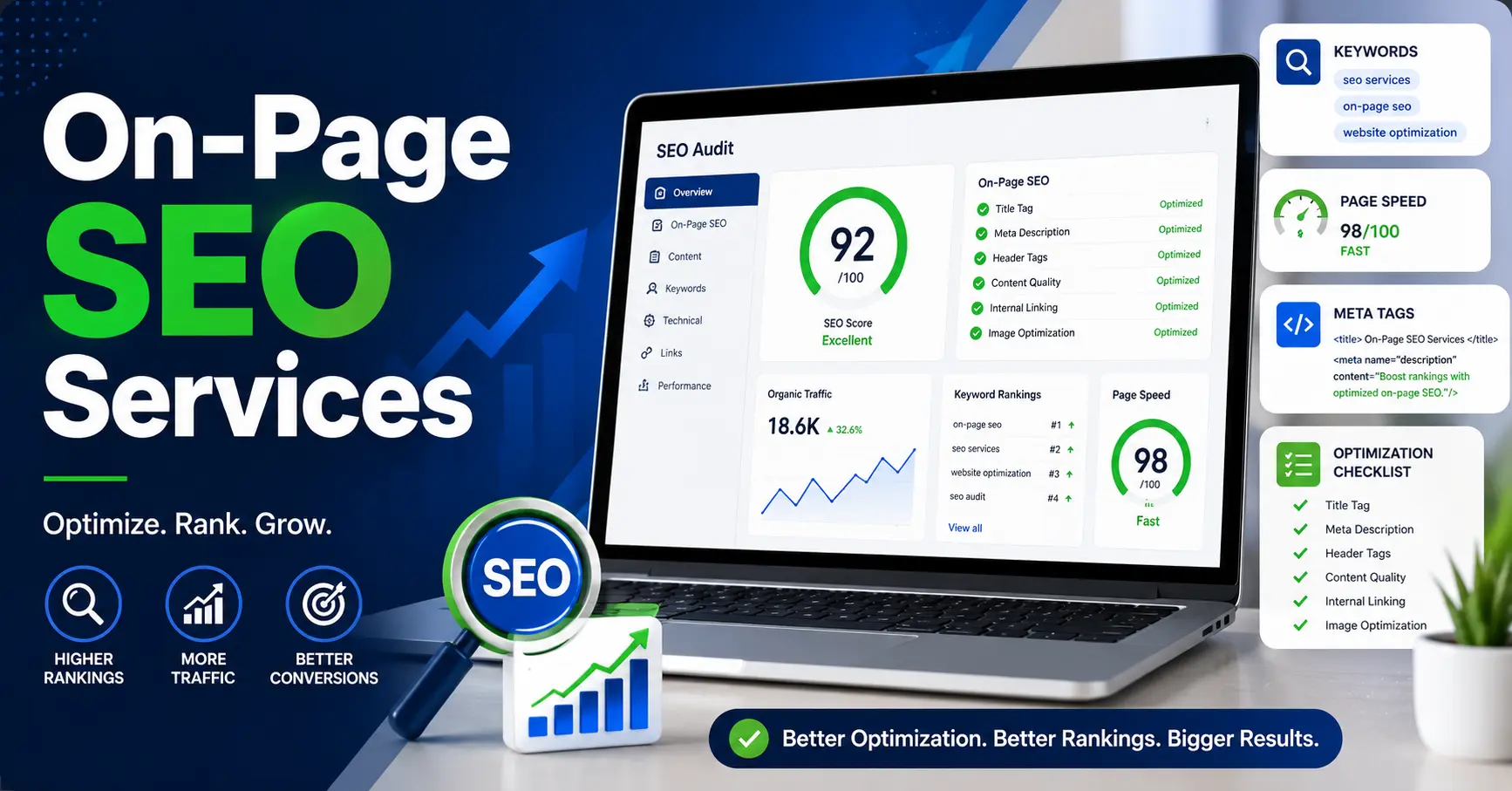
If your website is not showing up on the first page of Google, the problem is almost always the same: your pages are not optimized. On-page SEO services fix that. They align your content, structure, and technical signals so search engines understand exactly what your pages are about and rank them accordingly.
This guide explains everything you need to know about on-page SEO services, from what they include and why they matter, to what good looks like and how to choose a provider that delivers real results.
What Are On-Page SEO Services?
On-page SEO refers to all the optimization work done directly on your website pages to improve their visibility in search engine results. Unlike off-page SEO, which focuses on backlinks and external signals, on-page SEO is entirely within your control.
On-page SEO services are provided by SEO specialists or agencies who audit your existing pages, identify what is stopping them from ranking, and then implement targeted changes to fix those issues. These changes can be as straightforward as rewriting a title tag, or as involved as restructuring an entire page around a new keyword strategy.
Key insight: Google’s ranking algorithms analyze over 200 signals on every page. On-page SEO ensures the most important of those signals are correctly optimized before Google ever crawls your site.
Why On-Page SEO Is the Foundation of Every Ranking Strategy
Many businesses jump straight to link building or paid ads while ignoring their own pages. This is a costly mistake. You cannot build a strong SEO foundation on poorly optimized content, just as you cannot build a stable house on a weak foundation.
Here is what strong on-page SEO delivers:
- Higher rankings for your target keywords
- More organic traffic without increasing your ad spend
- Better user experience that keeps visitors on your site longer
- Improved conversion rates because pages are clearer and more relevant
- Faster indexing because Google can crawl and understand your pages easily
- Long-term ranking stability compared to tactics that rely on loopholes
Most competitor pages ranking today have one thing in common: every element on the page, from the URL to the last paragraph, has been intentionally optimized. On-page SEO services give your pages the same advantage.
What Is Included in Professional On-Page SEO Services?
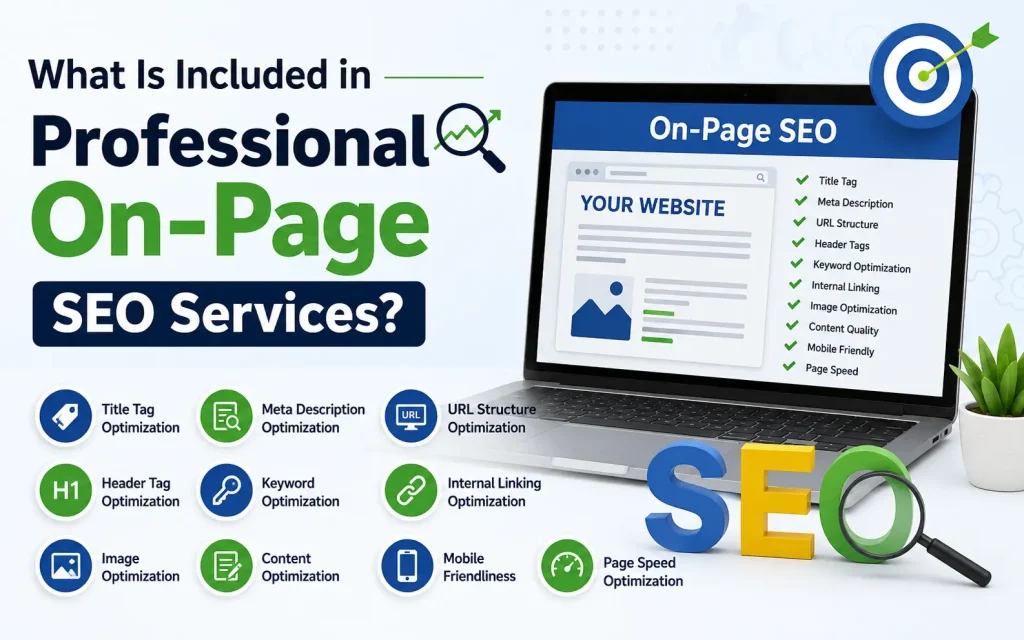
A comprehensive on-page SEO service covers multiple layers of optimization. Here is a detailed breakdown of what should be included:
1. Keyword Research and Search Intent Analysis
Effective on-page SEO starts with understanding what your target audience is actually searching for. This goes far beyond finding high-volume keywords. It involves analyzing search intent, which means understanding whether a user wants information, wants to compare options, or is ready to buy.
- Primary keyword identification for each page
- Long-tail keyword mapping to capture specific queries
- Search intent classification (informational, navigational, commercial, transactional)
- Competitor keyword gap analysis
- Keyword cannibalization detection and resolution
2. Title Tag Optimization
The title tag is one of the most powerful on-page SEO elements. It tells both Google and users what the page is about. A well-written title tag includes the primary keyword, stays within 60 characters, and gives users a compelling reason to click.
- Primary keyword placed naturally near the front
- Clear value proposition or benefit included
- Brand name added where appropriate
- Every page given a unique title (no duplicates across the site)
3. Meta Description Optimization
Meta descriptions do not directly affect rankings, but they heavily influence your click-through rate. A compelling meta description acts as a free advertisement in the search results. When users click more, Google interprets your page as more relevant and can reward it with higher rankings over time.
4. Header Tag Structure (H1, H2, H3)
Proper use of header tags creates a clear content hierarchy that helps both users and search engines navigate the page. Every page should have one H1 tag containing the primary keyword, supported by H2 subheadings that cover related topics, and H3 tags for detailed breakdowns within those sections.
5. Content Optimization and Semantic SEO
Modern on-page SEO goes well beyond keyword placement. Google now uses natural language processing to evaluate whether your content genuinely covers a topic in depth. Semantic SEO means using related terms, synonyms, and topically relevant phrases that signal expertise.
- Content rewritten to match the search intent of target keywords
- Related entities and LSI (Latent Semantic Indexing) keywords included naturally
- Content gaps filled based on what top-ranking competitors cover
- Thin or duplicate content identified and improved
- Readability optimized for the target audience
6. URL Structure Optimization
Clean, descriptive URLs help Google understand page content and improve user trust. A good URL is short, includes the target keyword, and avoids unnecessary parameters, numbers, or generic strings like page IDs.
- URLs shortened and made descriptive
- Target keyword included in the URL slug
- Hyphens used to separate words (not underscores)
- Redirect mapping created when URLs are changed
7. Internal Linking Strategy
Internal links distribute page authority across your site and help search engines discover new content. A strategic internal linking structure ensures your most important pages receive the most internal link equity, helping them rank faster and higher.
- Relevant anchor text used for every internal link
- Orphan pages (pages with no internal links) identified and connected
- Site architecture mapped and improved
- Contextual links added throughout existing content
8. Image Optimization
Unoptimized images slow down your website and miss an important ranking opportunity. Every image on a page should be compressed for fast loading, given a descriptive file name, and include an alt text tag that describes the image using relevant keywords where natural.
- Alt text added to all images
- File names changed from generic codes to descriptive terms
- Images compressed without quality loss using modern formats like WebP
- Lazy loading enabled to improve page speed
9. Page Speed and Core Web Vitals
Google made page experience a ranking factor, which means slow pages lose rankings. Core Web Vitals are the specific metrics Google measures: Largest Contentful Paint (LCP), Interaction to Next Paint (INP), and Cumulative Layout Shift (CLS). On-page SEO services address these by optimizing code, images, and server response times.
- LCP (Largest Contentful Paint) target: under 2.5 seconds
- INP (Interaction to Next Paint) target: under 200 milliseconds
- CLS (Cumulative Layout Shift) target: under 0.1
10. Schema Markup and Structured Data
Schema markup is code added to your pages that helps Google display rich results in search, such as star ratings, FAQ dropdowns, how-to steps, and product prices. Pages with rich results consistently earn higher click-through rates than plain blue links. Most competitor pages skip this completely, which creates an immediate advantage for those who implement it properly.
- FAQ schema for question-and-answer content
- Article schema for blog posts and news
- Product schema for ecommerce pages
- Local Business schema for location-based businesses
- Review and rating schema where applicable
11. Mobile Optimization
Google uses mobile-first indexing, which means it primarily crawls and ranks the mobile version of your website. If your mobile experience is poor, your rankings suffer regardless of how good your desktop site looks. On-page SEO services verify that every page element renders correctly on mobile devices.
12. Canonical Tags and Duplicate Content Resolution
Canonical tags tell Google which version of a page is the original when similar or duplicate content exists across multiple URLs. Without them, Google may split your page authority across duplicates, weakening your ability to rank. Proper canonicalization consolidates that authority onto the correct page.
13. E-E-A-T Signals (Experience, Expertise, Authoritativeness, Trustworthiness)
Google evaluates E-E-A-T to determine whether a page should rank for queries where accuracy and trust matter. This is especially important for health, finance, legal, and any other topics where bad information causes real harm. On-page SEO services improve E-E-A-T by adding author credentials, citing trustworthy sources, displaying reviews, and ensuring content demonstrates genuine expertise.
On-Page SEO vs Technical SEO vs Off-Page SEO: What Is the Difference?
Many people confuse these three pillars of SEO. Here is a clear breakdown:
- On-page SEO covers everything on the page itself: content, keywords, title tags, meta descriptions, internal links, and structured data.
- Technical SEO covers the infrastructure behind your site: crawlability, indexability, site speed, HTTPS, XML sitemaps, and server configurations. It ensures Google can access your pages in the first place.
- Off-page SEO covers signals that come from outside your site: backlinks, brand mentions, social signals, and digital PR.
All three work together. But on-page SEO is where you should always start, because technical and off-page SEO efforts deliver far stronger results when the pages themselves are well optimized.
Common On-Page SEO Mistakes That Kill Rankings
Even well-intentioned SEO efforts can backfire if these common mistakes are present on your site:
- Keyword stuffing: Forcing keywords into content unnaturally, which Google now penalizes as a manipulative tactic.
- Duplicate title tags: Using the same title across multiple pages confuses Google about which page to rank.
- Missing or thin content: Pages with fewer than 300 words rarely rank for competitive keywords because they offer little value to users.
- Ignoring search intent: Optimizing for keywords without matching the type of content users expect leads to high bounce rates and poor rankings.
- Broken internal links: Links pointing to 404 pages waste crawl budget and damage user experience.
- Unoptimized images: Large image files slow page load times, directly hurting both rankings and user experience.
- No structured data: Missing out on rich snippets means lower click-through rates compared to competitors who use schema markup.
- Generic meta descriptions: Copied or auto-generated meta descriptions miss the opportunity to increase clicks from search results.
How to Measure the Success of On-Page SEO Services
Good on-page SEO delivers measurable, trackable results. Here is what to monitor after implementation:
Rankings
Track your target keyword positions weekly using tools like Google Search Console, Ahrefs, or SEMrush. After proper on-page optimization, ranking improvements typically begin showing within four to twelve weeks depending on domain authority and competition level.
Organic Traffic
An increase in organic sessions through Google Analytics directly reflects the impact of on-page SEO. Monitor both total sessions and the pages that are gaining traffic.
Click-Through Rate (CTR)
Optimized title tags and meta descriptions increase the percentage of users who click your result. Monitor CTR per page in Google Search Console. A CTR improvement from 2% to 4% on a page receiving 10,000 impressions doubles your traffic with no additional effort.
Bounce Rate and Dwell Time
Well-optimized pages that match search intent keep users engaged. A falling bounce rate and increasing average session duration tell Google your pages are valuable, which reinforces rankings.
Core Web Vitals Scores
Monitor your LCP, INP, and CLS scores through Google Search Console’s Core Web Vitals report or PageSpeed Insights. Aim to achieve Good status across all three metrics.
Conversions
Ultimately, traffic means nothing without conversions. Track goal completions in Google Analytics to measure whether optimized pages are driving leads, sales, or sign-ups.
What Makes a Great On-Page SEO Service Provider?
Choosing the right provider determines whether you get lasting results or wasted budget. Here is what separates genuine experts from generic agencies:
- They start with a thorough audit before making any changes, not a cookie-cutter checklist.
- They explain their strategy in plain English and set realistic expectations about timelines.
- They optimize for search intent, not just keyword density.
- They implement schema markup and Core Web Vitals improvements, not just basic meta tag updates.
- They provide transparent reporting with actual ranking and traffic data, not just activity reports.
- They have documented case studies showing results for businesses in your industry.
- They stay current with Google algorithm updates and adjust strategies accordingly.
On-Page SEO Services for Different Business Types
On-page SEO is not one-size-fits-all. The strategy varies significantly depending on the type of website and business:
Local Businesses
For businesses targeting customers in a specific city or region, on-page SEO focuses on localizing content with suburb, city, and region-specific keywords, optimizing Google Business Profile signals, and building location pages that target service areas. Local schema markup for business name, address, and phone number is essential.
Ecommerce Stores
Product page optimization is the priority for ecommerce. This includes optimizing product titles, descriptions, and alt text, adding product schema for rich results, improving category page structure, and ensuring faceted navigation does not create duplicate content issues.
Service Businesses
Professional service providers benefit from individual service pages optimized for each specific offering. A law firm should have a separate optimized page for family law, criminal law, and commercial law rather than listing all services on a single page. Each page can then rank independently for its own set of keywords.
B2B and SaaS Companies
B2B on-page SEO focuses on longer buying cycles and more research-driven search behavior. This means optimizing for informational keywords at the top of the funnel, building content clusters around core service topics, and using FAQ schema to capture featured snippets for industry questions.
How Long Does On-Page SEO Take to Show Results?
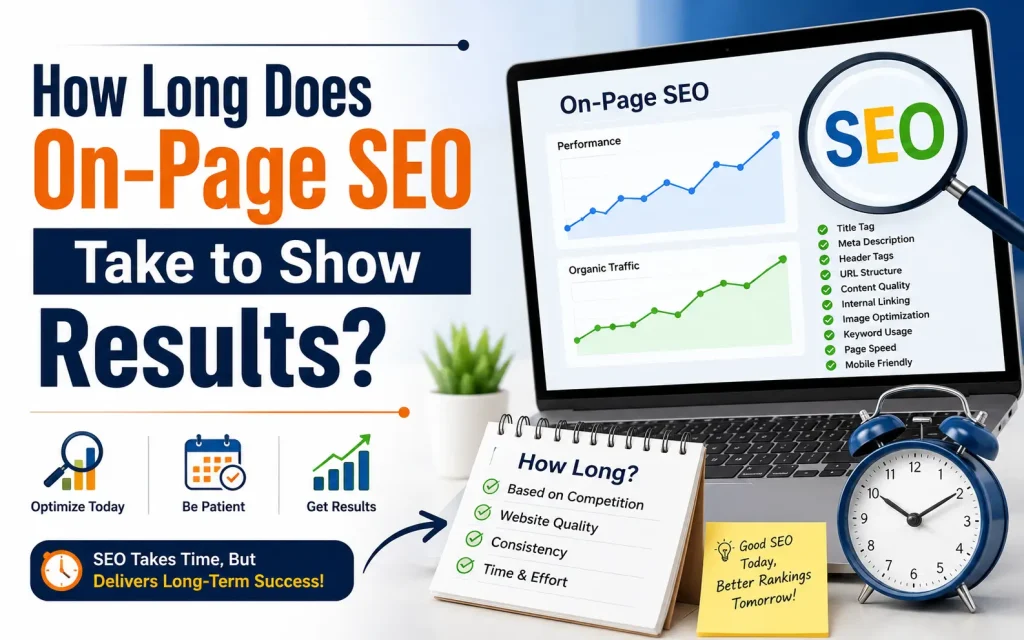
This is one of the most common questions businesses ask, and the honest answer is: it depends. Here are the realistic timelines:
- New websites or pages: Four to six months before significant ranking movement because new pages need time to be crawled, indexed, and evaluated.
- Established pages with existing rankings: Two to eight weeks for improvements to reflect after optimization because Google has already established some trust in the page.
- High-competition keywords: Six to twelve months or longer because competing for terms where authority sites dominate takes time and sustained effort.
- Low-competition keywords: Sometimes as few as two to four weeks because less competition means Google can quickly identify your page as the best result.
On-page SEO is not a one-time task. Google updates its algorithms regularly, competitors continuously improve their pages, and search behavior evolves. Ongoing optimization is what maintains and builds on initial results.
The On-Page SEO Process: Step by Step
Here is the structured process a professional on-page SEO service follows:
- Step 1 – Website Audit: A complete analysis of your current pages to identify all on-page issues affecting rankings.
- Step 2 – Keyword Research: Identifying the right keywords for every page based on search volume, competition, and business relevance.
- Step 3 – Strategy Development: Creating a prioritized optimization plan based on impact and effort.
- Step 4 – Content Optimization: Rewriting or enhancing page content to match search intent and cover topics comprehensively.
- Step 5 – Technical On-Page Fixes: Updating title tags, meta descriptions, header tags, URLs, and structured data.
- Step 6 – Internal Link Audit: Mapping and improving links between pages to distribute authority strategically.
- Step 7 – Page Speed Optimization: Compressing images, minifying code, and resolving Core Web Vitals issues.
- Step 8 – Monitoring and Reporting: Tracking rankings, traffic, and engagement metrics and refining the strategy based on data.
On-Page SEO in 2025 and Beyond: What Has Changed
Google’s approach to evaluating pages continues to evolve. Here is what has changed and what it means for on-page SEO today:
Helpful Content System
Google now runs a site-wide signal that rewards websites producing genuinely useful, people-first content and suppresses sites that produce content primarily for search engines. On-page SEO must now balance keyword optimization with authentic, experience-driven content that actually helps the reader.
AI Overviews in Search Results
Google’s AI Overviews (formerly Search Generative Experience) pull content from well-structured, authoritative pages to answer user queries directly in search results. Pages optimized with clear headings, FAQ schema, and well-structured answers are far more likely to be featured.
INP Replaces FID as a Core Web Vital
In March 2024, Google replaced First Input Delay with Interaction to Next Paint as a Core Web Vital. INP measures the responsiveness of a page throughout the entire user session, not just the first interaction. Websites that have not updated their page speed optimization may now be falling short of the Good threshold.
E-E-A-T More Important Than Ever
The additional E for Experience was added to Google’s quality evaluator guidelines. This means Google increasingly favors content written by people with real, demonstrated experience in a topic, not just theoretical knowledge. Biographies, credentials, first-hand case studies, and real examples all strengthen E-E-A-T signals.
Frequently Asked Questions
What is on-page SEO?
On-page SEO is the process of optimizing individual web pages so they rank higher in search engine results. It covers content quality, keyword usage, title tags, meta descriptions, header structure, URL slugs, internal links, image optimization, page speed, and structured data.
How much do on-page SEO services cost?
Costs vary based on the scope of work, the size of your website, and the provider. A single-page audit and optimization can range from a few hundred dollars to over a thousand. Ongoing monthly on-page SEO services for a full website typically range from $500 to $5,000 per month depending on the agency and the level of work involved.
Is on-page SEO a one-time task?
No. While an initial optimization delivers significant improvements, SEO requires ongoing attention. Google updates its algorithms, competitors improve their pages, and user behavior changes. Regular content updates, fresh keyword analysis, and periodic technical audits keep your pages competitive.
Can I do on-page SEO myself?
Yes, basic on-page SEO can be done without an agency using tools like Google Search Console, Yoast SEO, or Surfer SEO. However, competitive industries require deep expertise in content strategy, structured data, and technical implementation. For meaningful results in a competitive market, professional services offer the fastest and most reliable path.
How is on-page SEO different from technical SEO?
On-page SEO focuses on the content and visible elements of a page, such as keywords, headings, and internal links. Technical SEO focuses on the behind-the-scenes infrastructure, such as crawlability, site speed, HTTPS, and XML sitemaps. Both are essential to a complete SEO strategy.
How do I know if my on-page SEO is working?
Monitor your keyword rankings weekly in Google Search Console or an SEO tool. Track organic traffic growth in Google Analytics. Watch for improvements in click-through rate, bounce rate, and goal completions. Results typically begin appearing within four to twelve weeks for established pages.
Final Thoughts
On-page SEO services are not a luxury for large corporations. They are the most direct and controllable way to improve your Google rankings, drive qualified organic traffic, and convert more visitors into customers. Every page on your website is either working for you or against you in search results. The right on-page SEO strategy ensures every page works as hard as possible.
Whether you are a local business trying to outrank nearby competitors, an ecommerce store targeting product keywords, or a service provider building authority in your niche, on-page SEO is where sustainable ranking growth begins.
You May Also Like It:
