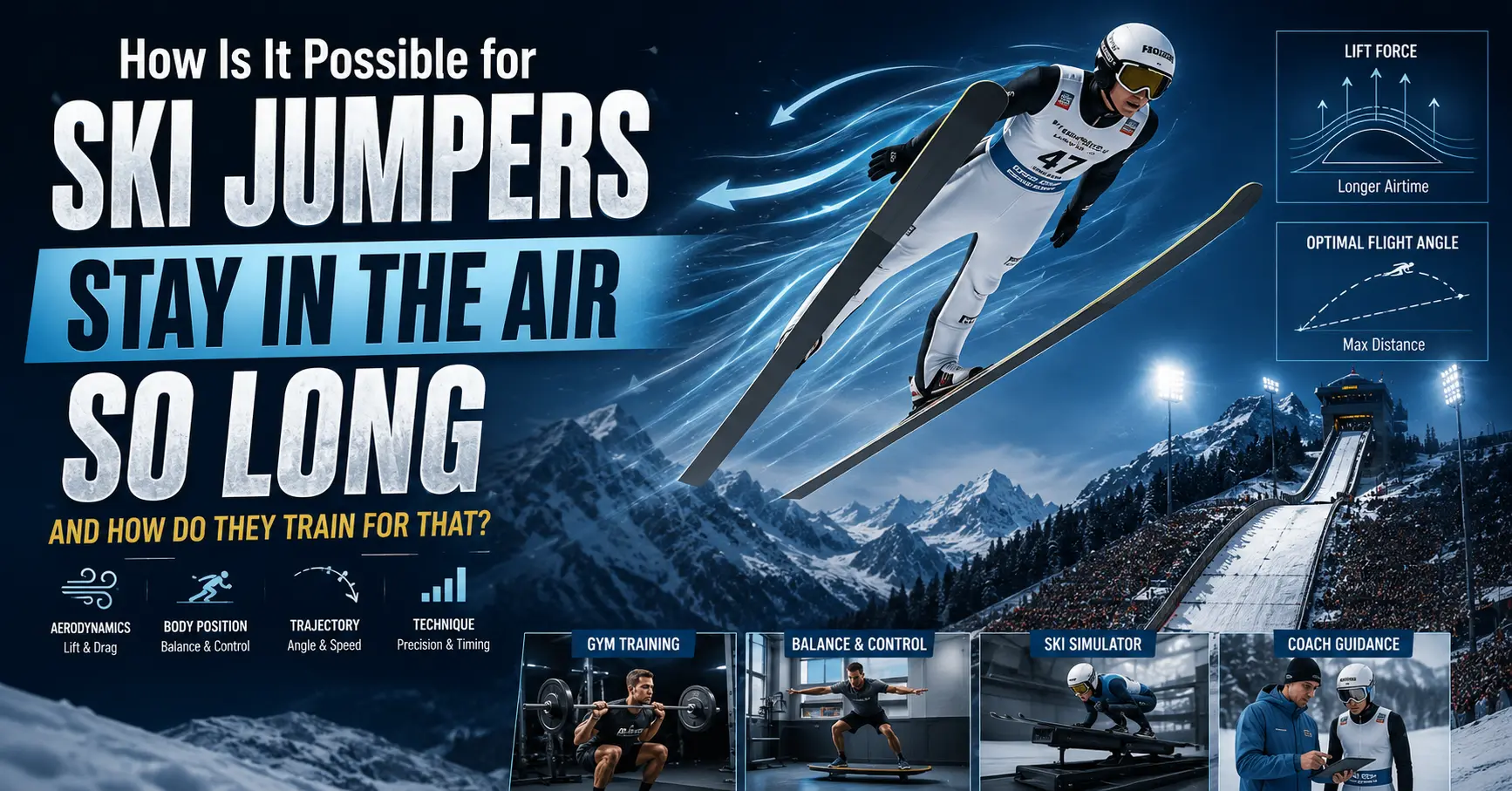

Watching a ski jumper launch off a ramp and glide through the air for several seconds feels almost unreal. They seem to float. They seem to fly. But this is not magic. It is physics, body mechanics, and years of disciplined training working together in perfect harmony.
How Is It Possible for Ski Jumpers to Stay in the Air So Long?
The best ski jumpers in the world can travel over 100 meters through the air. That is roughly the length of an American football field. And they stay airborne for approximately four to five seconds, sometimes longer on the biggest hills.
So what is actually happening? Why do they not simply fall like any other object would? And how do athletes train their bodies and minds to perform at that level?
This guide answers all of those questions clearly, with the science and the step-by-step training methods that most sources never fully explain.
What Is Ski Jumping? A Quick Overview for New Readers
Ski jumping is a winter sport in which an athlete glides down a steep in-run ramp, launches off the takeoff point, and attempts to fly as far as possible before landing on the slope below.
The competition is judged on two things: the distance of the jump and the style points awarded by judges based on body position during flight and the quality of the landing. There are different hill sizes in the sport:
- Normal Hill (90 meters): used in the Olympic Games and World Championships
- Large Hill (120 meters): the main Olympic event
- Ski Flying Hills (200+ meters): the biggest hills in the world, where athletes can fly over 250 meters
The Core Question: Why Do Ski Jumpers Stay in the Air So Long?
The simple answer is this: ski jumpers generate aerodynamic lift that partially counteracts gravity. The longer answer involves several forces working at the same time.
When you or I fall off a ledge, gravity pulls us straight down. We have no way to generate lift. A ski jumper, on the other hand, enters the air at high speed with their body and skis positioned like a wing. That positioning creates the same basic principle that keeps an airplane in the sky.
The Four Forces Acting on a Ski Jumper in Flight
Every object moving through air is affected by four key forces. In ski jumping, these forces interact in a very specific way:
- Gravity: This always pulls the jumper downward. It never stops.
- Lift: This is the upward force generated by air flowing over and under the jumper’s body and skis. It opposes gravity and keeps the jumper airborne longer.
- Drag: This is the air resistance that slows the jumper down horizontally. In ski jumping, some drag is useful because it also pushes the jumper backward and slightly upward, extending the flight time.
- Thrust: Unlike a plane, a ski jumper has no engine. Their initial speed from the ramp is their only source of forward momentum.
The goal in ski jumping is to maximize lift, manage drag intelligently, and convert as much of the ramp speed as possible into horizontal and vertical flight distance.
The Science of Aerodynamic Lift in Ski Jumping
Lift is the most important concept to understand. It is the reason ski jumpers can travel so far through the air instead of simply arcing downward like a stone.
How Lift Is Generated
Lift is produced when air flows faster over one surface than another, creating a pressure difference. In ski jumping, the jumper’s body and skis together act like an airfoil, which is the same shape principle used in airplane wings.
As the jumper flies through the air, air must travel over the top surface of their body and skis. Because of the curved angle of their position, the air on top has a longer path to travel than the air below. This causes the air on top to move faster, which lowers its pressure. The higher pressure air underneath then pushes upward. That upward push is lift.
The V-Style: The Invention That Changed Everything
Before the late 1980s, ski jumpers kept their skis parallel and pointed straight forward during the flight. This was considered correct form for decades. Then, in 1985, a Swedish athlete named Jan Boklov began experimenting with spreading his ski tips outward in a V-shape.
The results were dramatic. The V-style increased the surface area presented to the oncoming air, which significantly boosted aerodynamic lift. Jumpers using the V-style were staying in the air longer and landing much further down the hill than those using the parallel style. By the early 1990s, nearly every competitive ski jumper in the world had adopted the V-style. It remains the standard technique today
Key Fact
The V-style increased jump distances by roughly 10 to 20 percent compared to the old parallel style. It remains one of the biggest technical revolutions in winter sports history.
Body Position and Its Effect on Lift
The jumper’s body angle is just as important as the skis. During flight, an elite ski jumper leans their torso forward and positions their body nearly parallel to their skis, creating one long, flat aerodynamic surface from head to ski tips.
This position achieves two things at once: it increases the total surface area catching air, and it reduces the frontal area that creates unwanted drag. Think of it as making the body as flat and wide as possible, rather than tall and blocky.
If a jumper sits up too much, they present a larger area to the wind from the front, which creates excessive drag and slows them down quickly. If they lean too far forward, they lose balance and the aerodynamic advantage disappears.
The Four Phases of a Ski Jump: From Top to Bottom
A ski jump is not a single movement. It is a sequence of four carefully controlled phases, each one setting up the next.
Phase 1: The In-Run
The athlete starts at the top of the ramp in a tightly crouched position. The goal here is to build maximum speed while minimizing air resistance. Jumpers crouch low with their arms held close to their bodies, their shins angled forward, and their upper body nearly parallel to the slope.
The in-run takes approximately three to four seconds on a standard large hill. By the time the athlete reaches the takeoff point, they are traveling at speeds between 85 and 95 kilometers per hour, roughly 55 to 60 miles per hour.
The quality of the in-run directly determines the quality of everything that follows. A balanced, relaxed in-run with good shin angle gives the jumper the ideal foundation for a powerful takeoff.
Phase 2: The Takeoff
This is the most technically demanding moment in the entire jump. It lasts less than one second.
At the exact moment the skis reach the edge of the ramp, the athlete must explosively extend their body upward and forward. The goal is to increase their center of gravity as high as possible without creating excessive air resistance that would slow them down.
Timing is everything here. If the jumper extends too early, the ski tips angle upward and the jump becomes unstable. If they extend too late, the skis point downward and the jumper loses lift immediately.
Elite jumpers complete this explosive extension in roughly 0.3 seconds. Every millisecond matters.
Phase 3: The Flight
Once airborne, the athlete immediately moves into the V-style position with their ski tips spread wide and their body leaning forward over the skis. The arms are typically held close to the sides or slightly behind the body to reduce drag.
During a typical large hill jump, the athlete is in the air for four to five seconds. On ski flying hills, this can extend to seven seconds or more. Importantly, the athlete is rarely more than 10 to 15 feet above the surface of the landing slope at any point. The slope itself drops away steeply beneath them, which is why the flight appears to last so long.
Throughout the flight, the jumper makes constant micro-adjustments with their hips, arms, and body angle to maintain the optimal aerodynamic position. This requires extraordinary body awareness and core strength.
Phase 4: The Landing
A good landing is essential for both safety and style points. The standard landing position is called the Telemark position, named after a traditional Norwegian skiing technique. In this position, the jumper places one foot forward and one foot back, with knees bent to absorb the impact.
The Telemark position earns maximum style points from judges. A two-footed landing or a fall results in point deductions.
One interesting physics phenomenon during landing is called the ground effect. As the jumper approaches the slope, the air between their body and the ground becomes compressed, creating an additional cushion of lift that briefly slows their descent. This makes the landing softer than it would otherwise be.
After landing, the athlete must maintain balance and ski through the outrun without touching the snow with their hands or body.
Why Body Weight and Size Matter in Ski Jumping

This is one aspect that most general articles on ski jumping do not address adequately, but it is critically important to understanding the sport.
In ski jumping, lighter athletes have a significant aerodynamic advantage. The lift generated by the body and skis is roughly the same regardless of how much the jumper weighs. However, the force of gravity pulling the jumper down is directly proportional to their weight. A lighter jumper experiences less gravitational force pulling them down, which means the same amount of lift keeps them airborne longer.
This relationship has historically created serious problems in the sport. For decades, many ski jumpers severely restricted their food intake to reduce their weight and gain aerodynamic advantage. The consequences on athlete health were severe.
In response, the International Ski Federation introduced a Body Mass Index based rule in 2004. Under this rule, the length of the skis an athlete is permitted to use is linked to their BMI. Athletes who are underweight are assigned shorter skis, which reduces their lift and effectively negates their weight advantage. This rule has largely addressed the problem, though body weight management remains a discussed topic in the sport.
Important Note
The ski length rule introduced by the International Ski Federation in 2004 was a landmark moment for athlete health in winter sports. It directly tied competitive equipment to body weight, discouraging dangerous underweight practices.
The Equipment: How Gear Shapes the Jump
The equipment in ski jumping is highly specialized and plays a major role in performance. It is not the same as recreational skiing equipment.
The Skis
Ski jumping skis are among the most distinctive pieces of equipment in any winter sport. They are very long, typically one and a half times the height of the athlete, which for most jumpers means skis between 240 and 270 centimeters in length. They are also very wide at approximately 10 centimeters, which helps them function as lift-generating surfaces during flight.
The skis are made from layers of fiberglass and other composite materials that give them a specific flex pattern. The tips curve upward naturally, which helps maintain the V-position during flight without requiring the athlete to actively hold the skis up.
The Suit
The competition suit worn by ski jumpers is designed specifically for aerodynamic performance. The suit is made from a porous fabric that traps a thin layer of air against the athlete’s body, which helps maintain consistent aerodynamic properties during the jump.
The International Ski Federation strictly regulates suit thickness, porosity, and design to prevent teams from gaining unfair advantages through suit technology. Suits are checked by officials at every major competition.
Boots and Bindings
Ski jumping boots are forward-leaning, similar to alpine ski boots but designed to allow the foot to flex forward significantly. This forward lean is what allows jumpers to achieve the aggressive body angle during the in-run and the flat body position during flight.
The bindings attach the boot to the ski at the toe only, with a cord attached to the back of the boot that connects to the rear of the ski. This cord controls how far forward the athlete can lean, and the tension of the cord is adjusted precisely for each individual athlete.
How Do Ski Jumpers Train? A Complete Breakdown
Training for ski jumping is far more complex than most people realize. It is not simply about practicing jumps. Elite ski jumpers spend the majority of their training time away from snow, building the physical and technical foundation that makes every jump possible.
Year-Round Training Structure
Professional ski jumpers train throughout the entire year. The season is divided into an on-snow competition period in winter and an extensive off-season training phase in spring, summer, and autumn.
The off-season is when the real foundational work happens. Athletes focus on building strength, explosive power, body awareness, and aerodynamic technique. Many facilities feature special plastic-covered summer jumping hills that allow athletes to practice takeoffs and flight positions without snow.
Physical Conditioning: What the Body Needs
Ski jumping requires a very specific physical profile. Athletes need to be lean, powerful, and have exceptional body control. The physical training reflects these demands:
- Explosive Leg Strength: The takeoff requires the athlete to generate maximum upward force in approximately 0.3 seconds. This demands extraordinary explosive power in the legs, particularly in the quadriceps, hamstrings, and calves. Training includes heavy squats, jump squats, plyometric exercises, and loaded power cleans.
- Core Stability: During flight, the athlete must hold a demanding body position against the force of the wind for four to five seconds. Without a strong core, the position collapses and lift is lost. Training includes planks, cable exercises, rotational core work, and Swiss ball exercises.
- Balance and Proprioception: Ski jumping requires precise body awareness in three dimensions. Athletes train their balance systems using balance boards, single-leg exercises, stability training, and gymnastics-based drills.
- Flexibility: The forward lean position during the in-run and flight requires significant flexibility in the hips, ankles, and lower back. Stretching and mobility work are daily requirements.
- Cardiovascular Fitness: While a ski jump itself lasts only seconds, overall cardiovascular fitness supports recovery, concentration, and the ability to train at high volume. Running, cycling, and cross-country skiing feature in most training programs.
Wind Tunnel Training
This is one of the most fascinating and least-discussed aspects of ski jumping training. Elite national teams, particularly those from Austria, Germany, Norway, and Japan, use wind tunnels to perfect aerodynamic positioning without the risk and cost of repeated actual jumps.
In a wind tunnel, the athlete lies in the air stream generated by a powerful fan system and practices maintaining the correct body position. Coaches can observe the athlete from multiple angles and provide immediate feedback. High-speed cameras record the session so the athlete can review their position in detail.
Wind tunnel sessions allow athletes to train their muscles to hold the correct aerodynamic position until it becomes automatic. When they transfer this to a real jump, the correct position feels natural rather than effortful.
Trampoline and Gymnastics Training
Trampolining is a core part of ski jump training that many people do not know about. By working on a trampoline, athletes develop the body awareness and spatial orientation needed to control their position during flight.
In the air, a ski jumper cannot rely on visual cues from the ground the way we normally do when we move our bodies. The slope is rushing past below them, the wind is pushing against them, and everything happens very fast. Trampoline training develops the proprioceptive sense, the body’s ability to know where it is in space without seeing it, which is essential for maintaining correct flight position.
Dry-Land Jump Training on Summer Hills
During the summer months, most countries with serious ski jumping programs have hills covered with a ceramic or plastic surface that mimics the friction of snow. Athletes practice full jumps on these surfaces, using water sprayed onto the landing area to simulate snow conditions.
This allows athletes to accumulate hundreds of training jumps during the off-season, maintaining and developing their technique without waiting for winter. The aerodynamic environment is identical to a real snow jump, so all the technical skills transfer directly.
Mental Training and Visualization
This is an area that separates good ski jumpers from elite ones, and it is almost entirely absent from competitor articles on this topic.
A ski jump happens extremely fast. The entire event from the start of the in-run to the landing takes less than ten seconds. There is no time to consciously think through each technical element during the jump itself. By the time a thought forms in the athlete’s mind, the moment it was relevant has already passed.
Elite athletes train their mental approach as seriously as their physical preparation. Key methods include:
- Visualization: Athletes practice mentally rehearsing the perfect jump in vivid detail, from the starting position through every phase to the landing. This neural rehearsal trains the brain’s motor pathways the same way physical practice does.
- Routine and focus cues: Jumpers develop pre-jump routines that bring their mind to the right state of alertness and calm before pushing off. These routines are practiced until they become automatic triggers for optimal performance.
- Process goals: Rather than focusing on distance, elite jumpers focus on executing specific technical elements correctly. Distance becomes a byproduct of good technique rather than a target in itself.
- Pressure management: Competing in front of crowds at the Olympics or World Championships creates enormous psychological pressure. Athletes work with sports psychologists to develop strategies for managing anxiety and maintaining focus.
How Do Beginner Ski Jumpers Learn to Jump?
One of the most reassuring things about ski jumping as a sport is that it is designed with progressive safety as its foundation. No child or beginner is put on a large hill from the start. The learning process is carefully structured.
The Progression System
Beginners start on very small hills, sometimes just 5 to 10 meters in size, using standard alpine skis they are already comfortable on. At this stage, the goal is simply to experience the sensation of becoming briefly airborne while maintaining balance.
As the athlete develops comfort and basic technique, they progress to slightly larger hills with specialist ski jumping equipment. Each progression only happens when the athlete and coach agree the foundational skills are solid enough for the next level.
This patient progression system means that by the time an athlete is jumping on hills large enough to be genuinely challenging, they have deeply practiced every required skill in a safer environment. The largest competitive hills are reached only after years of development.
Coaching and Feedback
Coaches use video analysis extensively at every level of the sport. Every jump is recorded from multiple angles, and athletes review the footage immediately after each session. This immediate visual feedback allows athletes to connect the physical sensation of a movement with its visual result, accelerating the learning process significantly.
Many coaches also use slow-motion and frame-by-frame analysis to identify subtle technical issues that are invisible to the naked eye in real time.
Weather, Wind, and Its Effect on Ski Jumpers
Wind is one of the most significant variables in competitive ski jumping, and it is something most articles do not address in adequate detail.
A headwind, meaning wind blowing toward the jumper as they fly, provides additional lift and can significantly extend the distance of a jump. A tailwind, blowing from behind the jumper, reduces the relative speed of air over their body and decreases lift, shortening the jump.
Because of this, competitions use a wind compensation system. Officials monitor wind speed and direction throughout the competition. If conditions change significantly between athletes, judges apply a mathematical compensation factor that adjusts scores to account for favorable or unfavorable wind conditions. This makes it fairer when athletes jump in different conditions.
Temperature also affects air density. Cold air is denser than warm air, which means there is more air available to generate lift on cold days. This is one reason ski jumping performs best in cold, calm conditions.
Common Misconceptions About Ski Jumping
Many people watching ski jumping for the first time hold mistaken beliefs about what they are seeing. It is worth addressing these directly.
- Misconception 1 – Jumpers fly high above the ground: In reality, ski jumpers rarely travel more than 10 to 15 feet above the surface of the landing slope. The reason they appear so high is that the slope drops sharply beneath them, creating the visual impression of great height.
- Misconception 2 – The biggest jumpers fly furthest: As explained earlier, lighter athletes have a lift-to-weight advantage. Physical size does not help in ski jumping the way it might in other sports.
- Misconception 3 – Landings are extremely hard: Because the slope angles downward at roughly the same angle as the jumper’s arc through the air, the relative speed of impact is much lower than it appears. This, combined with the ground effect, makes landings gentler than expected.
- Misconception 4 – It is extremely dangerous: Ski jumping is designed with safety as a priority. Equipment, hill design, and the progressive training system all work together to minimize risk. At the recreational and junior level, it is considered a safe sport when practiced under proper coaching.
World Records and the Limits of Human Flight in Ski Jumping

The official world record in ski flying, the largest hill format in the sport, stands at 253.5 meters, set by Stefan Kraft of Austria in Vikersund, Norway in 2017. This is over 830 feet of airborne travel.
Scientists who study the biomechanics of ski jumping believe that the theoretical maximum, based on current equipment and the physics of human flight, is somewhere around 260 to 270 meters. Athletes are approaching the edge of what the human body and current equipment can achieve.
Improvements in future records will likely come from advances in equipment technology, marginal gains in aerodynamic positioning, and the continued development of athletes who combine ideal physical profiles with exceptional technical mastery.
Scoring in Ski Jumping: How Distance and Style Both Count
Many casual viewers believe ski jumping is purely about distance. In reality, the scoring system balances two elements.
Distance Points
Each hill has a designated K-point, which is the target distance for a standard jump. Jumpers receive a set number of base points for landing exactly at the K-point. For every meter beyond the K-point, points are added. For every meter short of it, points are deducted. The exact point values per meter vary depending on the hill size.
Style Points
Five judges, each from a different nation, independently assess the style of each jump. They evaluate the flight position, the stability and control during the flight, and the quality of the landing, specifically whether the jumper lands in the Telemark position.
Each judge awards up to 20 style points. The highest and lowest scores are discarded, and the remaining three are added together for a maximum of 60 style points. Combined with distance points, this gives the final score for each jump.
Frequently Asked Questions
How fast do ski jumpers travel when they leave the ramp?
On a standard large hill, athletes leave the takeoff at approximately 85 to 95 kilometers per hour, which is roughly 55 to 60 miles per hour. On ski flying hills, this can be slightly higher.
How long are ski jumpers actually in the air?
On a normal or large hill, approximately four to five seconds. On ski flying hills, the flight can last six to seven seconds or longer, depending on conditions.
What age do most ski jumpers start training?
Many elite ski jumpers begin training between the ages of seven and twelve, starting on very small hills and progressing gradually. However, athletes who start slightly later can still reach competitive levels if they are talented and dedicated.
Can women compete in ski jumping at the Olympics?
Yes. Women’s ski jumping was added to the Olympic program at the 2014 Sochi Winter Olympics. Women now compete in individual normal hill and large hill events, as well as team events.
Is ski jumping only a winter sport?
Professional ski jumping has become effectively a year-round sport at the elite level. Plastic and ceramic hill surfaces allow athletes to train and compete during summer and autumn. The formal World Cup competition season runs from November through March on snow.
Conclusion
Ski jumping is one of the most extraordinary athletic disciplines in the world. The ability of a human being to launch off a ramp at nearly 100 kilometers per hour, arrange their body into an aerodynamic position, and glide through the air for distances that would have seemed impossible a century ago is a testament to what disciplined training and applied science can achieve.
The key factors that allow ski jumpers to stay in the air so long are the aerodynamic lift generated by the V-style body position, the intelligent management of drag, the explosive and perfectly timed takeoff, and the skill to maintain optimal positioning throughout the flight.
The training that produces this ability is equally impressive: years of progressive skill development, explosive strength training, wind tunnel sessions, trampoline work, mental rehearsal, and video analysis. Nothing is left to chance.
Whether you are a curious fan, a student of physics, a young athlete considering taking up the sport, or simply someone amazed by what you saw at the Winter Olympics, the answer to the question is the same: ski jumpers stay in the air so long because they have mastered the science of human flight, one jump at a time.
You May Also Like It:
How to Draw a River Easy Step by Step Guide
How to Start a Blog Step by Step Beginner Guide 2026 Easy Tutorial