
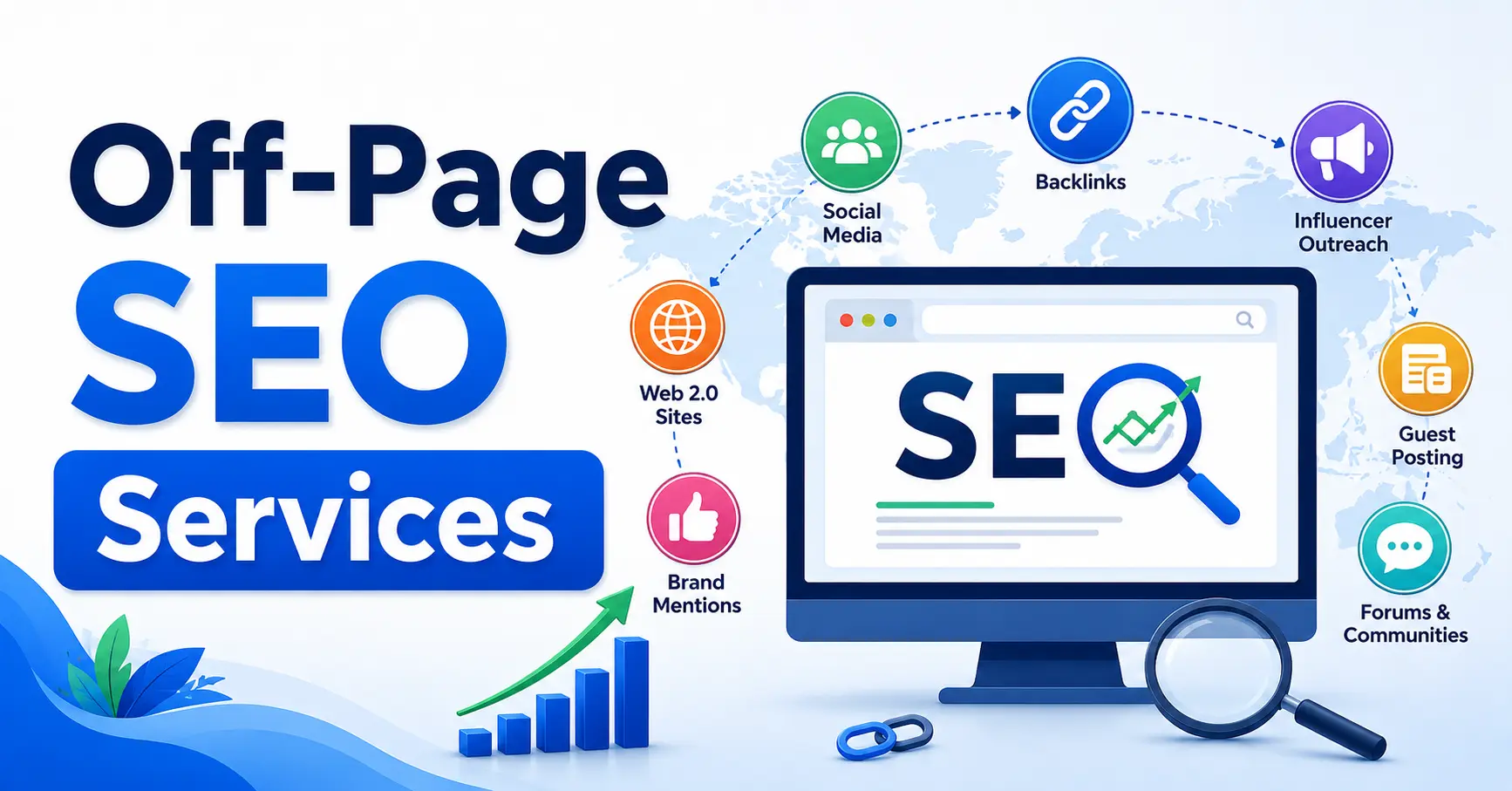
Off-Page SEO Services most websites publish good content and still struggle to rank. The reason is almost always the same: they are not investing in off-page SEO services. Search engines do not just read your website. They read the entire internet and ask one simple question: what does the rest of the web say about you?
Off-page SEO is your answer to that question. It is the collection of strategies you use outside your own website to build authority, earn trust, and signal to Google that your content deserves to rank at the top.
This guide walks you through everything you need to know about off-page SEO services in 2025. Whether you are a business owner exploring your options or a marketer looking to deepen your knowledge, this is your practical starting point.
What Are Off-Page SEO Services
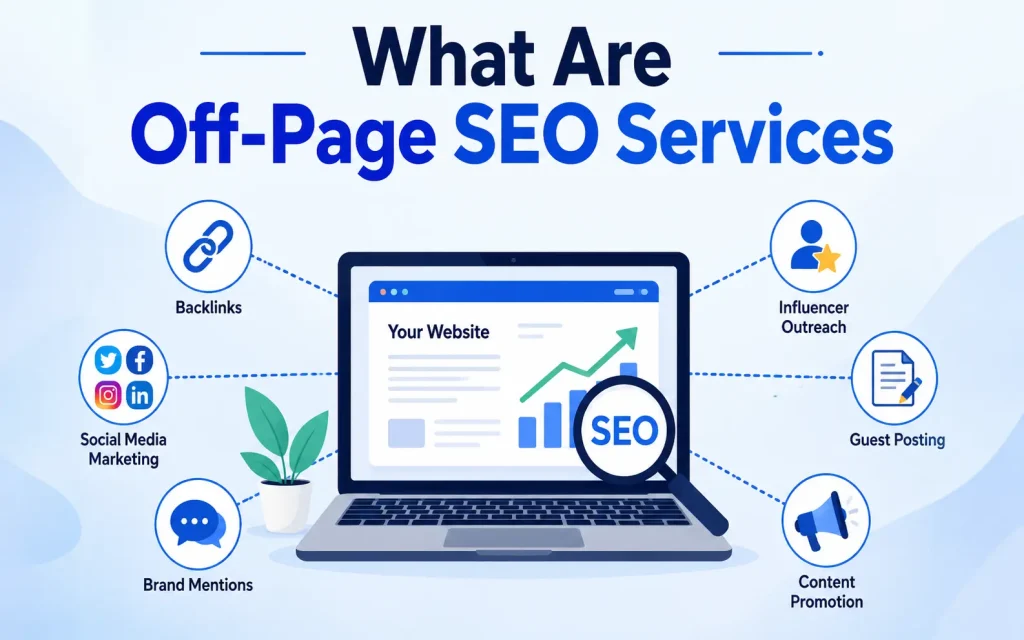
Off-page SEO services cover all optimization activities that happen outside your website. While on-page SEO focuses on your content, headings, and internal links, off-page SEO is about your reputation across the internet.
Think of it this way. Your website is a politician running for office. On-page SEO is your campaign speech. Off-page SEO is every newspaper endorsement, peer recommendation, and public mention you receive. Google counts those endorsements as votes, and the candidate with the most credible votes wins the top ranking.
Off-page SEO services typically include:
- High-quality backlink acquisition from authoritative websites
- Digital PR and media outreach for brand mentions
- Guest posting and content placement on industry-relevant sites
- Local citation building for businesses targeting regional audiences
- Social media brand signal development
- Forum and community participation
- Influencer and podcast collaborations
- Unlinked brand mention monitoring and conversion
Why Off-Page SEO Services Matter in 2025
Google’s algorithms have become significantly more sophisticated. In 2025, simply having well-written content is not enough to earn top rankings in competitive niches. You need external validation.
| Signal | Impact on Rankings | Priority Level |
|---|---|---|
| High-authority backlinks | Direct ranking boost from domain authority transfer | Critical |
| Brand mentions (linked and unlinked) | Builds entity recognition in Google Knowledge Graph | High |
| Digital PR placements | Earns links from news and editorial sites Google trusts most | High |
| Local citations | Increases visibility for location-based searches | Medium-High |
| Social signals | Indirect boost through traffic and brand awareness | Medium |
| Review signals | Improves E-E-A-T trust score for local and niche markets | Medium |
Google evaluates websites using its E-E-A-T framework: Experience, Expertise, Authority, and Trustworthiness. Off-page SEO is the primary mechanism through which you demonstrate authority and trustworthiness to search engines, because those signals must come from third parties, not from your own website.
Core Off-Page SEO Services Explained
1. Link Building and Backlink Acquisition
Backlinks remain the single strongest off-page ranking signal in Google’s algorithm. A backlink is a link from another website pointing to yours. When a credible site links to you, it passes what SEOs call link equity, boosting your domain’s authority in the eyes of search engines.
Not all backlinks are equal. One link from a respected publication in your industry carries more weight than hundreds of links from unrelated or low-quality sites. Quality always outweighs quantity.
Ethical link building methods that work in 2025 include:
- Editorial link building through original research, data studies, and expert commentary
- Guest posting on relevant high-authority industry blogs
- Broken link building by identifying dead links on niche sites and suggesting your content as a replacement
- Resource page outreach where sites list helpful tools and articles
- Niche edits which place your link within existing published content
What to avoid: private blog networks, link farms, paid links that violate Google’s guidelines, and any scheme that prioritizes quantity over quality. These tactics result in manual penalties that can wipe out your search visibility overnight.
2. Digital PR and Media Outreach
Digital PR is one of the fastest-growing and most effective off-page SEO strategies available in 2025. According to recent surveys of SEO professionals, digital PR was ranked the most effective link-building tactic, with nearly half of practitioners naming it their top choice.
Digital PR works by pitching compelling stories, expert quotes, original data, and newsworthy angles to journalists and editors at high-authority publications. When a journalist at Forbes, Business Insider, or TechCrunch writes about your company or quotes your expert, your brand earns both a valuable backlink and lasting credibility.
Tactics within digital PR include:
- Journalist outreach using services like HARO and Qwoted to provide expert commentary
- Original research reports and industry surveys that news outlets cite
- Thought leadership content published in trade and niche publications
- Press release distribution tied to genuine business news
- Reactive PR responding to trending news with expert insight
3. Guest Posting Services
Guest posting means contributing an original article to another website in your industry. In return, you earn a backlink and introduce your brand to a new audience. When done correctly, guest posting is one of the most reliable ways to build domain authority.
The key is relevance and quality. Publishing a well-researched article on a respected industry site is valuable. Publishing low-quality content on irrelevant sites for the sole purpose of getting a link will trigger spam signals and hurt your rankings.
A strong guest posting strategy focuses on:
- Sites with genuine traffic and engaged audiences
- Topics that align naturally with the host site’s editorial focus
- Original insights rather than recycled generic content
- Natural anchor text that does not over-optimize for target keywords
4. Local Citation Building
For businesses that serve a specific geographic area, local citations are essential. A citation is any online mention of your business name, address, and phone number, commonly called NAP data.
Search engines use citations to verify that your business exists, operates at a real address, and serves a legitimate market. Consistent NAP data across directories like Google Business Profile, Yelp, Bing Places, and industry-specific directories signals trustworthiness to local search algorithms.
Citation building services handle:
- Initial submission to high-authority national and niche directories
- Citation cleanup to fix inconsistent or outdated business information
- Monitoring and maintenance to keep listings accurate over time
- Industry-specific directory placement for maximum local relevance
5. Brand Mention Monitoring and Unlinked Mention Conversion
Every time someone mentions your brand online without linking to your website, it is a missed opportunity. Unlinked brand mentions still provide a small authority signal, but converting them into actual backlinks multiplies their value significantly.
Google recognizes brand mentions as implied links and uses them to build a more complete picture of your entity and its relevance in a topic area. Tools like Ahrefs, Semrush, and Brand24 allow you to monitor these mentions in real time so you can reach out to the authors and request a link.
This tactic often produces a strong return because the writer already knows and likes your brand enough to mention it. Adding a link is often a simple and welcomed request.
6. Social Signals and Community Participation
Social media activity does not directly change your Google rankings. However, it drives real traffic to your content, increases brand visibility, and amplifies the reach of link-worthy assets. More visibility means more organic backlinks as people discover and reference your work.
Beyond social platforms, active participation in forums like Reddit and Quora, industry-specific communities, and professional networks builds topical authority and keeps your brand visible in the conversations your target audience is already having.
7. Review Acquisition and Reputation Management
Online reviews are an underutilized off-page SEO asset. Positive reviews on Google, Trustpilot, G2, and industry review sites send strong trust signals that influence both rankings and conversion rates.
Responding to reviews, both positive and negative, demonstrates active engagement and adds fresh relevant content to your brand’s online footprint. For local businesses, review velocity and recency directly impact local pack rankings.
8. Influencer Collaborations and Podcast Appearances
Partnering with niche influencers and appearing as a guest on industry podcasts is a modern off-page strategy that builds both backlinks and brand recognition. Podcast hosts typically link to guests in show notes, and influencer content often earns citations from followers who write about similar topics.
The SEO benefit compounds over time as these mentions and links accumulate and contribute to a diversified natural-looking link profile.
On-Page SEO vs Off-Page SEO: Key Differences
| Factor | On-Page SEO | Off-Page SEO |
|---|---|---|
| Where it happens | Inside your website | Outside your website |
| Primary focus | Content quality, keywords, page structure | Authority, trust, and backlinks |
| Control level | Full control | Influence but not direct control |
| Examples | Title tags, meta descriptions, internal links | Backlinks, digital PR, citations |
| Time to results | Faster (days to weeks) | Slower but more durable (weeks to months) |
| Google signals used | Relevance signals | Authority and trust signals |
| Impact on E-E-A-T | Expertise and Experience | Authority and Trustworthiness |
Red Flags to Watch for When Hiring an Off-Page SEO Agency
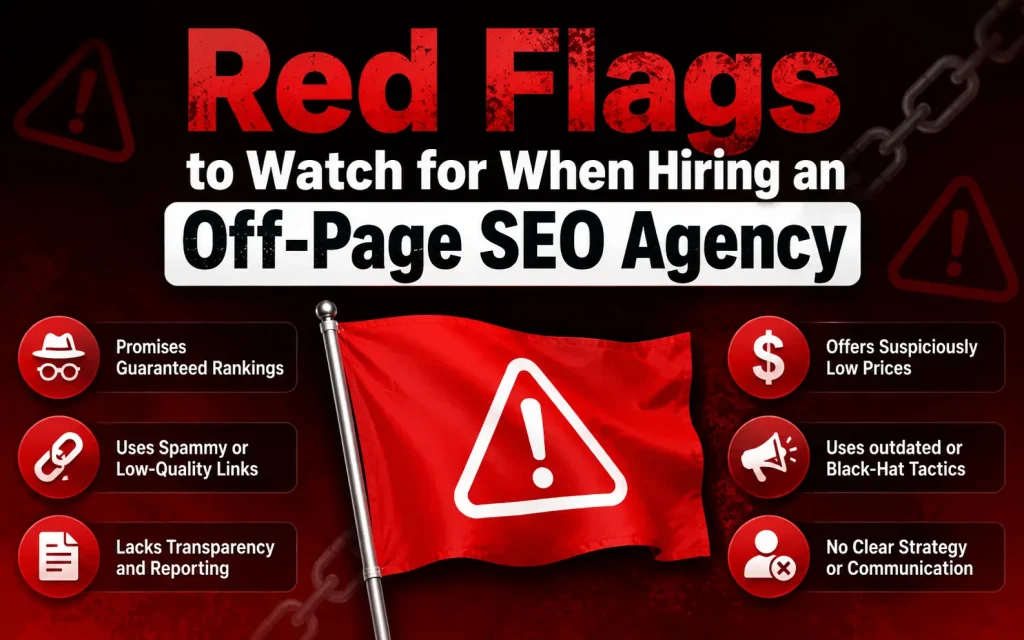
The off-page SEO industry attracts vendors who sell cheap links in bulk or use automated tools that violate Google’s guidelines. Choosing the wrong agency can result in a manual penalty that removes your site from search results entirely. Here is what to watch for:
- Guarantees of a specific number of backlinks within a fixed timeframe
- Prices that seem too low to reflect real editorial work
- No transparency about where links will be placed
- Use of private blog networks or link farms
- Automated outreach without personalization or relationship building
- No reporting or documentation of work completed
- Anchor text profiles that are over-optimized for a single keyword
A trustworthy off-page SEO service provider will show you the sites they target, explain their outreach process, share monthly reports, and operate under a strict no-spam policy.
What Your Competitors Are Not Telling You About Off-Page SEO
| Topic | What Most Competitors Cover | What This Guide Adds |
|---|---|---|
| Link quality | Get backlinks from authority sites | Relevance to your niche matters as much as domain authority |
| Digital PR | Rarely mentioned | Now ranked the number one link-building tactic by SEO professionals |
| Unlinked mentions | Not covered | Google uses implied links as entity signals even without a clickable URL |
| E-E-A-T connection | Rarely explained | Off-page SEO is the primary way to prove Authority and Trust in Google’s framework |
| AI search impact | Not addressed | LLMs surface content that is widely cited, making off-page presence essential for AI visibility |
| Review signals | Not mentioned | Review velocity and sentiment directly impact local rankings and E-E-A-T scores |
| Risk mitigation | Minimal | Specific red flags to avoid penalties when choosing vendors |
How Long Does Off-Page SEO Take to Show Results?
| Timeframe | What You Can Expect |
|---|---|
| Month 1 to 2 | Link prospecting, outreach begins, first citations go live, baseline metrics documented |
| Month 3 to 4 | First backlinks indexed, domain authority begins to improve, referral traffic increases |
| Month 4 to 6 | Keyword rankings start climbing for mid-competition terms, brand mentions accumulate |
| Month 6 to 12 | Compounding authority gains, high-competition keywords become achievable, organic traffic grows steadily |
| Beyond 12 months | Sustainable rankings, reduced paid advertising dependency, strong brand footprint across the web |
Off-page SEO is a long-term investment. The authority you build over months and years creates a durable competitive advantage that is difficult for competitors to replicate quickly.
Off-Page SEO in the Age of AI Search
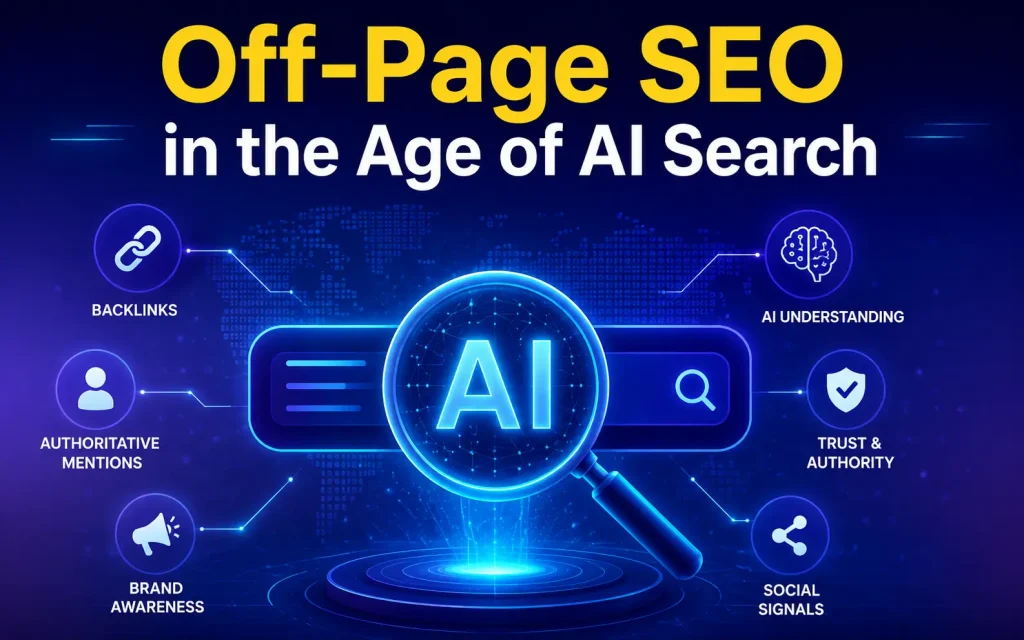
The rise of AI-powered search tools including Google’s AI Overviews and large language model search assistants has changed how content gets discovered and referenced. These AI systems do not rely exclusively on backlinks. They surface brands and content that are widely cited and mentioned across authoritative sources.
This makes off-page SEO more important than ever, not less. A strong presence through digital PR, brand mentions, and authoritative backlinks increases your likelihood of being featured in AI-generated answers, which represent the next generation of search visibility.
Brands that invest in off-page SEO now are building the kind of web-wide presence that both traditional search engines and AI assistants reward with top placement.
What metrics should I track for off-page SEO?
- Domain authority or domain rating as tracked by Ahrefs or Moz
- Number of referring domains (unique websites linking to you)
- Total backlink count and the quality distribution
- Branded search volume growth over time
- Organic traffic from non-branded keywords
- Local citation accuracy and count
- Online review ratings and volume
FAQs
What are off-page SEO services?
Off-page SEO services involve activities performed outside your website to improve its search engine rankings, such as link building, guest posting, brand mentions, and digital PR.
Why are off-page SEO services important?
Off-page SEO helps build your website’s authority, credibility, and trustworthiness, which can lead to higher rankings and increased organic traffic.
What techniques are included in off-page SEO services?
Common techniques include guest posting, backlink building, local citations, social bookmarking, influencer outreach, content promotion, and brand mention campaigns.
How long does it take to see results from off-page SEO?
Most websites begin seeing noticeable improvements within 3 to 6 months, depending on competition, industry, and the quality of the SEO strategy.
Are backlinks still important for SEO?
Yes. High-quality backlinks remain one of the most important ranking factors because they signal trust and authority to search engines.
Final Thoughts
Off-page SEO services are not optional if you want to compete for meaningful search rankings in 2025. Your content can be excellent and your website can be technically perfect, but without the external signals that off-page SEO creates, search engines have no way to distinguish you from the thousands of other sites in your niche.
The best approach combines multiple off-page tactics working together: quality backlinks from relevant sites, strategic digital PR placements, consistent local citations, active reputation management, and ongoing brand presence across the channels your audience uses. Each signal reinforces the others, and the compounding effect over time is what creates durable long-term rankings.
