
SEO Keyword Research Services you have a great website and a quality product or service. Yet Google continues to ignore you. The reason is almost always the same: you are either targeting the wrong keywords, or you have no keyword strategy at all. This is where professional SEO keyword research services become your most valuable investment.
This guide covers everything you need to know about SEO keyword research services, including what they include, how they work, what separates good services from bad ones, and how to measure the results. Whether you are a small business owner, a marketing manager, or an agency looking to understand the full scope of keyword research, this guide gives you a clear and honest picture.
What Are SEO Keyword Research Services
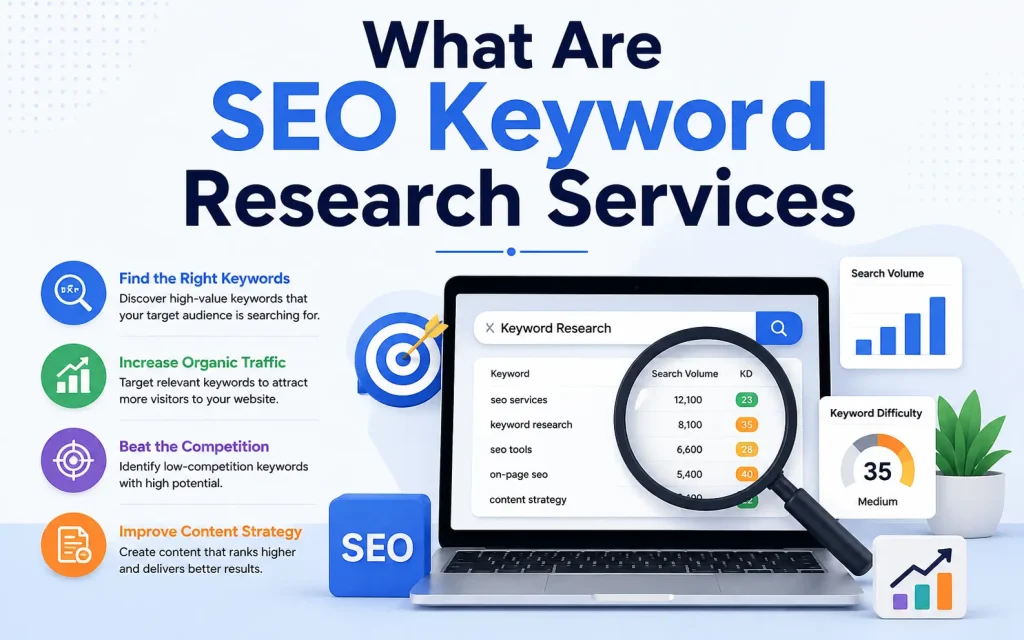
SEO keyword research services are professional, data-driven processes in which trained SEO specialists identify, analyze, and prioritize the exact search terms your target audience uses on Google and other search engines. The output is a strategic keyword map that tells you what content to create, which pages to optimize, and where to focus your resources.
Unlike using a free keyword tool yourself and downloading a spreadsheet, a professional keyword research service goes several layers deeper. It connects your business goals to search demand, aligns every keyword with the correct search intent, and builds a content strategy around what will actually generate traffic, leads, and revenue for your specific website.
What Is Included in a Professional Keyword Research Service
A complete SEO keyword research service typically delivers the following:
- Seed keyword discovery based on your products, services, and business goals
- Competitor keyword gap analysis to identify what your rivals rank for that you do not
- Long-tail keyword identification for faster ranking opportunities
- Search intent mapping, classifying every keyword as informational, navigational, commercial, or transactional
- Keyword difficulty and search volume analysis for every target term
- Keyword clustering, grouping related keywords into topic silos
- A prioritized content map showing which pages to build or optimize first
- Negative keyword lists for PPC campaigns to eliminate wasted ad spend
- Rank tracking setup to monitor progress over time
- A clear, deliverable report your team can act on immediately
Why Keyword Research Is the Foundation of All SEO
Every successful SEO campaign begins with keyword research. Without it, you are creating content in the dark and hoping Google notices. With it, every page you publish serves a defined purpose and has a measurable target.
Google processes approximately 8.5 billion searches every single day. Each one is a signal of intent. The people searching are telling you exactly what they want. Keyword research decodes those signals and connects them to your business. Skip this step and you skip the single most powerful intelligence-gathering process available to digital marketers.
The Business Impact of Poor Keyword Strategy
When a business targets the wrong keywords, the consequences are significant:
- Traffic that does not convert because visitors arrive looking for something different from what you offer
- Content production that wastes budget because it targets keywords no one searches for
- Ad spend that drains without return because campaigns target broad, irrelevant terms
- Competitor dominance that grows over time because they invested in keyword research and you did not
Professional keyword research eliminates all of these problems before they happen.
Types of Keywords You Need to Understand
Not all keywords work the same way. A mature SEO keyword research service builds a strategy that balances multiple keyword types to cover your entire sales funnel, from awareness to purchase.
| Keyword Type | Description | Example | Best For |
|---|---|---|---|
| Short-tail | 1-2 words, high volume, high competition | keyword research | Brand awareness |
| Long-tail | 3+ words, lower volume, easier to rank | best SEO keyword research services | Conversions and leads |
| Local | Location-specific phrases | SEO agency in Karachi | Local businesses |
| Informational | Questions and how-tos | how to do keyword research | Blog and content pages |
| Commercial | Comparison or buying-intent phrases | best keyword research tools | Landing pages |
| Transactional | Ready-to-buy phrases | hire SEO keyword expert | Product and service pages |
| Seasonal | Trend-based, time-sensitive | SEO strategy for Ramadan sales | Campaign planning |
| Negative | Terms that waste ad budget | free, DIY, tutorial | PPC exclusion lists |
Your keyword strategy should include a mix of all types listed above. Relying only on short-tail keywords means you are competing with major brands for difficult rankings. Relying only on long-tail keywords limits your reach. A balanced approach covers every stage of the buyer journey.
How SEO Keyword Research Services Work: A Step-by-Step Process
Understanding the process helps you evaluate service providers and set realistic expectations. A high-quality keyword research service follows a structured methodology.
Step 1: Business and Audience Discovery
The process begins with understanding your business model, target customers, geographic focus, competitors, and revenue goals. Good keyword research is not generic. It is built around the specific context of your business and the actual language your customers use when they search.
Step 2: Seed Keyword Generation
SEO specialists brainstorm core topics that describe your products and services. These seed keywords are then expanded using professional tools. The goal is to create an initial list of hundreds or thousands of candidate keywords that represent your full topical footprint.
Step 3: Data Collection and Metric Analysis
Each candidate keyword is analyzed against the following metrics:
- Monthly search volume: the average number of times people search for that term per month
- Keyword difficulty (KD): a score from 0 to 100 estimating how hard it is to rank on page one
- Cost per click (CPC): what advertisers pay per click, which signals commercial value
- Search intent: what the searcher wants, whether information, comparison, or a purchase
- SERP features: whether the keyword triggers featured snippets, local packs, image packs, or other rich results
- Trend data: whether the keyword is growing, stable, or declining in popularity
Step 4: Competitor Keyword Gap Analysis
This is one of the most valuable and most overlooked steps in keyword research. A specialist analyzes the exact keywords your top three to five competitors rank for that your site does not. This reveals ready-made opportunities. If your competitor ranks for a high-value keyword and your site has none of that content, you have an identified gap that you can close with a targeted page.
Step 5: Keyword Clustering and Silo Building
Raw keyword lists are not a strategy. Clustering groups related keywords together so that each page on your site targets a coherent set of terms that share the same intent. This prevents keyword cannibalization, which happens when multiple pages compete for the same search term and dilute each other’s rankings.
Step 6: Priority Mapping and Content Planning
The final deliverable is a prioritized content map. Every keyword cluster is assigned to an existing page or a new page that needs to be created. Pages are ranked by opportunity, so you know where to focus your content team first to get the fastest results.
DIY Keyword Research vs. Professional Keyword Research Services
| Factor | DIY Keyword Research | Professional Service |
|---|---|---|
| Time Investment | 10-40 hours per project | Delivered in days, zero of your time |
| Tool Access | Limited to free tools | Premium tools: Ahrefs, SEMrush, GSC |
| Competitor Analysis | Surface-level only | Deep gap and opportunity analysis |
| Search Intent Mapping | Guesswork | Data-driven intent classification |
| Keyword Clustering | Manual, error-prone | Automated plus expert-reviewed clusters |
| Content Strategy | Keywords only, no plan | Full content map with priority order |
| Ongoing Updates | Forgotten after launch | Quarterly or monthly refresh cycles |
| ROI Tracking | Not included | Rank tracking plus traffic reporting |
The core difference is not the tools. It is the expertise, methodology, and time investment that professional services bring. A trained SEO specialist knows which keyword metrics matter for your specific site, how to interpret competitive landscapes, and how to translate data into a content plan that produces measurable results.
What Good SEO Keyword Research Services Do That Competitors Miss
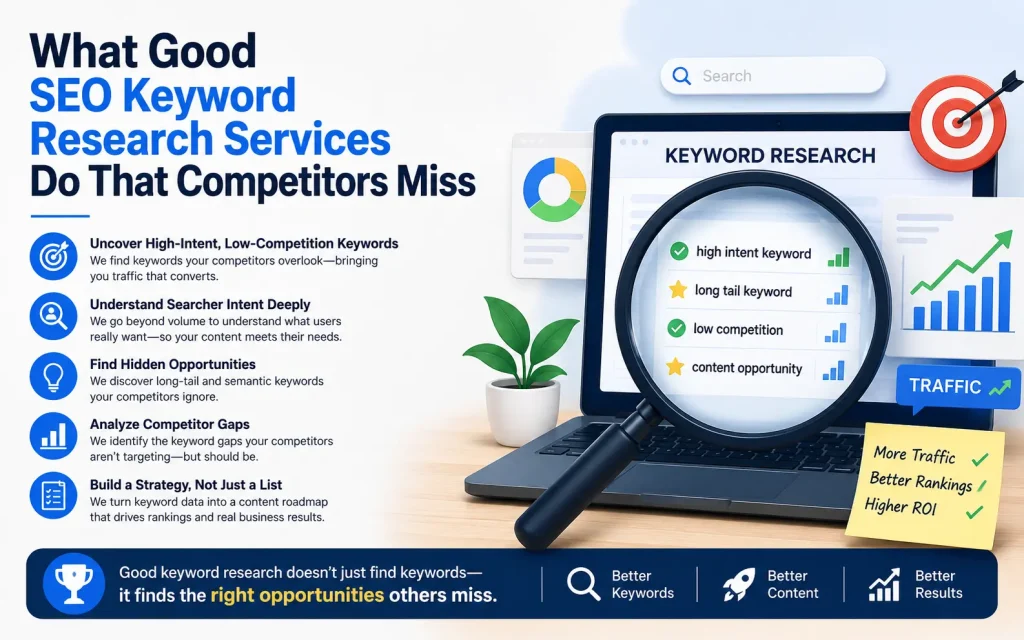
After analyzing the top-ranking pages for keyword research services, we identified clear gaps in what most competitors cover. Here is what a truly complete service includes that most guides and tool pages fail to mention.
Search Intent Alignment at Scale
Most tools show you volume and difficulty. They do not tell you whether a keyword matches the type of page you can realistically create. A professional service maps every keyword to the correct content format: blog post, product page, comparison page, local landing page, FAQ, or case study. This alignment is what determines whether your content ranks and converts.
Topical Authority Building
Google ranks websites that demonstrate expertise across an entire topic, not just individual pages. Professional keyword research builds a topic cluster model: a central pillar page targeting a broad keyword supported by multiple cluster pages targeting specific subtopics. This interconnected structure signals authority to Google and accelerates rankings across the entire cluster.
SERP Feature Targeting
Ranking in the first position is not the only goal. Featured snippets, People Also Ask boxes, image packs, local packs, and knowledge panels are SERP features that appear above traditional results. A professional keyword research service identifies which keywords trigger these features and structures your content to win them. Ranking in a featured snippet can double or triple click-through rates compared to a standard first-position result.
Voice Search and Conversational Keyword Optimization
Voice searches are longer, more conversational, and often phrased as full questions. A professional service identifies question-based keywords starting with who, what, where, when, why, and how that align with how people speak to voice assistants. As voice search and AI-powered search platforms grow in use, this layer of keyword research becomes increasingly important.
AI Search Visibility Optimization
AI-powered search platforms such as Google AI Overviews, ChatGPT, and Perplexity increasingly pull answers from web content. Keywords that trigger question-based answers, definition queries, and how-to content are especially likely to appear in AI-generated responses. A forward-thinking keyword research service identifies these opportunities and structures your content so it is more likely to be referenced by AI search platforms.
Keyword Cannibalization Audit
If your website has been online for more than a year, it has almost certainly accumulated pages that compete against each other for the same keywords. This keyword cannibalization confuses Google about which page to rank and splits the authority that should flow to a single, strong page. A professional service audits your existing content, identifies cannibalization issues, and resolves them through consolidation, redirection, or differentiation.
Seasonal and Trend-Based Keyword Planning
Some keywords spike in search volume during specific times of the year. An e-commerce site selling winter clothing, a travel agency promoting summer holidays, or a financial services firm targeting tax season searches all benefit from seasonal keyword planning. A professional service maps these patterns and ensures your content is published and optimized ahead of the demand curve.
Key Metrics to Understand Before Choosing Keywords
- Search Volume: The average monthly number of searches for a keyword. Higher is better, but only if paired with manageable difficulty.
- Keyword Difficulty (KD): A score from 0 to 100. For new websites, target keywords with a KD below 30. Established sites with strong authority can pursue keywords up to 60 or 70.
- Cost Per Click (CPC): A high CPC signals commercial value. If advertisers pay $10 or more per click, the keyword drives revenue for those who rank organically for it.
- Click-Through Rate (CTR): The percentage of searchers who click a result. Featured snippet positions and strong meta descriptions significantly increase CTR.
- Search Intent: The most important metric of all. A keyword with 10,000 monthly searches means nothing if it does not match the page you are trying to rank.
- Trends: Use tools like Google Trends to verify whether a keyword is growing or declining. Targeting a shrinking keyword wastes resources.
- SERP Features Present: Check whether the keyword triggers features like featured snippets, local packs, or video carousels that could affect how much traffic organic rankings generate.
Local SEO Keyword Research: A Separate and Critical Strategy
Local businesses require a distinct approach to keyword research. If your customers find you geographically, then local keyword research is not optional. It is the core of your entire SEO strategy.
Local keyword research identifies geo-specific search phrases such as “SEO agency in Karachi,” “plumber near me in Lahore,” or “digital marketing services Dubai.” These keywords tend to have lower monthly search volumes than national terms, but they convert at dramatically higher rates because the searcher is specifically looking for a local provider.
Local Keyword Research Best Practices
- Include your city, neighborhood, region, and surrounding areas in keyword variations
- Target “near me” phrases, which have grown significantly with mobile search
- Optimize your Google Business Profile with local keywords to appear in the local pack
- Create dedicated location pages if you serve multiple cities or regions
- Target local intent keywords across services, reviews, and comparison pages
How to Evaluate an SEO Keyword Research Service Provider
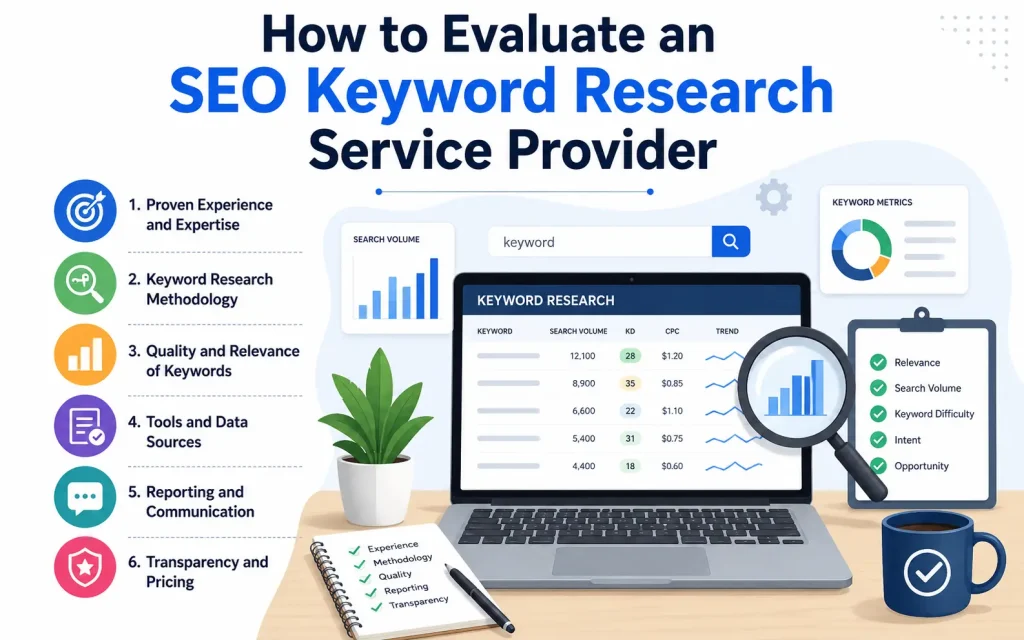
Not all keyword research services are created equal. Here is what to look for when choosing a provider.
Questions to Ask Before You Hire
- What tools do you use for keyword research? Look for providers who use professional-grade tools such as Ahrefs, SEMrush, Moz, or Google Search Console.
- Do you conduct a competitor analysis as part of the service? Competitor gap analysis is non-negotiable for a complete keyword strategy.
- How do you determine search intent for each keyword? The answer should involve manual SERP review, not just tool labels.
- Will I receive a keyword map or just a keyword list? A list without a content plan is of limited strategic value.
- Do you offer ongoing keyword monitoring and updates? Search trends change. A one-time report becomes outdated within months.
- Can you show me examples of past keyword research deliverables? Seeing sample reports reveals the depth and quality of the work.
Red Flags to Avoid
- Providers who promise to rank you for thousands of keywords overnight
- Services that deliver a spreadsheet of keywords with no context, intent mapping, or prioritization
- Agencies that use only free tools and charge premium prices without access to professional data sources
- No mention of search intent, keyword difficulty, or competitor analysis in the service description
Measuring the Success of Your Keyword Research Investment
- Organic Traffic Growth: Track your organic sessions in Google Analytics month over month and compare against the period before implementing the keyword strategy.
- Keyword Rankings: Use a rank tracker to monitor where your target keywords appear in Google search results. Aim to move from page two or three to page one.
- Impressions in Google Search Console: Rising impressions indicate that Google is beginning to surface your pages for the targeted keywords even before click-through increases.
- Click-Through Rate (CTR): A rising CTR alongside rising impressions confirms that your titles and meta descriptions are compelling.
- Conversions from Organic Traffic: The ultimate measure. Track how many leads, sign-ups, purchases, or contact form submissions originate from organic search.
- Pages Entering the Top 10: Count how many of your optimized pages break into the top ten results over time. This is the most direct measure of keyword research effectiveness.
When Should You Invest in Professional SEO Keyword Research Services?
The short answer: before you publish any new content, before you launch a new website, and before you run any paid search campaign.
Here are the situations where professional keyword research services deliver the clearest and fastest return:
- Launching a new website or online store and building your content strategy from the ground up
- Rebranding or expanding into a new product line or service area
- Entering a new geographic market or targeting a new audience segment
- Running Google Ads campaigns and needing to identify high-converting, cost-efficient keywords
- Recovering from a Google algorithm update that caused a traffic drop
- Preparing a quarterly content calendar and needing prioritized topics
- Conducting an annual SEO audit that requires revisiting the entire keyword strategy
The Connection Between Keyword Research and Content Strategy
Keyword research without a content plan is a spreadsheet. Content without keyword research is guesswork. The two must work together.
When you receive a completed keyword research deliverable from a professional service, you should be able to answer the following questions without any additional research:
- Which keywords should I target on my homepag
- Which keywords need new blog posts, and in what order should I publish them
- Which keywords should each of my service or product pages target
- Which long-tail keywords could I turn into FAQ content or a dedicated FAQ page
- Which keywords are my competitors ranking for that I am completely missing
- Which keywords have strong commercial intent that I should prioritize for paid ads
If your keyword research service cannot answer all of these questions, it is incomplete.
SEO Keyword Research Tools Used by Professionals
- Ahrefs: Industry-leading keyword difficulty data, backlink analysis, and competitor research
- SEMrush: Broad keyword database, position tracking, and comprehensive SERP analysis
- Google Search Console: First-party data showing exactly which queries already bring users to your site
- Google Keyword Planner: Official search volume ranges from Google, ideal for PPC keyword planning
- Moz Keyword Explorer: Strong intent classification and keyword priority scoring
- AnswerThePublic: Visualizes question-based and preposition-based keyword variations
- Google Trends: Reveals seasonality, geographic interest, and trend direction for any keyword
- Surfer SEO: Analyzes the top-ranking pages for a keyword and shows what content factors correlate with ranking
FAQs
What are SEO keyword research services?
SEO keyword research services help businesses identify the best keywords their target audience uses in search engines. These services focus on finding high-traffic, low-competition, and high-intent keywords to improve rankings and attract qualified visitors.
Why is keyword research important for SEO?
Keyword research is the foundation of SEO. It helps you understand what people are searching for, create relevant content, target the right audience, and increase organic traffic and conversions.
What tools are used for keyword research?
Professional SEO keyword research services often use tools such as Google Keyword Planner, Ahrefs, SEMrush, Moz, and Ubersuggest to analyze search volume, competition, and keyword opportunities.
How often should keyword research be updated?
Keyword research should be reviewed regularly, typically every three to six months. Trends, search behavior, and competitor strategies change over time, making ongoing research essential for maintaining rankings.
Can keyword research services help local businesses?
Yes. SEO keyword research services can identify location-based keywords and local search opportunities, helping businesses attract customers in specific cities or regions and improve visibility in local search results.
Conclusion
Every business that earns organic traffic from Google has one thing in common they invested in understanding what their audience searches for and built their content strategy around those insights. That is all keyword research is at its core. But at a professional level, it is a sophisticated, multi-layered process that connects search data to business outcomes.
SEO keyword research services give you the roadmap your website needs to compete, rank, and convert. They eliminate guesswork, save enormous amounts of time, and ensure that every piece of content you create has a defined purpose, a measurable target, and a realistic path to the first page of Google.
If your website is not generating the organic traffic and leads your business deserves, the answer almost certainly starts with keyword research. Get it right, and everything else in your SEO strategy becomes more effective.
You May Also Like It:
Professional Off-Page SEO Services
