
HVAC digital marketing helps heating ventilation and air conditioning companies reach more customers through powerful online strategies. Today most homeowners and businesses search online before choosing an HVAC service provider. If your company does not appear in search results you may lose valuable customers to competitors.
A strong HVAC digital marketing strategy can help you increase website traffic attract qualified leads improve local search visibility and grow your business revenue. By using effective digital marketing techniques HVAC companies can connect with potential customers who are actively looking for heating and cooling solutions.
From SEO and Google Ads to social media marketing and content creation digital marketing provides HVAC businesses with the right tools to build brand awareness generate consistent leads and reach customers at the perfect time.
What Is HVAC Digital Marketing
HVAC digital marketing is the use of online channels, such as search engines, social media, email, and paid ads, to attract, convert, and retain heating and cooling customers.
It covers everything from getting found on Google when someone searches “AC repair near me” to nurturing past customers so they call you again when their furnace acts up five years later.
Unlike traditional advertising, digital marketing lets you track exactly where every lead came from and how much it cost to get them. That level of visibility is why more HVAC owners are shifting budget away from print ads and mailers.
Why HVAC Companies Can’t Skip Digital Marketing Anymore
A few numbers explain the shift:
- Most homeowners search online before calling a contractor, even ones referred by a friend.
- Nearly all consumers read online reviews before hiring a local service business.
- Mobile searches for “near me” services have grown steadily every year, and HVAC is one of the categories that benefits most.
If your company isn’t visible in those searches, your competitor down the street is getting the call instead. This isn’t about chasing trends. It’s about meeting customers where they already are.
The Core Pillars of HVAC Digital Marketing
Most agencies talk about these separately, but they work best as a connected system. Here’s a quick overview before we go deeper into each one.
| Pillar | What It Does | Best For |
|---|---|---|
| SEO | Ranks your site organically on Google | Long-term, steady lead flow |
| Local SEO / GBP | Gets you into the map pack | “Near me” and emergency searches |
| PPC / Google Ads | Buys instant visibility | Fast leads, seasonal spikes |
| Website | Converts visitors into calls | Every other channel depends on this |
| Reviews & Reputation | Builds trust before the call | Closing the deal |
| Social Media | Builds brand awareness | Repeat customers, referrals |
| Email & SMS | Keeps past customers coming back | Maintenance plans, seasonal tune-ups |
Let’s go through each of these in plain terms.
Search Engine Optimization (SEO)
SEO is how your website earns free, ongoing traffic from Google. For HVAC companies, this usually means ranking for searches like:
- “furnace repair [city]”
- “AC installation cost”
- “best HVAC company near me”
Good HVAC SEO includes:
- Service pages for each thing you do (AC repair, heating installation, duct cleaning), not one vague “services” page.
- City or neighborhood pages if you serve multiple areas, so you show up in each one’s local searches.
- Fast load times, since slow sites lose visitors within seconds.
- Mobile-friendly design, because most local searches happen on a phone.
SEO takes months to build momentum, but it keeps paying off long after you stop actively pushing content, unlike ads that stop the moment you stop paying.
Local SEO and Google Business Profile
This is the single most overlooked opportunity for HVAC companies. When someone searches “HVAC repair near me,” Google shows a map with three businesses first. That’s called the map pack, and it gets the majority of clicks on local searches.
To improve your chances of landing there:
- Claim and fully complete your Google Business Profile (services, hours, service area, photos).
- Keep your business name, address, and phone number identical across every directory (Yelp, Angi, Facebook, etc.). Inconsistent information confuses Google and hurts rankings.
- Post updates and photos regularly, especially after jobs.
- Respond to every review, good or bad.
Most competitor guides mention Google Business Profile but skip the detail that really moves rankings: review velocity. Google favors businesses that get new reviews consistently over time, not ones with 50 reviews from three years ago and nothing since. A steady stream of five new reviews a month often outperforms a one-time push for 100.
Hvac Digital Marketing Pay-Per-Click Advertising (PPC)
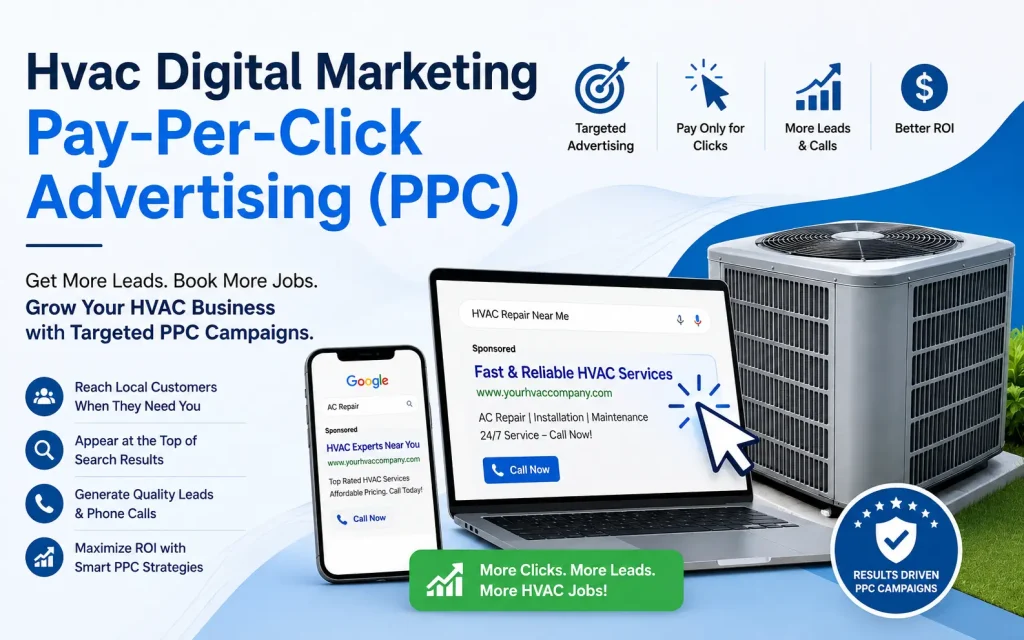
PPC, mainly Google Ads and Local Services Ads, puts your business at the top of search results immediately. You pay per click, not per placement, so budget control matters.
PPC works well for:
- Emergency repair searches, where people need someone right now
- Slow seasons, when you need to fill the schedule fast
- New businesses that don’t have SEO traction yet
The catch: HVAC keywords are expensive because the value of a single job is high. A poorly built campaign can burn through budget fast with nothing to show for it. That’s why landing page quality matters as much as the ad itself. Sending PPC traffic to your generic homepage instead of a dedicated, offer-specific landing page is one of the most common ways money gets wasted.
Website Design That Actually Converts
Traffic means nothing if visitors don’t call or book. Your website needs to be built to convert, not just to look nice.
Key elements of a converting HVAC website:
- Click-to-call buttons visible on every page, especially on mobile.
- Clear service area so visitors know instantly if you cover their location.
- Simple booking or quote form, ideally under five fields.
- Trust signals above the fold: licenses, years in business, guarantees, review scores.
- Financing information, since HVAC replacements are a major expense for most homeowners.
A slow, cluttered, or outdated website undoes all the work your SEO and ads are doing to drive traffic there in the first place.
Online Reviews and Reputation Management
Reviews are the modern word of mouth. Before someone calls, they check your rating. A 3.8-star average with old reviews reads very differently than a 4.9-star average with reviews from last week.
Practical ways to build reviews:
- Ask right after the job, while satisfaction is fresh, ideally through a text message with a direct link.
- Make leaving a review as short as possible, one tap if you can manage it.
- Train technicians to ask in person; customers respond better to a person than a follow-up email.
- Respond to negative reviews calmly and professionally. How you handle criticism often matters more to future customers than the complaint itself.
Social Media for HVAC Companies
Social media won’t replace search and reviews, but it builds familiarity and trust over time. HVAC companies get the most value from:
- Before-and-after job photos
- Short videos explaining common problems (why your AC is leaking, how often to change filters)
- Team and community content that humanizes the business
- Seasonal reminders (tune-up season, filter changes, energy-saving tips)
The goal isn’t viral content. It’s staying visible so past customers remember you when something breaks.
Email and SMS Marketing
This is where most HVAC companies leave money on the table. Once a customer pays for a repair or installation, many businesses never contact them again until the next breakdown. That’s a missed opportunity.
A simple follow-up system might include:
- A thank-you message right after service
- Seasonal maintenance reminders (spring AC tune-up, fall furnace check)
- Maintenance plan renewal notices
- Occasional tips that keep your brand top of mind
Text messages get opened far more often than emails, making SMS especially effective for reminders and quick offers.
What Most HVAC Marketing Guides Get Wrong
Many competitor articles cover the channels above but miss a few things that actually make or break results:
They treat channels as separate instead of connected. SEO brings someone to your site, but a bad website kills the conversion. Reviews get someone to click your PPC ad over a competitor’s. These pillars support each other, and ignoring one weakens all the others.
They skip the “close” step entirely. Getting the phone to ring is only half the job. If your team doesn’t answer quickly, follow up on missed calls, or send quotes fast, marketing dollars go to waste. Track your call answer rate and speed-to-lead time (how fast you respond to a new inquiry). Leads contacted within five minutes convert at dramatically higher rates than leads contacted an hour later.
They underweight seasonality. HVAC demand swings hard with the seasons. Smart companies shift budget and messaging ahead of the season, not during it. Start AC campaigns in early spring, before the first heat wave, when competition and cost-per-click are still low.
They don’t mention tracking. If you can’t tell which channel a job came from, you can’t tell what’s actually working. Call tracking numbers and simple UTM tagging on links solve this without needing complicated software.
How Much Should an HVAC Company Spend on Marketing
There’s no single right number, but a useful starting range is 7 to 12 percent of gross revenue for established companies, and closer to 15 percent for companies actively trying to grow market share. Newer or smaller companies often need to spend a higher percentage early on to build visibility, then can scale back once organic channels like SEO and reviews start carrying more weight.
A rough split that works for many HVAC businesses:
| Channel | Typical Share of Budget |
|---|---|
| SEO & website | 25 to 30 percent |
| PPC / Google Ads | 30 to 40 percent |
| Reviews & reputation tools | 5 to 10 percent |
| Social media | 10 to 15 percent |
| Email/SMS | 5 to 10 percent |
These numbers shift depending on your market’s competitiveness and how established your business already is online.
Hvac Digital Marketing Common Mistakes to Avoid
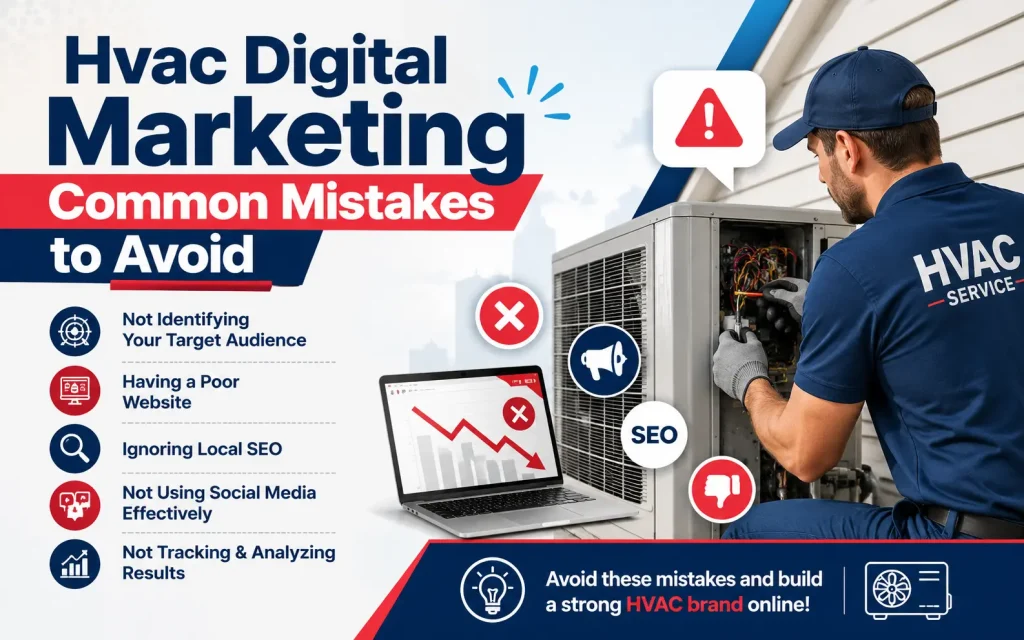
- Chasing rankings for the wrong keywords. Ranking first for “how HVAC systems work” won’t get you jobs. Ranking for “furnace repair [your city]” will.
- Ignoring mobile users. If your site is hard to use on a phone, you’re losing the majority of your traffic.
- Running ads without tracking calls. You can’t optimize what you don’t measure.
- Letting reviews go unanswered. Silence on a bad review looks worse than the review itself.
- Setting and forgetting. Digital marketing needs regular attention, not a one-time setup.
Building a Simple 90-Day Action Plan
If you’re starting from scratch, here’s a realistic order of operations:
- Weeks 1 to 2: Clean up and fully complete your Google Business Profile.
- Weeks 3 to 4: Audit your website for speed, mobile usability, and clear calls to action.
- Weeks 5 to 6: Launch a review request system for every completed job.
- Weeks 7 to 9: Start a targeted PPC campaign for your highest-value services, with dedicated landing pages.
- Weeks 10 to 12: Begin publishing consistent content: service pages, seasonal tips, and social posts.
- Ongoing: Set up email/SMS follow-ups and track every lead source monthly.
Small, consistent steps beat a rushed overhaul. Most HVAC companies see meaningful movement in local rankings and lead volume within three to six months of consistent effort.
Frequently Asked Questions
What Is HVAC Digital Marketing?
HVAC digital marketing is the process of promoting heating ventilation and air conditioning services through online marketing channels. It includes SEO Google Ads social media marketing content marketing and local search optimization to help HVAC companies reach more customers and grow their business.
Why Do HVAC Companies Need Digital Marketing?
HVAC companies need digital marketing because most customers search online before hiring an HVAC service provider. A strong online presence helps businesses appear in search results attract potential customers and increase service bookings.
How Does SEO Help HVAC Companies Grow?
SEO helps HVAC companies improve their search engine rankings and appear in front of customers searching for HVAC services. A well optimized website can bring organic traffic increase leads and create long term business growth.
How Can Local SEO Help An HVAC Business?
Local SEO helps HVAC companies appear in location based searches such as HVAC repair near me or AC installation services near me. Optimizing your Google Business Profile collecting customer reviews and creating local service pages can improve visibility in local search results.
How Much Does HVAC Digital Marketing Cost?
The cost of HVAC digital marketing depends on the services you choose and your business goals. SEO advertising website improvements and content creation all have different costs. A customized marketing plan can help you get the best return on your investment.
Final Thoughts
HVAC digital marketing isn’t about picking one trendy tactic and hoping it works. It’s about building a connected system where SEO brings visibility, your website converts that visibility into calls, reviews build the trust needed to close, and follow-up marketing keeps customers coming back for years.
Companies that treat these pieces as one system, rather than a checklist of separate tasks, consistently outperform competitors who are simply doing more of everything without connecting it together.
Start with the fundamentals a complete Google Business Profile, a fast and clear website, and a habit of collecting reviews. Everything else builds on that foundation.