
SEO ranking services are professional strategies and tactics that help your website appear higher in Google and other search engine results. When someone types a query into Google, hundreds or thousands of websites compete for the top spots. SEO ranking services put your website in those top positions, where 71% of all search traffic clicks happen.
Simply put: if your business is not on page one, most potential customers will never find you.
Unlike paid ads that stop the moment your budget runs out, good SEO builds lasting visibility. It is an investment that compounds over time, bringing you free, high-quality traffic every single day. Businesses that focus on blogging & seo can further improve their search rankings by creating valuable content that attracts visitors, builds authority, and increases organic traffic over the long term..
Why Most Businesses Struggle with SEO (And How to Fix It)
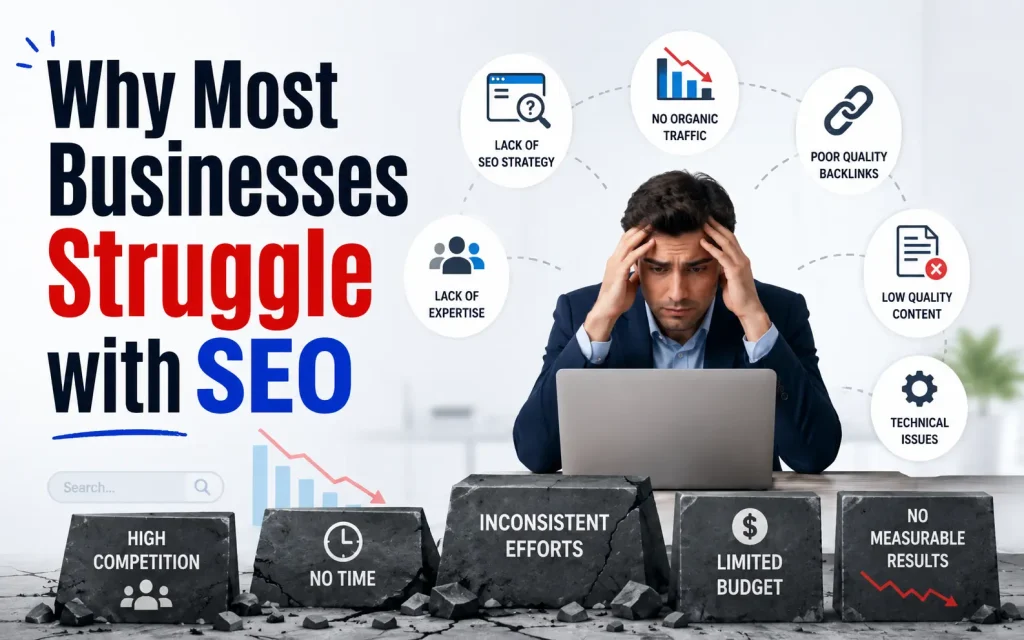
Many business owners try SEO on their own and see no results. Here is why that happens:
- They target keywords that are too broad and too competitive.
- Their website has technical issues that stop Google from reading it properly.
- They publish content without a clear strategy.
- They ignore backlinks, which are still one of Google’s top ranking factors.
- They expect overnight results but quit before SEO has time to work.
A professional SEO ranking service addresses all of these problems with a structured, data-driven approach built around your specific goals.
The Core Components of a Professional SEO Ranking Service
Good SEO is not one thing. It is a collection of practices that work together.
Here is what a complete SEO service covers:
1. Keyword Research and Strategy
Every strong SEO campaign starts with finding the right keywords.
This means:
- Identifying what your target customers actually search for.
- Analysing keyword difficulty and search volume.
- Targeting a mix of high-volume head terms and specific long-tail keywords.
- Mapping keywords to the right pages on your website.
The goal is to find keywords that your customers use and that you can realistically rank for, not just the most popular terms in your industry.
2. Technical SEO
This is the foundation that most agencies overlook in their client communication. .
Technical SEO fixes the issues that stop Google from crawling, indexing, and understanding your website:
- Site speed optimisation (Google uses page speed as a ranking factor for both desktop and mobile).
- Mobile-friendliness and Core Web Vitals compliance.
- Crawl error fixes and XML sitemap submission.
- Canonical tags to prevent duplicate content issues.
- Structured data markup (schema) so Google can display rich snippets in search results.
- HTTPS security and secure redirects.
Without a solid technical foundation, no amount of content or link building will move the needle.
3. On-Page SEO
On-page SEO is the process of optimising each individual page on your website to rank for its target keyword:
- Writing optimised title tags and meta descriptions.
- Using header tags (H1, H2, H3) in a clear, logical hierarchy.
- Placing keywords naturally in your content without stuffing.
- Optimising images with descriptive alt text and compressed file sizes.
- Improving internal linking so Google and users can navigate your site easily.
- Ensuring content depth: Google consistently ranks comprehensive, useful pages over thin ones.
4. Content Creation and Optimisation
Content is what Google ranks. Without quality content, you have nothing to rank.
A professional SEO service builds a content strategy that:
- Covers the full search journey: informational, navigational, and transactional intent.
- Publishes blog posts, guides, and landing pages targeting relevant keywords.
- Updates existing content to stay accurate and competitive.
- Builds topical authority, showing Google that your site is a trusted expert in your niche.
5. Link Building and Off-Page SEO
Backlinks remain one of the most powerful ranking signals in Google’s algorithm. When authoritative websites link to yours, Google sees your site as trustworthy and relevant.
Legitimate link building includes:
- Digital PR and outreach to earn editorial mentions.
- Guest posting on relevant industry publications.
- Building resource pages and linkable assets.
- Recovering lost or broken backlinks.
- Local citations for businesses targeting geographic areas.
What to avoid: Any agency promising hundreds of links in days through link farms or private blog networks (PBNs). Google penalises these practices and the damage can take months to undo.
6. Local SEO
If your business serves a specific city or region, local SEO is non-negotiable:
- Optimising your Google Business Profile with accurate information, photos, and categories.
- Building consistent Name, Address, and Phone (NAP) citations across directories.
- Earning and responding to Google reviews.
- Creating locally relevant content targeting geographic search terms.
- Implementing local schema markup.
7. Reporting and Analytics
You should always know what your SEO investment is doing. A trustworthy SEO service provides:
- Monthly reports showing keyword ranking movements.
- Organic traffic data from Google Analytics and Google Search Console.
- Conversion tracking to connect SEO to actual leads and sales.
- Clear explanation of what work was done and what is planned next.
What Competitors Are Not Telling You: 6 Honest Truths About SEO
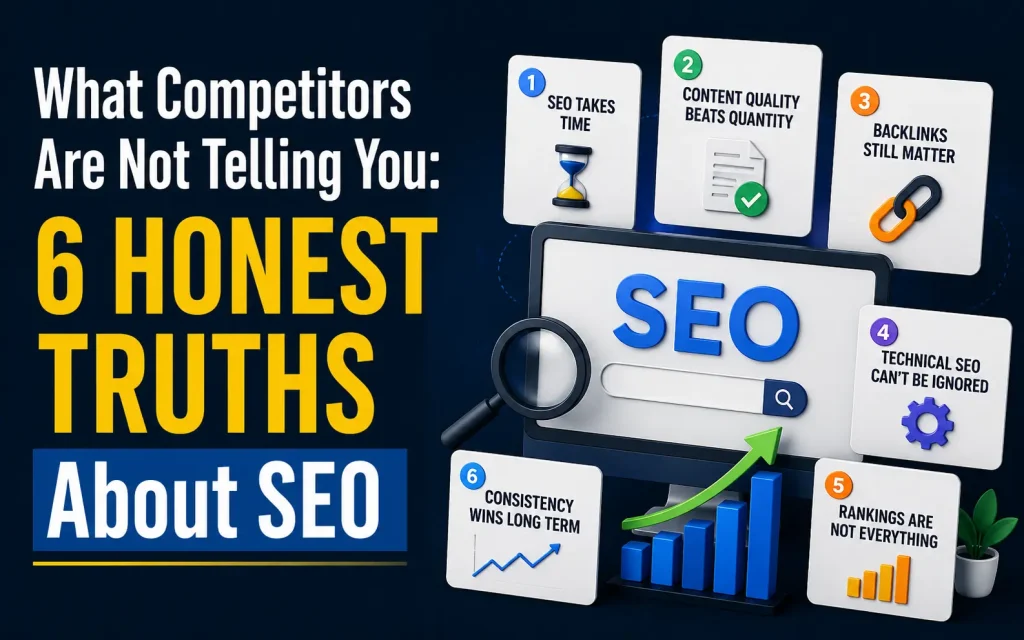
This is the information most agencies leave out of their service pages.
SEO takes time. Genuine results typically take 3 to 6 months to appear, and meaningful organic traffic growth usually takes 6 to 12 months. Any agency guaranteeing page-one rankings in 30 days is misleading you.
There are no guaranteed rankings. Google’s algorithm changes hundreds of times per year. A reputable agency can significantly improve your rankings using proven methods, but no one can promise a specific position because Google makes that decision.
Cheap SEO is expensive in the long run. Low-cost providers often use shortcuts that violate Google’s guidelines. When Google catches up, your site can lose rankings or receive a manual penalty. Recovery takes months and costs more than doing it right the first time.
Not every keyword is worth ranking for. A keyword with 10,000 monthly searches that attracts the wrong audience is less valuable than a keyword with 500 searches from buyers ready to spend money. Good SEO focuses on keywords that drive revenue, not just traffic.
Your website must convert visitors into customers. SEO brings people to your site. But if your site is slow, confusing, or unpersuasive, you will get traffic without results. The best SEO services consider user experience (UX) and conversion rate as part of the strategy.
AI and search are changing. Google’s AI Overviews and tools like ChatGPT are changing how people find information. Smart SEO providers are already adapting their strategies to ensure your brand appears in AI-generated answers, not just traditional blue links.
How to Choose the Right SEO Ranking Service
Here is a simple checklist to evaluate any SEO provider before you sign:
Ask these questions:
- Can you show me case studies with measurable results (not just screenshots of rankings)?
- What does your link building process look like and how do you stay within Google’s guidelines?
- How do you conduct keyword research and strategy?
- Who will manage my account and how often will we communicate?
- What does your monthly reporting include?
- What happens to the work you have done if I decide to stop working with you?
Red flags to watch for:
- Promises of guaranteed rankings.
- Very low prices with no clear explanation of what is included.
- No transparency about methods or processes.
- Contracts that lock you in for years with no exit clause.
- Agencies that outsource all work to unvetted third parties.
- No clear communication plan.
Green flags that indicate a quality provider:
- Proven track record with verifiable client results.
- Clear, written strategy tailored to your business, not a generic package.
- Regular, transparent reporting.
- Certified professionals using Google-approved methods.
- Honest timelines and realistic expectations from the start.
Understanding SEO Pricing: What Should You Pay?
SEO pricing varies widely depending on the scope of work, market competition, and provider quality.
Here is a general breakdown:
| Service Level | Monthly Investment | Best For |
|---|---|---|
| Basic SEO | $300 to $800 | Small local businesses with low competition |
| Standard SEO | $800 to $2,500 | Growing businesses in competitive markets |
| Advanced SEO | $2,500 to $7,000+ | E-commerce, national, or enterprise brands |
The cheapest option is rarely the best value. Think of SEO as hiring a specialist: you get what you pay for, and poor work now means expensive repairs later.
SEO Ranking Services vs. Paid Ads: Which Is Right for You?
Both SEO and paid advertising (like Google Ads) have their place. Here is how they compare:
SEO:
- Takes 3 to 12 months to show strong results.
- Traffic continues even if you pause investment.
- Builds long-term brand authority and trust.
- Lower cost per click over time.
Paid Ads:
- Results appear immediately.
- Traffic stops the moment you stop paying.
- Great for time-sensitive promotions or testing new markets.
- Can be expensive in competitive industries.
The smartest approach is to run paid ads for immediate leads while building SEO for long-term, sustainable growth. The two strategies complement each other.
How Long Does It Take to See Results from SEO
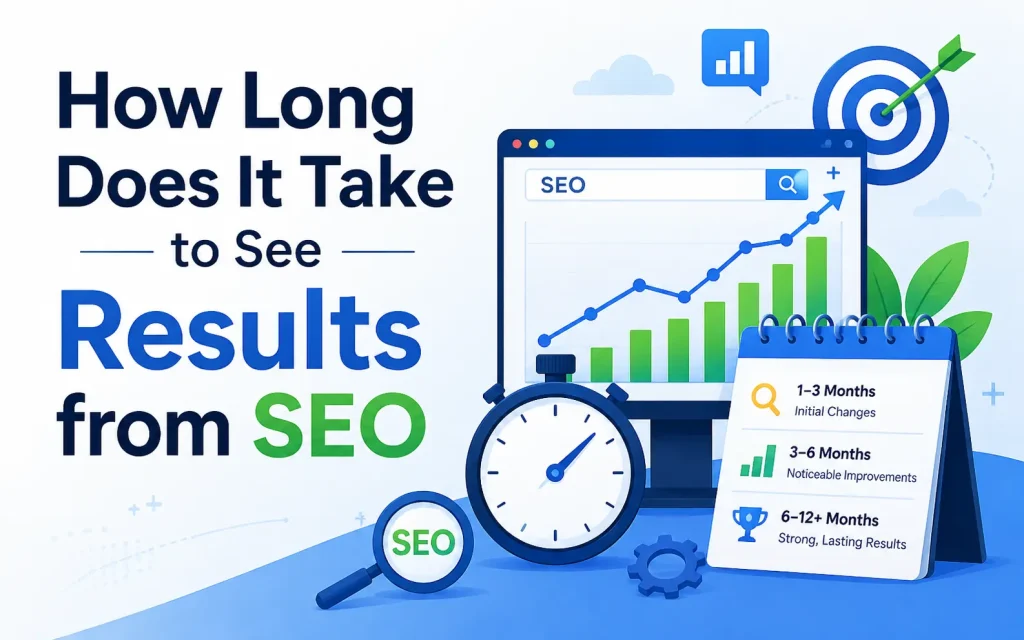
This is the question every client asks, and the honest answer is: it depends.
Factors that affect your timeline:
- How competitive your industry and target keywords are.
- The current state of your website (a new site takes longer than an established one).
- How frequently new content is published.
- The quality and quantity of backlinks you build.
- Whether technical issues need to be fixed before ranking work can begin.
As a general guide:
- Month 1 to 2: Technical audit, on-page fixes, and keyword strategy. Minimal visible ranking changes.
- Month 3 to 4: Content and link building in progress. Some keyword improvements begin.
- Month 5 to 6: Clear ranking improvements on target keywords. Organic traffic starts to grow.
- Month 6 to 12: Significant traffic growth. Leads and conversions from organic search increase noticeably.
The Role of E-E-A-T in Modern SEO
Google evaluates websites based on Experience, Expertise, Authoritativeness, and Trustworthiness, commonly called E-E-A-T. This framework shapes what Google considers a high-quality, rankable page.
To improve your E-E-A-T signals:
- Write content that demonstrates real, first-hand knowledge and experience.
- Include author bios with credentials and professional backgrounds.
- Earn mentions and links from authoritative, relevant websites.
- Keep your About page, contact details, and business information accurate and up to date.
- Display client testimonials, case studies, certifications, and awards.
- Publish accurate, well-researched content that is regularly reviewed and updated.
E-E-A-T is especially important for websites in health, finance, legal, and other industries where inaccurate information could cause real harm. Google holds these sectors to a higher standard.
Frequently Asked Questions
What is the difference between SEO and SEM?
SEO (Search Engine Optimisation) focuses on earning free, organic traffic from search engines. SEM (Search Engine Marketing) is a broader term that includes both SEO and paid search advertising.
Can I do SEO myself?
Yes, but it is time-intensive and requires significant technical knowledge to do effectively. Many business owners handle basic on-page optimisation themselves while outsourcing technical and link building work to specialists.
How do I know if my SEO is working?
Track keyword rankings, organic traffic in Google Analytics, and the number of leads or sales coming from organic search. A reliable SEO partner will provide this data in regular monthly reports.
Will blogging help my SEO rankings?
Yes, consistently publishing high-quality blog content targeting relevant keywords is one of the most effective long-term SEO strategies. It builds topical authority, attracts backlinks, and keeps your website fresh.
Does social media affect SEO rankings?
Social media is not a direct ranking factor, but it helps. Content that gets shared widely attracts more backlinks and brand searches, both of which signal to Google that your content is valuable.
Final Thoughts
SEO ranking services, done properly, are one of the highest-return investments a business can make. The traffic you earn through organic search is free, ongoing, and built on real trust with your audience.
The key is choosing a provider who is honest about timelines, transparent about methods, and focused on results that actually matter to your business: more leads, more sales, and sustainable growth.
Take your time selecting the right SEO partner. Ask hard questions, check references, and prioritise agencies that explain what they do in plain language rather than hiding behind jargon.
