

Most businesses do not have a marketing problem. They have a visibility problem. They are spending money on ads, posting content, and running campaigns, but nobody has actually sat down and checked whether any of it is working together.
That is exactly what digital marketing audit services are for. An audit does not add more tactics to your plate. It tells you which of your current tactics are earning their keep and which ones are quietly draining your budget.
This guide walks through everything you need to know: what an audit actually covers, how to run one step by step, what it should cost, and how to choose a provider that gives you real answers instead of a generic PDF.
What Is a Digital Marketing Audit
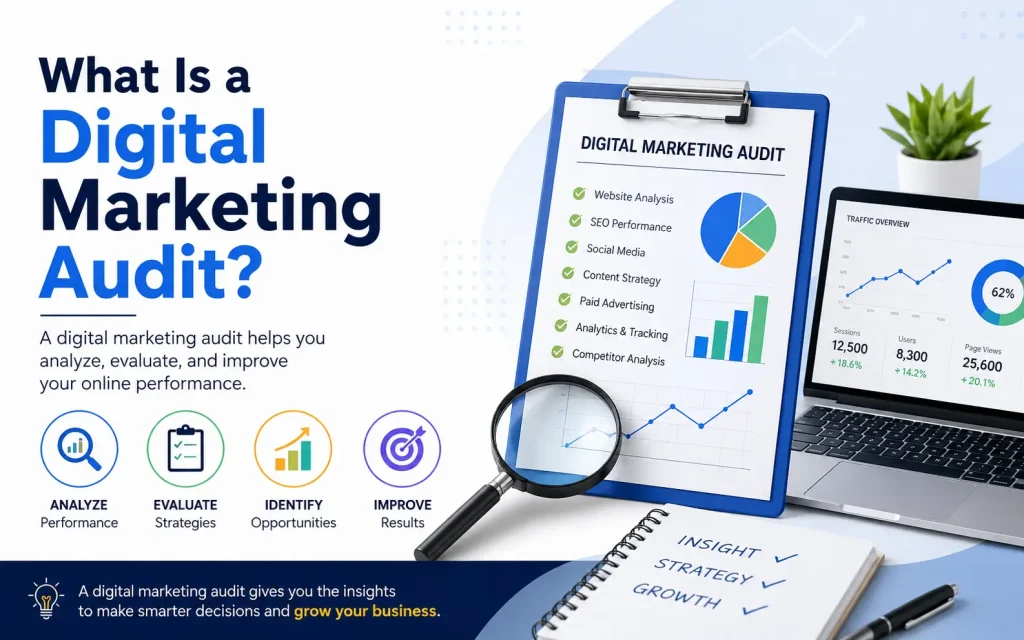
A digital marketing audit is a structured review of every online channel your business uses to attract and convert customers. That includes your website, SEO, paid ads, social media, email, and the analytics setup tracking it all.
The goal is simple: find out what is working, what is wasting money, and what needs to change. A good audit does not just list problems. It ranks them by impact, so you know what to fix first.
Think of it as a health checkup for your marketing. You would not keep taking medicine without knowing if it works. The same logic applies to your ad spend, your content, and your SEO strategy.
Why a Digital Marketing Audit Matters More Than Ever
Marketing budgets have grown, and so has the noise. When more business compete for the same attention, guesswork gets expensive fast.
Here is what an audit typically uncovers, and why it matters:
- Wasted ad spend. Many accounts run campaigns nobody has touched in months, still pulling budget with no results to show.
- Broken or missing tracking. If your analytics are not set up correctly, every other decision you make is based on bad data.
- Disconnected channels. SEO, ads, and social media often run in silos instead of supporting one shared goal.
- Outdated content. Pages that ranked well two years ago can quietly lose traffic as competitors update theirs.
- No clear ownership of ROI. Without an audit, it is hard to say which channel actually drives revenue versus which one just looks busy.
An audit turns these blind spots into a prioritized action list, so your next marketing dollar goes somewhere that pays you back.
Warning Signs You Need a Digital Marketing Audit
You probably need an audit if any of these sound familiar:
- You are spending on ads but cannot explain what is actually driving sales.
- Your tools do not talk to each other, so tracking a customer’s journey is guesswork.
- Every “expert” gives you different advice, and you no longer know who to trust.
- Campaigns launched months ago are still running, untouched and unreviewed.
- Competitors seem to dominate search results and social feeds, and you are not sure how.
- Your website gets visitors, but they leave without buying or contacting you.
- Traffic and impressions look fine, but sales do not match.
- You are staring at dashboards full of numbers and still cannot answer, “Is this working?”
If two or more of these apply, an audit will pay for itself quickly by showing you exactly where to redirect your budget.
Types of Digital Marketing Audits
Not every audit needs to cover everything. Businesses usually choose based on their most urgent concern.
| Audit Type | What It Reviews | Best For |
|---|---|---|
| Full Digital Marketing Audit | SEO, PPC, social, content, email, analytics | Businesses unsure where the problem even is |
| SEO Audit | Technical SEO, on-page content, backlinks, rankings | Sites losing organic traffic or stuck in rankings |
| PPC/Ad Spend Audit | Google Ads, Meta Ads, targeting, bidding, ROAS | Businesses with rising ad costs and flat sales |
| Social Media Audit | Content performance, engagement, posting strategy | Brands with followers but low engagement |
| Website & UX Audit | Site speed, mobile experience, conversion paths | High traffic but low conversion rate |
| Content Audit | Blog performance, duplication, outdated pages | Sites with large content libraries and mixed results |
| Analytics & Tracking Audit | Tag setup, conversion tracking, data accuracy | Anyone who does not fully trust their own reports |
Most businesses start with a full audit, then run focused mini-audits every quarter on the channel that needs the closest attention.
What a Complete Digital Marketing Audit Covers
A thorough audit typically looks at six core areas:
- Website and SEO: Technical health, page speed, mobile experience, keyword rankings, and backlink quality.
- Paid advertising: Campaign structure, targeting accuracy, wasted spend, and cost per conversion.
- Social media: Content quality, posting consistency, and real engagement versus vanity metrics.
- Content: Relevance, freshness, duplication, and whether it matches what your audience actually searches for.
- Email marketing: Open rates, click-through rates, list health, and automation setup.
- Analytics and tracking: Whether your data is accurate enough to trust for decision-making.
Missing even one of these areas leaves gaps. For example, fixing your SEO while your tracking is broken means you will not even know if the fix worked.
SEO and Website Audit Checklist
Your website is usually where an audit starts, because if visitors cannot use your site well, nothing else matters.
Check these areas:
- Page load speed on both desktop and mobile
- Mobile responsiveness across devices
- Broken links, 404 errors, and redirect chains
- Keyword rankings for your target terms
- On-page elements: title tags, meta descriptions, header structure
- Backlink profile quality, not just quantity
- Site architecture and internal linking
- Duplicate or thin content pages
- Core Web Vitals scores
- SSL security and crawlability (robots.txt, sitemap)
A slow, hard-to-navigate site can undo the benefit of every other marketing dollar you spend, since paid traffic that lands on a poor experience rarely converts.
Paid Advertising (PPC) Audit Checklist
Ad platforms are built to spend your budget efficiently for the platform, not always for you. An audit brings that back under your control.
Review:
- Campaign and ad group structure for overlap or waste
- Keyword match types and negative keyword lists
- Audience targeting accuracy
- Ad copy relevance and click-through rate
- Landing page alignment with ad promises
- Bidding strategy versus actual goals
- Conversion tracking accuracy
- Return on ad spend (ROAS) by campaign, not just overall
- Budget allocation across underperforming versus high-performing campaigns
It is common to find 20 to 40 percent of ad budget going toward keywords or audiences that have never produced a sale. Catching that alone often covers the entire cost of the audit.
Social Media Marketing Audit Checklist
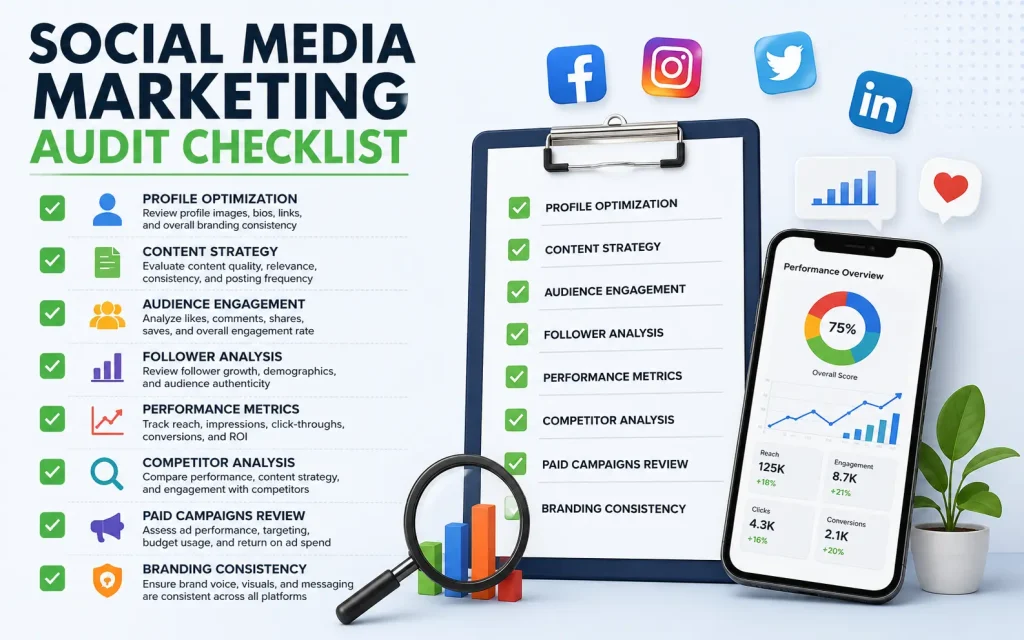
Follower counts look good on a slide, but they rarely pay bills on their own. This part of the audit separates real traction from noise.
Look at:
- Engagement rate relative to follower count, not just raw numbers
- Which content formats and topics actually perform
- Posting consistency and best times to post
- Audience demographics versus your actual target customer
- Paid social ad performance and targeting
- Response time and community management
- Competitor benchmarking on the same platforms
A brand with 5,000 engaged followers often outperforms one with 50,000 disengaged ones. The audit tells you which situation you are actually in.
Content and Email Marketing Audit Checklist
Content and email are where a lot of marketing budget quietly goes unmeasured.
Content review points:
- Which pages or posts drive traffic and which drive none
- Content freshness and accuracy of information
- Duplicate topics competing against each other
- Alignment between content and buyer intent at each funnel stage
Email review points:
- Open rate and click-through rate against industry benchmarks
- List hygiene and unengaged subscriber cleanup
- Automation sequences and whether they still make sense
- Segmentation quality versus one-size-fits-all sends
Old, outdated content is often worse than no content at all, since it can actively mislead visitors and hurt trust.
Analytics, Tracking, and Data Quality Audit
This step gets skipped the most, and it is often the most important. If your tracking is wrong, every decision built on top of it is wrong too.
Verify:
- Google Analytics (or your analytics platform) is correctly installed sitewide
- Conversion events are firing accurately, not double-counting or missing entirely
- UTM tagging is consistent across all campaigns
- CRM and ad platform data match up with actual sales
- Attribution model matches how your customers actually buy
Many businesses discover during an audit that a tracking code broke months ago, meaning every report since then has been misleading. Fixing this first prevents wasted decisions later.
How to Conduct a Digital Marketing Audit: A 7-Step Process
Here is the practical order to follow, whether you are doing this yourself or briefing an agency.
| Step | Action | Outcome |
|---|---|---|
| 1. Define objectives | Set clear, measurable goals tied to business outcomes | A benchmark to measure everything against |
| 2. Collect data | Pull data from website, ads, social, email, and CRM | A single, complete picture instead of scattered reports |
| 3. Check tracking accuracy | Verify analytics and conversion tracking are correct | Confidence that the data you are about to analyze is real |
| 4. Analyze performance by channel | Review each channel against its own goals | A clear view of strong and weak performers |
| 5. Benchmark against competitors | Compare your visibility and engagement to rivals | Context for whether your numbers are actually good |
| 6. Identify opportunity gaps | Rank issues by potential impact and effort to fix | A prioritized list, not just a problem dump |
| 7. Build an action plan | Assign fixes, owners, and timelines | A roadmap your team can actually execute |
Skipping step 3 is the most common mistake. Analyzing performance before confirming your tracking is accurate means you might “fix” something that was never actually broken.
Key KPIs and Metrics to Track During Your Audit
Different funnel stages need different metrics. Tracking the wrong one for the wrong stage is a common reason audits miss the real problem.
| Funnel Stage | Key Metrics | What They Tell You |
|---|---|---|
| Awareness | Impressions, reach, unaided/aided brand awareness | How many people see your brand at all |
| Consideration | Click-through rate (CTR), cost per click (CPC), engagement rate | Whether your message makes people stop and look |
| Conversion | Conversion rate, cost per acquisition (CAC), return on ad spend (ROAS) | Whether interest turns into paying customers |
| Retention | Repeat purchase rate, email open rate, customer lifetime value (CLV) | Whether customers come back after the first sale |
Auditing only conversion metrics while ignoring awareness is like judging a race by the finish line alone. You miss why some people never even entered the race.
DIY Audit vs. Hiring Digital Marketing Audit Services- Cost and ROI

Both paths are valid, but they suit different situations.
Doing it yourself works well if:
- You have basic analytics knowledge and time to spare
- Your marketing setup is simple, with just one or two channels
- You mainly need a quick sanity check, not a deep technical review
Hiring a professional audit service works better if:
- You run paid ads across multiple platforms with real budget at stake
- Your tracking setup is complex or you suspect it is broken
- You want an outside, unbiased view instead of marking your own homework
- You need a report that translates data into a clear action plan
Professional digital marketing audit services typically range from a few hundred dollars for a focused single-channel review to a few thousand for a full, multi-channel audit with a detailed action plan. Compare that to the cost of continuing to waste 20 to 40 percent of an ad budget every month, and the audit usually pays for itself within weeks.
Common Mistakes That Ruin a Digital Marketing Audit
Even well-intentioned audits fail when they fall into these traps:
- Analyzing vanity metrics. Followers and impressions feel good but rarely predict revenue on their own.
- Skipping the tracking check. Building conclusions on broken data leads to the wrong fixes.
- No clear priorities. A 40-page report with no ranked action list just creates more confusion.
- Auditing channels in isolation. SEO, ads, and social all influence each other. Reviewing them separately misses the bigger picture.
- Treating it as a one-time event. Markets shift constantly. An audit from a year ago is already outdated.
- No follow-up plan. Finding problems without assigning owners and deadlines means nothing actually changes.
How to Choose the Right Digital Marketing Audit Service
When comparing providers, look past the pitch and check for these signals:
- Transparency: They should show you the raw data, not just a summary slide.
- Cross-channel expertise: Someone who understands SEO, PPC, and analytics together, not just one specialty.
- A track record with businesses like yours: Industry experience matters more than a long client logo wall.
- A prioritized action plan: Not just a list of problems, but a ranked plan for what to fix first.
- Clear next steps: The audit should end with a roadmap, not just a diagnosis.
Ask any provider you are considering to walk you through a sample report before you commit. If they cannot explain their findings in plain language, that is a warning sign about the final deliverable.
Frequently Asked Questions
How often should I run a digital marketing audit?
A full audit once or twice a year is a reasonable baseline, with lighter channel-specific check-ins every quarter, especially for paid ads where costs shift quickly.
How long does a digital marketing audit take?
A focused single-channel audit can take a few days. A full, multi-channel audit with a detailed action plan usually takes one to three weeks, depending on how much data needs review.
What is the difference between an SEO audit and a digital marketing audit?
An SEO audit only reviews your website and search visibility. A digital marketing audit covers SEO plus paid ads, social media, email, content, and analytics together.
Can I run an audit myself for free?
Yes, using free tools like Google Analytics, Google Search Console, and platform-native ad reports. This works fine for a basic check, but a professional audit catches issues that free tools alone tend to miss, especially around tracking accuracy and cross-channel strategy.
What should I do right after receiving my audit report?
Start with the highest-impact, lowest-effort fixes first, such as correcting broken tracking or pausing wasted ad spend, then move into the larger strategic changes on a set timeline.
Final Thoughts
Digital Marketing Audit Services are essential for businesses that want to improve their online performance and achieve sustainable growth. A detailed audit helps identify weaknesses uncover new opportunities and create a clear roadmap for success.
From SEO and website performance to content social media and advertising a complete digital marketing audit provides valuable insights that help businesses make smarter decisions.
In a competitive online environment businesses that regularly analyze and improve their digital strategies have a stronger chance of attracting customers building trust and growing successfully.