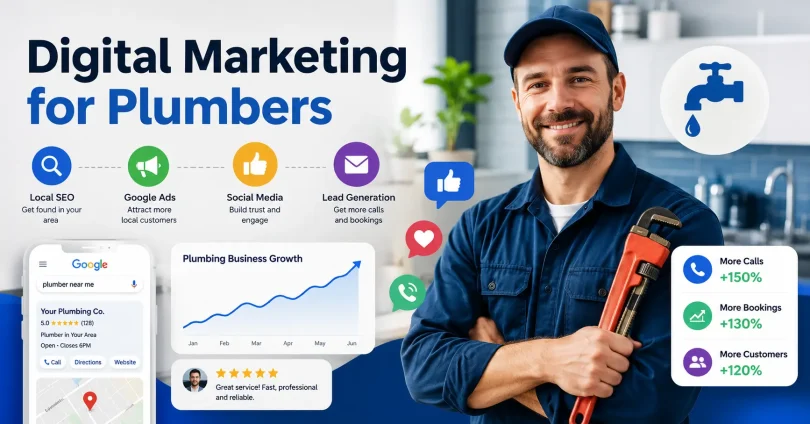

Digital Marketing for Plumbers is no longer just about having a website or a Facebook page. It is about making sure your business appears exactly when homeowners and businesses need emergency plumbing services. Whether someone is dealing with a burst pipe, a leaking water heater, a blocked drain, or an overflowing toilet, their first instinct is usually to search online for a trusted local plumber. If your business is visible and your competitors are not, you have already won half the battle.
Plumbing is a trust-based business, and customers search for a plumber only when they need immediate help. That is why Digital Marketing for plumbers is different from most industries. Effective Digital Marketing helps your business build trust quickly through strong local visibility, positive customer reviews, and a professional website that shows your team is reliable and ready to help.
Why Digital Marketing Matters for Plumbers
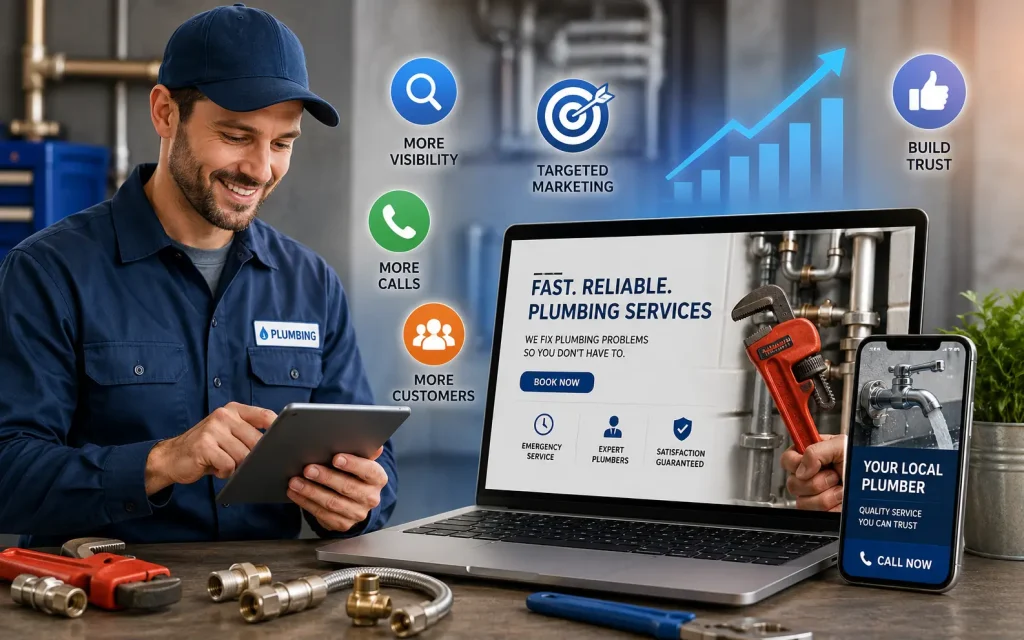
People rarely plan for plumbing emergencies. They search online when they need immediate help that means your business needs to appear where customers are looking.
Benefits include:
- Generate more qualified local leads.
- Increase emergency service calls.
- Build trust with online reviews.
- Improve local brand recognition.
- Grow repeat business.
- Stay ahead of competitors.
- Reduce dependence on referrals.
- Increase monthly revenue.
Businesses that invest consistently in online marketing often receive a steady flow of inquiries throughout the year.
Why Plumbers Need a Different Marketing Playbook
Plumbing customers fall into two very different buckets, and your marketing has to speak to both:
- Emergency searchers who need help right now. They’re comparing response time, availability, and trust signals in seconds, often from a phone while standing in water.
- Planned-project searchers who are budgeting for a bathroom remodel, water heater replacement, or repiping job. They browse longer, read reviews, and compare quotes over days or weeks.
A marketing strategy built only for one group leaves money on the table. Emergency traffic needs speed fast-loading pages, a visible phone number, and same-day availability messaging.
Planned-project traffic needs proof portfolios, financing options, and detailed pricing guidance. Your website, ads, and content should serve both without forcing either group to dig for what they need.
Table 1: Emergency vs. Planned-Project Customers
| Factor | Emergency Customer | Planned-Project Customer |
|---|---|---|
| Decision time | Under 5 minutes | Several days to weeks |
| Top priority | Fast response, availability | Price, reputation, past work |
| Preferred contact | Phone call | Form, quote request |
| Marketing channel that wins | Google Maps, Local Service Ads | SEO content, reviews, social proof |
| Website must show | Phone number, “24/7” badge | Gallery, pricing ranges, financing |
Start With Local SEO, Not a Redesign
Plumbers often assume the fix for weak leads is a prettier website. In reality, most plumbing websites lose business long before design matters, because they’re invisible in local search. Local SEO for plumbers focuses on ranking in three places: the Google Map Pack, organic local results, and Google Business Profile.
Claim and Optimize Your Google Business Profile
This is the single highest-leverage step in plumber marketing, and it’s free. A complete, active Google Business Profile (GBP) is what populates the map with the three plumbers a searcher sees before scrolling further.
To get this right:
- Use your real business name, not a keyword-stuffed variant like “Best 24/7 Emergency Plumber.”
- List every service area you actually cover, not just your city.
- Pick primary and secondary categories carefully (“Plumber” as primary, then relevant secondaries like “Drainage service” or “Water heater installer”).
- Upload real photos of your team and completed jobs, not stock images. Google and customers can tell the difference.
- Post updates weekly: a finished job, a seasonal tip, an availability note. Profiles that post regularly get more visibility than static ones.
- Respond to every review, good or bad, within 48 hours. Response rate itself is a ranking factor, and it’s the first thing anxious customers read.
Build Location Pages, Not Just a Homepage
If you serve multiple towns or neighborhoods, one homepage cannot rank for all of them. Create a dedicated page for each major service area with unique content: the neighborhoods you cover, common local plumbing issues (hard water in one town, old cast-iron pipes in another), and a local phone number if possible. Duplicate boilerplate across these pages actively hurts your rankings, so each page needs real, specific text.
Fix Technical Basics Competitors Skip
Several plumbing marketing agencies talk about SEO in the abstract but skip the technical checklist that actually moves rankings:
- Site loads in under 3 seconds on mobile. Slow-loading emergency pages lose customers who are already anxious and impatient.
- Click-to-call buttons are present on every page, not buried in a menu.
- Schema markup (LocalBusiness, Service, and Review schema) is installed so Google understands your service area, hours, and ratings.
- HTTPS is active and there are no broken links or redirect chains.
- Your NAP (Name, Address, Phone) is identical across your website, GBP, and every directory listing. Inconsistent NAP data confuses Google and quietly suppresses rankings.
Local Service Ads and PPC: Paying for Speed to Market
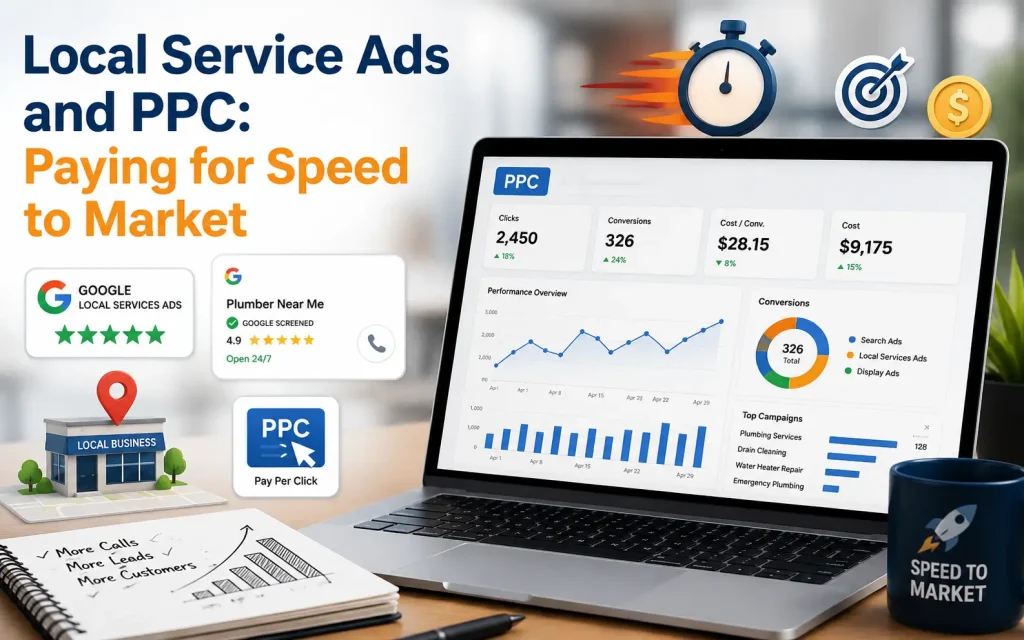
SEO takes months to build momentum. If you need calls this week, Google Local Service Ads (LSAs) and traditional pay-per-click (PPC) campaigns fill that gap.
Local Service Ads appear above the map pack, show your reviews and a “Google Screened” badge, and charge you per lead rather than per click, which matters because plumbing clicks can cost $15 to $50 in competitive markets. LSAs are worth prioritizing early because they build trust visually (the badge) while you wait for organic SEO to mature.
Search PPC campaigns still have a place, particularly for high-value services like repiping, sewer line replacement, or tankless water heater installs, where the customer lifetime value justifies a higher cost per click. The mistake most plumbers make with PPC is running one generic “plumber” campaign. Instead:
- Separate campaigns by service (drain cleaning, water heater repair, emergency plumbing) so you can control budget and messaging per service.
- Use call-only ad formats for emergency keywords like “burst pipe repair now.”
- Add negative keywords early (“DIY,” “how to,” “jobs,” “training”) to stop wasting budget on searchers who aren’t hiring anyone.
- Track calls, not just clicks. A click means nothing if it doesn’t convert to a booked job.
Table 2: Marketing Channel Speed-to-Result Comparison
| Channel | Time to See Results | Ongoing Cost | Best For |
|---|---|---|---|
| Google Business Profile / Local SEO | 2 to 6 months | Low (mostly time) | Long-term, steady lead flow |
| Local Service Ads | Days to 2 weeks | Pay-per-lead | Emergency calls, fast trust |
| Search PPC | Immediate | Pay-per-click | High-value jobs, seasonal spikes |
| Content marketing / blog | 3 to 9 months | Low to moderate | Planned-project customers, authority |
| Social media / review generation | Ongoing | Low | Reputation, referrals |
Reviews Are Your Real Advertising Budget
Here’s something most plumbing marketing content underplays: review volume and recency often outweigh website polish when it comes to winning the call. A plumber with 150 recent, detailed reviews and an average site will frequently out-book a plumber with a stunning website and 12 reviews.
Build a review system, not a hope:
- Text customers a review link within an hour of job completion, while the relief of a fixed problem is still fresh.
- Ask a specific question in your request, like “How was our technician’s punctuality and communication?” Specific prompts produce more detailed, more persuasive reviews than a generic ask.
- Spread reviews across Google, Yelp, and Facebook rather than funneling everything to one platform. It looks more organic and protects you if one platform changes its algorithm.
- Never buy or fake reviews. Google actively detects and penalizes this, and it can tank an otherwise healthy profile overnight.
Content Marketing That Actually Builds Authority
Blogging “how to unclog a drain” articles is common advice, and it’s not wrong, but it rarely differentiates you because every competitor writes the same five posts. What builds real authority and E-E-A-T (Experience, Expertise, Authoritativeness, Trustworthiness) signals is content that only someone who has actually done the work could write.
Stronger content ideas include:
- Real cost breakdowns for your region (“What a water heater replacement actually costs in [city], including permit fees”)
- Before-and-after case studies of specific jobs, with photos and the actual problem diagnosis
- Seasonal maintenance guides tied to your climate (frozen pipe prevention where winters are harsh, hard-water scaling where it’s common)
- Honest comparisons (“When to repair vs. replace a water heater”) that build trust precisely because they don’t push the most expensive option every time
This kind of content also naturally attracts backlinks from local news sites, home improvement bloggers, and community forums, which strengthens your domain’s authority far more than generic advice posts.
Table 3: Content Types Ranked by Trust and SEO Value
| Content Type | Builds Trust | SEO Value | Effort Required |
|---|---|---|---|
| Real cost breakdowns | High | High | Medium |
| Before-and-after case studies | Very high | Medium | Medium |
| Generic “how-to” DIY posts | Low | Low to medium | Low |
| Seasonal maintenance guides | High | High | Low to medium |
| FAQ pages targeting voice search | Medium | High | Low |
Don’t Ignore Voice and AI-Powered Search
An area most plumbing marketing guides still miss entirely: how people find services through voice assistants and AI answer engines is shifting fast. When someone asks Siri, Alexa, or an AI chat assistant “who can fix a leaking pipe near me tonight,” the answer typically pulls from structured, concise content and strong local listings, not long-form pages full of marketing language.
To stay visible as this grows:
- Write FAQ sections in plain, conversational question-and-answer format (“Can a plumber fix a burst pipe the same day?”)
- Keep answers concise (40 to 60 words) directly under each question, since that format is what gets pulled into featured snippets and voice answers.
- Make sure your service area, hours, and emergency availability are stated in plain text somewhere on your site, not just as an image or icon, since AI tools read text, not graphics.
Website Conversion: Traffic Means Nothing Without Booked Jobs
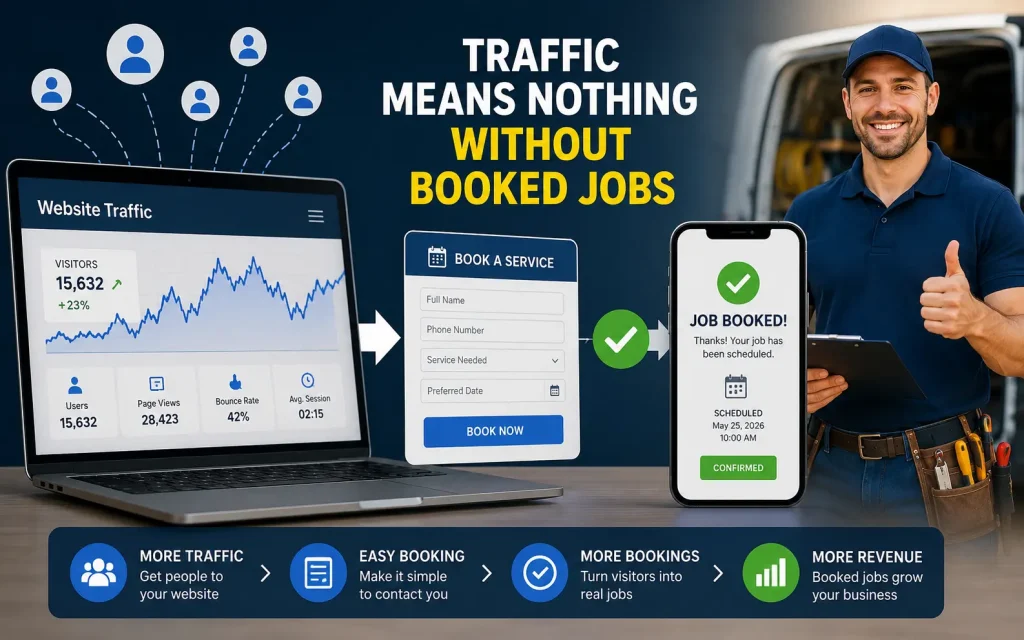
Getting someone to your site is only half the job. A shocking number of plumbing websites lose the customer at the final step.
Fix these common leaks:
- One clear call to action per page. Don’t make a visitor choose between “Call Now,” “Get a Quote,” and “Chat With Us” all competing for attention. Pick one primary action per page.
- Show pricing signals, even ranges. Plumbers avoid publishing prices out of fear of scaring people off, but vague pricing scares people off more. A stated range (“Drain cleaning typically runs $150 to $350”) builds trust and filters out bad-fit leads before they call.
- Add trust badges above the fold: licensed, bonded, insured, years in business, and any manufacturer certifications (Rheem, Rinnai, etc.).
- Make mobile the priority, not an afterthought. Most emergency searches happen on a phone. If your click-to-call button isn’t within thumb’s reach near the top of the screen, you’re losing calls.
- Add live chat or a text option. Some customers, especially younger homeowners, would rather text than call. Offering both doubles your capture rate.
Tracking What Actually Matters
Many plumbing businesses measure the wrong things: website visits, impressions, or vanity social metrics.
What actually matters is cost per booked job. Set up:
- Call tracking numbers on every marketing channel (GBP, PPC, LSAs, organic) so you know exactly where booked jobs come from.
- A simple spreadsheet or CRM that logs lead source against job value, so you can see which channel produces the highest-paying jobs, not just the most calls.
- Monthly review of which keywords or ads generate no-shows or price-shoppers versus real booked revenue, so budget shifts toward what actually pays.
A Realistic 90-Day Starting Plan
If you’re starting from close to zero, here’s a sequence that produces results without overwhelming a small team:
- Weeks 1 to 2: Fully optimize Google Business Profile, fix NAP consistency across directories, install basic schema markup.
- Weeks 2 to 4: Launch Local Service Ads and a focused PPC campaign for your highest-value service.
- Weeks 3 to 6: Build out location pages for each service area and fix mobile site speed and click-to-call placement.
- Weeks 4 to 8: Set up an automated review request system and start collecting fresh reviews weekly.
- Weeks 6 to 12: Publish three to four pieces of genuinely useful content (cost guides, case studies, FAQ pages) rather than generic blog filler.
- Ongoing from week 8: Install call tracking, review the data monthly, and shift budget toward the channels producing the highest-value booked jobs.
Frequently Asked Questions
What is digital marketing for plumbers?
Digital marketing for plumbers is the process of promoting plumbing services online using SEO Google Ads social media email marketing and local search optimization to generate more customers.
Is SEO worth it for plumbing businesses?
Yes. Local SEO helps plumbers rank higher in Google search results which increases calls website visits and qualified leads.
Should plumbers use Google Ads?
Yes. Google Ads can generate immediate leads especially for emergency plumbing services where customers need fast assistance.
How important are online reviews?
Online reviews build trust improve local search rankings and influence customer decisions making them essential for plumbing businesses.
What social media platform works best for plumbers?
Facebook and Instagram are excellent platforms for sharing completed projects maintenance tips customer testimonials and company updates.
How long does plumbing SEO take?
Most plumbing businesses begin seeing SEO improvements within three to six months although results depend on competition and website quality.
What is the best marketing strategy for plumbers?
The best strategy combines local SEO Google Ads review management content marketing email marketing and a fast mobile friendly website to generate consistent long-term leads.
Final Thoughts
Digital marketing for plumbers isn’t about picking one magic channel. It’s about matching the right channel to the right kind of customer: fast, trust-heavy tactics for emergencies, and proof-driven content for planned projects. Local SEO earns you the free, compounding leads.
Local Service Ads and PPC buy you speed while that SEO matures. Reviews and real content build the trust that ultimately closes the call. Skip any one piece, and you’re leaving booked jobs on the table for the competitor who didn’t.
Start with your Google Business Profile this week. It costs nothing but time, and for most plumbers, it’s the single fastest lever that turns searches into booked calls.
You May Also Like It:
Small Business Digital Marketing Agency