

Family Law Digital Marketing is essential because family law is personal. People come to you during a divorce a custody battle or another difficult life event. They are stressed searching late at night and comparing several attorneys before they ever pick up the phone.
Family Law Digital Marketing helps your firm appear where potential clients are looking. The law firm that ranks first looks trustworthy and responds quickly often wins the client not necessarily the firm with the most experience.
Family Law Digital Marketing in 2026 focuses on strategies that deliver real results including local SEO content marketing online reviews paid advertising client intake optimization and ethical compliance. This guide explains what actually works without unnecessary fluff or outdated advice.
What Is Family Law Digital Marketing
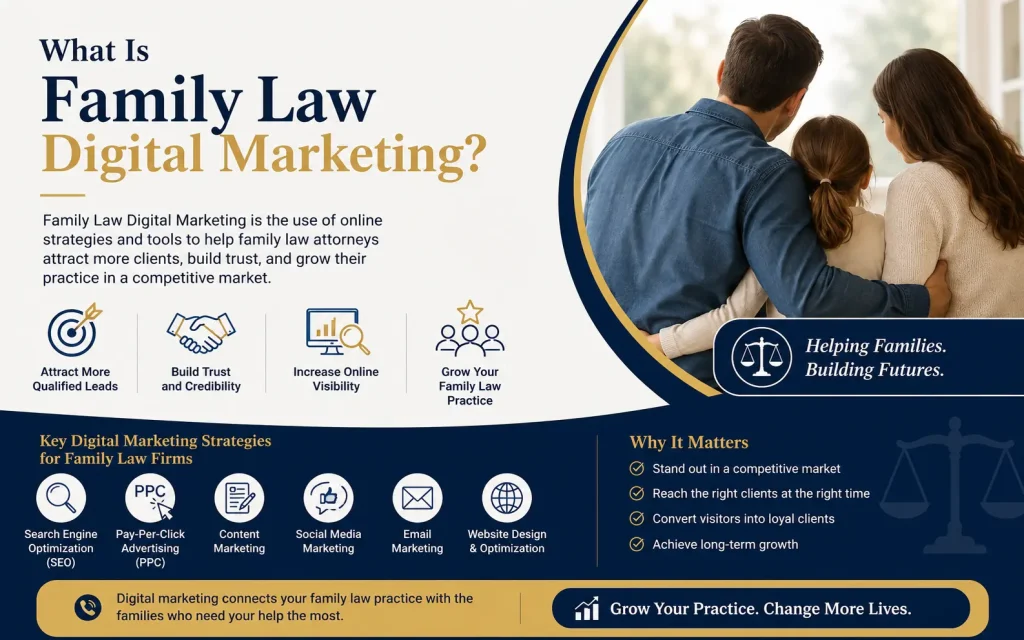
Family law digital marketing is the set of online strategies attorneys use to get found by people searching for divorce, custody, child support, or family-related legal help, and to convert those searches into signed clients.
It combines several moving parts:
- Search visibility (SEO and Google Business Profile)
- Paid advertising (Google Ads, Local Service Ads, social ads)
- Website experience (speed, clarity, mobile usability)
- Content (blog posts, videos, FAQs)
- Trust signals (reviews, testimonials, case results)
- Intake and follow-up (how fast and how well you respond to leads)
Skip any one of these, and you leave money on the table. A firm with great SEO but a slow intake process still loses clients to a competitor who calls back in five minutes.
Why Family Law Marketing Is Different From Other Legal Niches
Family law clients rarely make calm, comparison-shopping decisions. Someone searching “divorce lawyer near me” at 11 p.m. is often mid-crisis.
This changes your marketing priorities:
- Speed matters more than polish. A fast response often beats a fancier website.
- Trust signals carry more weight than in transactional practice areas like real estate closings.
- Search intent is hyper-local. People want a lawyer who knows their local family court, judges, and filing procedures, not just “a lawyer.”
- Emotional tone matters. Clinical, jargon-heavy copy pushes worried people away.
Keep this in mind as you read the rest of this guide. Every tactic below should ultimately answer one question: does this make an anxious person trust us enough to call?
Own Your Local Search Presence First
Most family law searches are local (“child custody attorney in Denver,” “divorce lawyer near me”). Before spending a dollar on ads, get your local search foundation right.
Optimize your Google Business Profile (GBP):
- Claim and verify your profile if you haven’t already.
- Choose accurate primary and secondary categories (e.g., “Divorce Lawyer,” “Family Law Attorney”).
- Add real photos of your office and team, not stock photos.
- List your practice areas divorce, custody, child support, adoption, prenups, mediation.
- Post updates monthly, such as a recent case win, a new blog post, or an office update.
- Keep your name, address, and phone number identical across your website, GBP, and directories. Inconsistent listings confuse Google and hurt rankings.
Build local citations:
List your firm on legal directories such as Avvo, Justia, FindLaw, and your local bar association, plus general directories like Yelp and Bing Places. Consistency across these listings is a ranking factor most firms overlook.
Why this matters: Google’s local results (the map pack) often appear above organic results for “near me” searches. If you’re not optimizing for this, you’re invisible to a large share of ready-to-hire searchers.
Build an SEO Strategy Around Real Client Questions
Keyword research should start with the questions your clients actually ask during consultations, not generic guesses.
Target a mix of keyword types:
| Keyword type | Example | Purpose |
|---|---|---|
| High-intent local | child custody lawyer in Austin | Ready to hire |
| Informational long-tail | how long does divorce take in Texas | Building trust early |
| Question-based | can I move out of state with my kids after divorce | Voice search and AI search |
| Comparison | mediation vs litigation divorce | Educating undecided prospects |
On-page basics that still matter:
- One clear, keyword-relevant title tag per page.
- A meta description that states a benefit, not just a topic.
- Descriptive URLs (
/child-custody-lawyer-austin, not/page2. - Internal links between related practice area pages and blog posts.
- Fast load times and mobile-first design. Google indexes the mobile version of your site, and most family law searches happen on a phone.
A gap most firms miss: structure your content so AI tools like Google’s AI Overviews and ChatGPT can quote you directly. Use clear, direct answers near the top of each section (a sentence or two answering the question plainly), then expand with detail. This is often called answer-engine optimization, and it’s becoming as important as traditional SEO.
Create Content That Actually Helps, Not Just Ranks
Content marketing for family law works best when it reduces a worried person’s uncertainty.
Cover the questions people ask before they ever call a lawyer:
- What happens to the house in a divorce
- How is child support calculated in state
- Do I need a lawyer for an uncontested divorce
- What’s the difference between legal and physical custody
Formats to mix in, beyond blog posts:
- Short videos answering one question each (60 to 90 seconds). Video builds trust faster than text because people see and hear you before ever meeting you.
- Downloadable checklists, such as “Documents to Gather Before Your Divorce Consultation.” These also work well for capturing email addresses.
- FAQ pages with schema markup, which can earn rich snippets in search results and feed AI answer engines.
- Client-friendly explainer graphics for complex topics like custody schedules or asset division timelines.
Publish consistently rather than in bursts. One well-researched article every one to two weeks outperforms ten rushed posts dumped in a single month.
Treat Your Website Like Your First Consultation

Your website is often the first “meeting” a prospective client has with your firm. Design it accordingly.
Non-negotiables:
- Phone number visible on every page, ideally clickable on mobile.
- A simple contact form with as few fields as possible. Every extra field lowers your conversion rate.
- Clear practice area pages (divorce, custody, support, adoption, mediation) instead of one vague “family law” page.
- Attorney bios with real photos, credentials, and a sentence about who they help and how.
- Load time under three seconds. Slow sites lose visitors before they read a word.
Trust elements that competitors often skip:
- Client reviews embedded directly on service pages, not just linked to Google.
- Case results or outcomes, presented carefully and in line with your state bar’s advertising rules (more on that below).
- A clear “what to expect” section describing your consultation process step by step. Uncertainty is the biggest barrier to a worried person picking up the phone.
Turn Reviews Into a Growth Engine
Reviews are one of the strongest trust signals in legal marketing, and they’re also a local SEO ranking factor. Yet most firms treat reviews as an afterthought.
A simple system that works:
- Ask for a review within 48 hours of case resolution, when gratitude is highest.
- Send a direct link that goes straight to the review form, not just your homepage.
- Respond to every review, positive or negative, professionally and promptly.
- Never offer anything of value in exchange for a review. Most state bars and Google both prohibit this.
A steady stream of recent, detailed reviews (not just star ratings) tells both Google and prospective clients that people trust you right now, not just five years ago.
Use Paid Ads to Capture People Ready to Hire
SEO and content build long-term visibility, but paid ads capture people searching today.
Google Ads and Local Service Ads (LSAs):
- LSAs are especially strong for family law because they show a “Google Screened” badge and charge per lead, not per click, which often lowers wasted spend.
- For standard Google Ads, bid on high-intent terms (“divorce attorney [city]”) and use ad extensions for phone numbers and location.
Retargeting ads:
Most visitors won’t call on their first visit. Retargeting (showing ads to people who already visited your site) keeps your firm visible while they weigh their options, without paying for a fresh click every time. This is one of the most underused tactics in family law marketing.
Set a realistic budget expectation:
Family law keywords are expensive because the client value is high. Track cost per lead and cost per signed case, not just cost per click. A $150 lead that becomes a $6,000 retainer is a good deal. A $20 lead that never converts is not.
Respond Faster Than the Other Attorneys They’re Calling
This is the step most marketing guides skip, but it determines whether all your SEO and ad spend actually pays off.
Family law prospects typically contact two to four firms before choosing one. Speed decides who wins the consultation.
Build this into your process:
- Answer or return calls within five minutes during business hours whenever possible.
- Use a chatbot or after-hours answering service so a 9 p.m. search doesn’t go unanswered until the next morning.
- Set up automated email or text confirmations the moment someone submits a contact form, even before a human replies.
- Use client intake software to track every lead so nothing falls through the cracks between your website, ads, and phone lines.
A beautifully optimized website with a 24-hour response time will consistently lose to a mediocre website with a five-minute response time.
Nurture Leads Who Aren’t Ready Yet
Not every visitor is ready to hire today. Some are still deciding whether to leave a marriage, researching options quietly, or waiting for the right moment. Losing these leads is a common, avoidable mistake.
Build a simple nurture sequence:
- Offer a helpful resource (a checklist or guide) in exchange for an email address.
- Send three to five follow-up emails over a few weeks with genuinely useful information, not sales pressure.
- Include one clear invitation to schedule a consultation in each email.
This turns “not ready yet” traffic into future clients instead of losing them entirely to whichever competitor happens to be visible when they finally are ready.
Stay Inside Your State Bar’s Advertising Rules
This is the part almost every marketing guide for lawyers leaves out, and it’s the one that can get a campaign pulled or a firm sanctioned.
Legal advertising is regulated. Rules vary by state, but common restrictions include:
- Prohibitions on guaranteeing outcomes (“We will win your case”) or comparing your results to other firms.
- Required disclaimers on testimonials or case results in some states.
- Rules around using terms like “specialist” or “expert” without proper certification.
- Restrictions on unsolicited direct contact with people who haven’t requested it, depending on the state.
Before publishing case results, testimonials, or comparative claims, check your state bar’s rules on lawyer advertising (usually under Rule 7.1 to 7.5 of your state’s Rules of Professional Conduct). A compliance review takes a fraction of the time a bar complaint does.
Family Law Marketing Track What Actually Matters

Traffic and clicks feel good, but they don’t pay the bills. Track the numbers that connect marketing to revenue:
- Cost per lead by channel (SEO, Google Ads, referrals, social)
- Lead-to-consultation rate: how many inquiries actually book a consult
- Consultation-to-client rate: how many consults convert to signed retainers
- Cost per signed case, not just cost per click
- Average case value, so you know which channels bring in your most valuable clients
Review this monthly. If a channel brings in leads but few actually sign, the problem might be intake speed, not marketing quality. Diagnosing the right stage saves you from cutting a channel that was actually working.
Common Mistakes to Avoid
- Treating the website as a brochure instead of a conversion tool. Every page should make it easy to take the next step.
- Ignoring mobile users. Most family law searches happen on a phone during a stressful moment, often outside business hours.
- Letting the blog go stale. A blog with no posts in eight months signals neglect, not authority.
- Chasing rankings while ignoring intake speed. More traffic without faster response times just means more missed opportunities.
- Copying competitor content word for word. It rarely ranks and can create real legal risk around originality and, in some cases, defamation or misrepresentation if case details are inaccurate.
Frequently Asked Questions
What is Family Law Digital Marketing?
Family Law Digital Marketing is the use of SEO, PPC, content marketing, social media, email marketing, and local SEO to help family law firms attract more qualified clients online.
Why is Family Law Digital Marketing important?
Family Law Digital Marketing helps your law firm increase online visibility, generate qualified leads, build trust, and grow your client base in a competitive legal market.
How does SEO help family law firms?
SEO improves your website’s rankings on Google, making it easier for potential clients to find your family law services when searching online.
What are the best digital marketing strategies for family law firms?
The most effective strategies include local SEO, Google Business Profile optimization, content marketing, PPC advertising, online reviews, and conversion-focused website design.
Is Google Ads effective for Family Law Digital Marketing?
Yes. Google Ads can generate high-quality leads by targeting people actively searching for family law attorneys, divorce lawyers, or child custody legal services.
How long does Family Law SEO take to show results?
Most family law firms start seeing SEO improvements within 3 to 6 months, while significant growth typically takes 6 to 12 months.
What type of content should a family law firm publish?
Publish helpful content about divorce, child custody, child support, adoption, mediation, domestic violence, alimony, and legal processes to answer clients’ questions.
The Bottom Line
Family law digital marketing isn’t just about ranking on Google It’s about being visible at the right moment, earning trust quickly, and responding fast enough to turn a worried searcher into a client who feels confident they chose the right firm.
Start with your Google Business Profile and reviews, since those changes are fast and free. Then layer in content, ads, and a faster intake process. The firms that grow steadily are rarely the ones with the biggest budget. They’re the ones that show up consistently and respond first.