
If you run a fintech company, you already know the challenge your product is complex, your audience is skeptical, and your competitors are spending heavily on every available channel.
A general marketing agency rarely cuts it. What you need is a fintech digital marketing agency that speaks your language, understands compliance, and knows how to build trust in one of the most regulated industries in the world.
This guide covers everything you need to know, from what these agencies actually do to how to pick the right one for your stage of growth.
What Is a Fintech Digital Marketing Agency
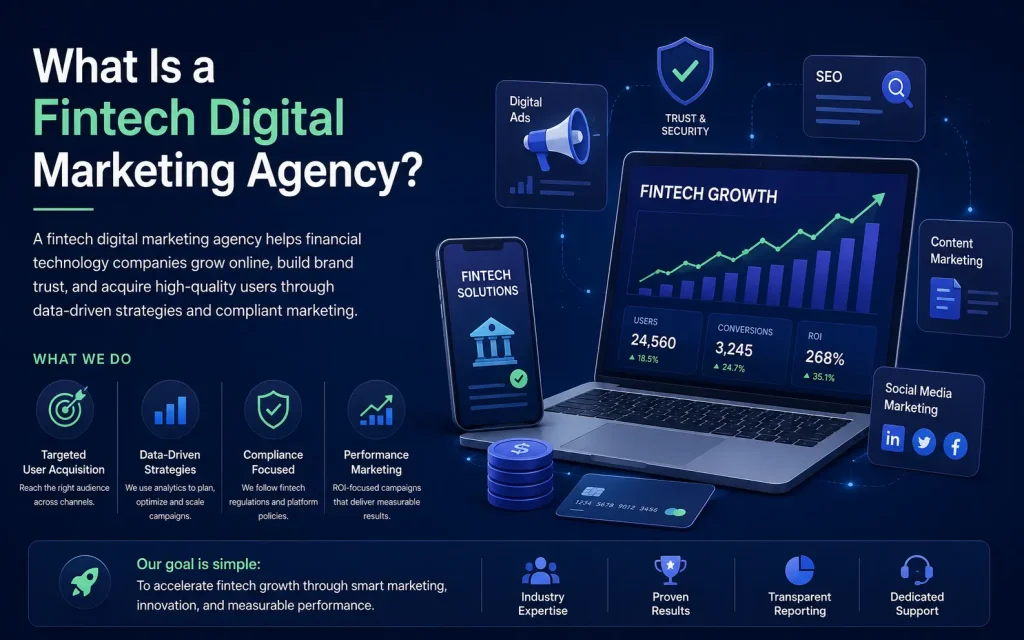
A fintech digital marketing agency is a specialist firm that helps financial technology companies grow their customer base, build brand authority, and generate revenue through digital channels. The word “specialist” is doing serious work in that sentence.
Fintech is not like selling software or e-commerce. Your buyers need to trust you with their money, their data, or both. Regulations such as FCA rules in the UK, SEC guidelines in the US, and GDPR across Europe shape what you can and cannot say. A great idea in a standard marketing brief can become a compliance violation in fintech.
These agencies understand that gap. They combine marketing execution with financial services expertise, so your campaigns are both effective and legally sound.
Why General Marketing Agencies Fall Short in Fintech
Most marketing agencies are excellent at growing e-commerce brands, SaaS tools, or consumer apps.
Fintech is a different category entirely, and here is why general agencies often struggle:
- Compliance blind spots. An agency without financial services experience may write claims like “guaranteed returns” or “zero risk” without realizing these trigger regulatory scrutiny.
- Wrong audience assumptions. Fintech buyers, whether CFOs evaluating B2B treasury software or consumers comparing neobanks, have high information demands. Generic messaging designed for impulse-driven purchases does not work.
- Trust is the product. In fintech, your marketing does not just attract users. It builds or destroys confidence. Agencies unfamiliar with financial psychology often miss this entirely.
- Long sales cycles for B2B fintech. Enterprise fintech deals can take 6 to 18 months. Agencies tuned to shorter cycles build campaigns that burn budget before any deal closes.
A fintech-focused agency builds its entire approach around these realities.
Core Services a Fintech Digital Marketing Agency Provides
Not all agencies offer the same mix. Here is what the best ones typically cover:
SEO and Content Marketing
Content is the backbone of long-term growth in fintech. Buyers research heavily before making decisions. A fintech digital marketing agency builds a content strategy that targets high-intent keywords, earns search visibility, and positions your brand as an authority.
This goes beyond blog posts. It includes:
- Pillar pages and topic clusters built around your product categories
- Long-form comparison guides that capture buyers already researching competitors
- Bottom-of-funnel content that converts readers who are ready to act
- Thought leadership that builds executive and brand credibility
Good fintech content also demonstrates expertise. Google’s E-E-A-T framework (Experience, Expertise, Authoritativeness, and Trustworthiness) weighs especially heavily in financial content because of its potential impact on readers’ financial decisions. A specialist agency knows how to satisfy those signals.
Paid Media and Performance Marketing
Search ads, LinkedIn, Meta, and programmatic display all play a role in fintech growth, but each platform has specific restrictions on financial advertising. A fintech agency knows how to work within those restrictions while still driving conversions.
Key capabilities include:
- Google Ads management with compliant ad copy
- LinkedIn campaigns targeting CFOs, finance directors, and procurement teams for B2B fintech
- Retargeting strategies that nurture leads over long decision cycles
- Landing page optimization built around trust signals, not just CTA buttons
Conversion Rate Optimization (CRO)
Getting traffic is only half the job. Fintech products often have friction-heavy sign-up flows: identity verification, bank linking, credit checks. A specialist agency understands which friction is necessary (and reassuring to users) and which is silently killing conversions.
Brand Strategy and Messaging
In a crowded market, clarity wins. Neobanks, payment processors, lending platforms, and WealthTech tools all look similar to a first-time visitor. A fintech agency helps you articulate a positioning that sticks: who you serve, what problem you solve, and why your approach is different.
PR and Digital Authority Building
Earned media coverage in publications like Forbes, TechCrunch, Finextra, or The Financial Times builds credibility that paid ads cannot replicate. Many agencies include PR strategy, journalist relationship building, and executive positioning as part of a broader authority-building program.
Email and Lifecycle Marketing
Fintech retention is a serious problem. Activation rates are low. Churn happens quietly. A strong lifecycle marketing program guides new users from sign-up through their first meaningful action, and keeps engaged customers coming back.
What Sets the Best Fintech Marketing Agencies Apart

Many agencies claim fintech expertise. Here is how to tell who actually has it:
They Show Real Results, Not Just Logos
Anyone can put Visa and Revolut logos on a homepage. The best agencies share case studies with specific outcomes: revenue generated, cost per acquisition, organic traffic growth, qualified pipeline. Ask for numbers, not names.
They Understand the Regulatory Landscape
Ask any prospective agency how they handle compliance review in their content and ad process. The answer should be specific. They should mention working with your compliance team, having internal review checklists, and knowing the difference between what is legally permitted and what is simply best practice.
They Have Experience Across the Fintech Stack
The fintech market is wide. Neobanking, crypto, insurtech, regtech, payments, lending, and wealth management all have different buyer profiles, sales cycles, and content needs. An agency that has worked across these sub-verticals will transfer insight from one area to another in ways a generalist never can.
They Are Honest About What They Cannot Do
No agency is perfect for every fintech product. A good one will tell you if your budget is too small for the results you expect, or if your product is not yet ready to scale marketing investment. That honesty is a sign of integrity, not a red flag.
How to Choose the Right Fintech Digital Marketing Agency
Use this checklist when evaluating potential partners:
Before the first call:
- Review their client list. Do they have verifiable fintech clients?
- Read their own content. Is it substantive and accurate? Would you trust it?
- Check their website’s SEO health. An agency that cannot rank itself raises questions.
During discovery calls:
- Ask: “How do you handle compliance review in content and ads?”
- Ask: “What is your process for tracking performance against business outcomes, not just vanity metrics?”
- Ask: “Have you worked with companies at our stage of growth? What happened?”
Red flags to watch for:
- Promises of fast, dramatic results with no explanation of how
- No case studies with specific, verifiable data
- Vague answers about compliance
- Agencies that talk only about traffic and impressions, never revenue or pipeline
Fintech Marketing Channels: Where Should You Actually Invest
Channel priorities depend heavily on your product type and growth stage. Here is a general framework:
Early-stage fintech (pre-product-market fit or early traction): Focus on content marketing and SEO for long-term compounding returns. Spend on paid media only to test messaging hypotheses, not to scale. Invest in community and PR to build credibility cheaply.
Growth-stage fintech (scaling a proven product): Layer paid search and LinkedIn campaigns on top of your content foundation. Invest in lifecycle marketing and CRO to improve activation and retention. Use PR to build category authority alongside performance channels.
Enterprise fintech (selling to large organizations): LinkedIn ABM (account-based marketing), executive thought leadership, and long-form educational content dominate. Paid search still plays a role, but relationship-driven outbound and earned media carry more weight.
Common Fintech Marketing Mistakes to Avoid
Even well-funded fintech companies make these errors:
Treating trust as a feature, not a foundation. Trust is not something you add to your marketing. It has to run through every touchpoint: your copy, your design, your reviews, your response time. Agencies that treat it as a checkbox are missing the point.
Underinvesting in content for too long. SEO and content take 6 to 12 months to compound. Companies that wait until they “need” organic growth are always 12 months behind. The time to start is earlier than you think.
Confusing activity with outcomes. Publishing 20 blog posts a month or running 15 ad variations is not a strategy. The metric that matters is revenue, or at minimum, qualified pipeline. A good agency keeps that number front and center.
Neglecting existing customers. Customer acquisition in fintech is expensive. Expansion revenue and referrals from satisfied customers are far cheaper. Lifecycle marketing and retention programs are often underinvested relative to their return.
What to Expect When You Hire a Fintech Digital Marketing Agency

Here is what a realistic engagement looks like:
Month 1 to 2: Discovery, audit, and strategy. The agency reviews your existing assets, analyzes competitors, audits your current channels, and builds a prioritized roadmap. Expect questions about your ICP (ideal customer profile), your sales cycle, your compliance requirements, and your growth targets.
Month 3 to 4: Foundation building. Content calendar, SEO groundwork, ad account setup, brand messaging refinement. This phase produces less visible output but is critical for what follows.
Month 5 onward: Execution and iteration. Campaigns go live, content publishes, and data starts to accumulate. A good agency uses this data to iterate quickly. Expect monthly reporting calls with clear attribution to business outcomes.
Month 12: Compounding returns. This is where the work starts to compound. Organic traffic builds. Brand awareness creates shorter sales cycles. Retargeting pools deepen. The earlier investment starts to pay clearly visible returns.
The Rise of AI in Fintech Marketing: What It Means for Agencies
AI is reshaping how fintech marketing agencies work. Content production is faster. Ad copy testing runs at scale. Attribution modeling is sharper. But the agencies leaning on AI without human judgment are producing content that looks like everything else.
The real advantage goes to agencies that use AI to do more of the legwork while investing human expertise in the things AI cannot replicate: genuine financial insight, nuanced compliance judgment, creative storytelling, and real relationships with journalists and influencers.
When evaluating agencies, ask how they use AI in their workflow. The best answer is specific: AI assists with research, drafting, and analysis. Humans review, edit, and make strategic decisions. An agency that either refuses to use AI or uses it without guardrails is behind the curve in different directions.
Frequently Asked Questions
What is a fintech digital marketing agency?
A fintech digital marketing agency specializes in promoting financial technology companies through SEO, PPC, content marketing, social media, email marketing, and conversion optimization while understanding financial industry regulations.
Why should fintech companies hire a digital marketing agency?
A fintech marketing agency helps generate qualified leads, improve online visibility, build trust with customers, and create compliant marketing campaigns that drive measurable business growth.
What makes fintech marketing different from traditional marketing?
Fintech marketing requires industry expertise, regulatory awareness, trust-building strategies, data-driven campaigns, and messaging that explains complex financial products in simple terms.
Can a fintech digital marketing agency help startups?
Yes. Many fintech agencies help startups build brand awareness, acquire early customers, improve search rankings, and scale customer acquisition within their budget.
How long does fintech SEO take to show results?
SEO typically takes 3 to 6 months to produce noticeable improvements, although the timeline depends on your competition, website authority, and content strategy.
What services does a fintech digital marketing agency provide?
Most fintech agencies offer SEO, PPC advertising, content marketing, social media management, email marketing, website optimization, branding, lead generation, analytics, and conversion rate optimization.
Final Thoughts
Choosing the right fintech digital marketing agency is one of the highest-leverage decisions a growing fintech company can make. The right partner does not just run campaigns. They help you build a brand that earns trust at scale, a content library that compounds over time, and a marketing system that grows with your business.
The wrong partner costs you more than money. It costs you time, credibility, and market position that is very hard to recover.
Be specific about what you need, ask the hard questions, and evaluate partners on results rather than reputation. The fintech market is competitive enough that you cannot afford to settle for marketing that is just “pretty good.”
You May Also Like It:
Small Business Digital Marketing Agency