
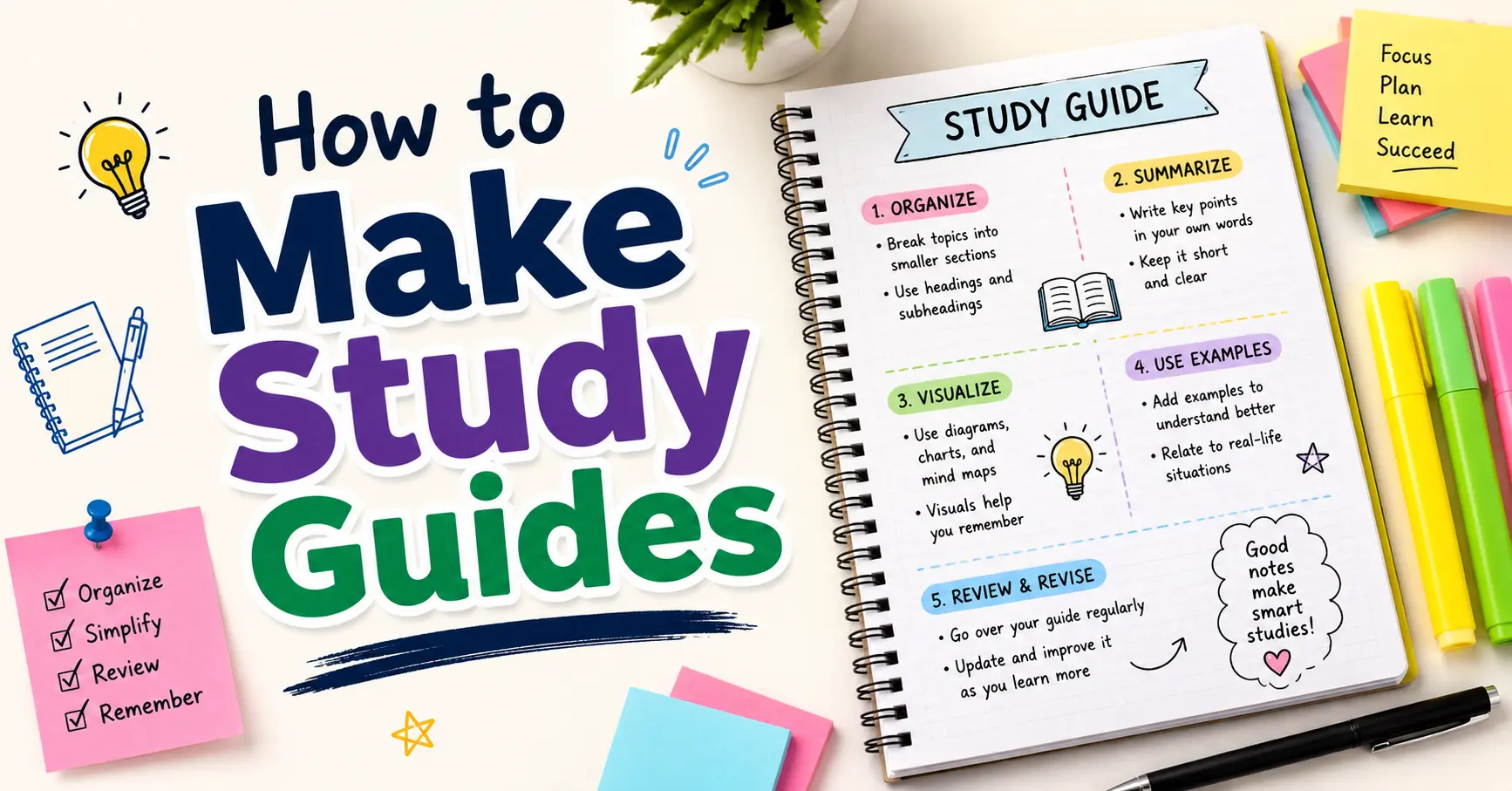
How to Make Study Guides a messy stack of notes is not a study guide. A real study guide takes everything you have learned and turns it into one clear, organized tool you can review again and again before a test. Done right, it saves you hours of last-minute cramming and helps the material actually stick in your memory.
A study guide is a structured collection of important information that helps students review lessons, prepare for exams, and retain knowledge more effectively. Whether you’re in high school, college, or preparing for professional certifications, learning how to make study guides can significantly improve your academic performance.
In this comprehensive guide, you’ll learn what study guides are, why they’re important, and how to create effective study guides step by step.
What Is a Study Guide
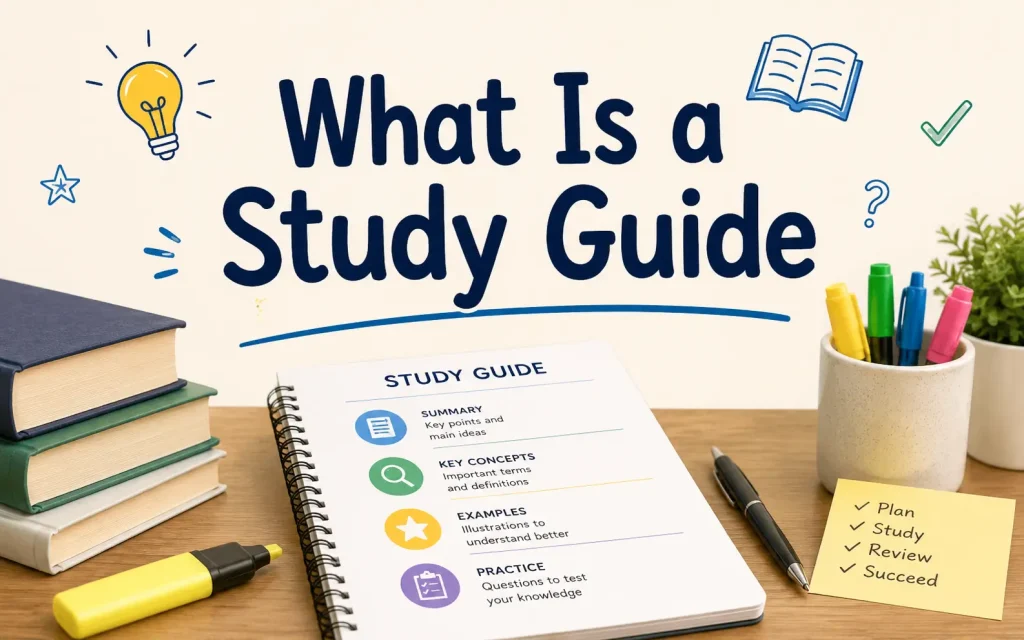
A study guide is a condensed, organized summary of everything you need to know for a test, exam, or project. Instead of flipping through pages of scattered notes, you pull out the key ideas, definitions, examples, and practice questions and arrange them in one place.
A good study guide is not a copy of your notes. It is a rewritten, simplified version that forces you to think about the material instead of just transcribing it. That extra step of organizing and rewording is what makes study guides effective.
Study guides usually take one of a few visual forms, and most strong guides combine more than one:
- Outlines, which organize information in a top-down hierarchy of main ideas and supporting details.
- Concept maps, which show how ideas connect to each other using boxes and linking lines.
- Flashcards, which pair a question or term on one side with the answer on the other for quick self-testing.
- Charts and tables, which are useful for comparing similar concepts side by side.
- Timelines, which work well for sequences of events or processes that happen in order.
Once you understand these basic building blocks, you can mix and match them to fit whatever you are studying, and reuse the same skeleton for future classes.
Who Benefits Most From a Study Guide?
Almost every student benefits from building a study guide, but the format that works best can depend on what you are studying and how you learn:
- Students in fact-heavy courses (history, biology, vocabulary-based language classes) benefit from condensing large amounts of information into lists, tables, and flashcards.
- Students in skill-based courses (math, chemistry, computer science) benefit more from worked examples and practice problems than from definitions alone.
- Visual learners get the most out of diagrams, color-coding, and concept maps.
- Students preparing for cumulative or final exams benefit from a layered guide: a detailed version built throughout the term, plus a short one-page summary built closer to the exam.
Knowing which group you fall into before you start saves you from building a guide that looks good but does not actually help you recall information under test conditions.
Why Study Guides Work
Researchers have found that students who use study guides can score noticeably higher than those who do not, partly because building a study guide requires active learning rather than passive reading. When you summarize, organize, and quiz yourself, you are practicing retrieval, which is one of the most reliable ways to move information into long-term memory.
Study guides help in several specific ways:
- They force you to identify what actually matters, instead of treating every line of notes as equally important.
- They reduce exam anxiety because you walk in with a clear sense of what you know and what you still need to review.
- They make review sessions faster, since everything is in one place instead of scattered across notebooks, slides, and textbooks.
- They reveal gaps in your understanding before the exam, not during it.
Step 1: Gather Everything First
Before you organize anything, collect every source of information: class notes, textbook chapters, slides, handouts, and any practice problems your teacher provided. If your instructor gives you a syllabus or list of learning objectives, keep it next to you. It tells you exactly what the exam will likely cover.
Step 2: Sort Your Material
Pick one organizing method and stick to it. Common options include:
- By chapter or unit
- By topic or theme
- Chronologically (useful for history or literature timelines)
- By difficulty (start with what confuses you most, since that gives you the most time to get help before the exam)
Step 3: Write a One-Paragraph Summary for Each Topic
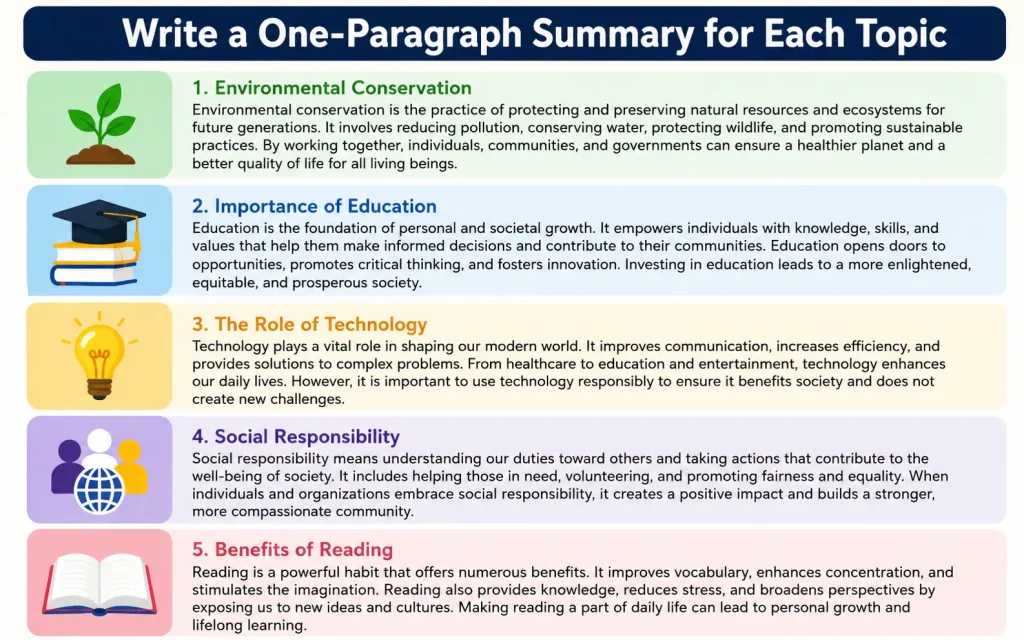
Before diving into details, write two or three sentences that answer: What is this topic actually about? Why does it matter? This step keeps you from getting lost in details before you understand the big picture.
Step 4: Rewrite Key Information in Your Own Words
This is the step most students skip, and it is the most important one. Do not copy sentences from your notes or textbook. Read the material, close it, and write down what you remember in your own words. This single habit, known as active recall, is one of the most effective study techniques backed by learning science.
A simple way to apply this:
- Write down everything you remember about a topic before checking your notes.
- Check your notes and add anything you missed, ideally in a different color or font so you can see your gaps.
- Repeat for every topic on your list.
Step 5: Add Examples, Diagrams, and Practice Questions
Information alone is not enough. Strengthen your study guide with:
- Worked examples for formulas or processes
- Diagrams or timelines for anything visual or sequential
- Practice questions, ranging from simple recall to harder application questions
- Real-world connections that make abstract ideas easier to remember
Step 6: Review and Fill the Gaps
Compare your finished guide against the syllabus, your teacher’s review sheet, or a study group’s notes. Mark anything missing and add it before moving on. This is also a good time to ask your teacher or classmates about anything still unclear.
Step 7: Test Yourself Under Real Conditions
Once your guide feels complete, close it and try to answer your own practice questions from memory, ideally within a time limit similar to the real exam. This step is often skipped, but it is the only way to know whether your guide actually prepared you, or whether it just looks thorough. If you struggle with a section, that is valuable information: it tells you exactly where to focus your remaining study time.
How Much Time Should You Spend on Each Step
For a major exam, spreading this process over several days produces far better results than doing it all in one sitting.
A reasonable timeline looks like this:
| Days Before Exam | Focus |
|---|---|
| 5 to 7 days out | Gather materials and sort by topic |
| 4 to 5 days out | Write summaries and rewrite key concepts in your own words |
| 2 to 3 days out | Add examples, diagrams, and practice questions |
| 1 day out | Review the full guide, fill gaps, test yourself |
| Day of exam | Skim your one-page quick-reference summary only |
This pacing prevents the most common failure mode: spending all your energy formatting a guide and running out of time to actually practice with it.
Study Guide Formats by Subject
Different subjects need different structures.
Here is a quick comparison to help you choose the right approach:
| Subject | Best Format | What to Include |
|---|---|---|
| Math | Worked examples | Formulas, step-by-step solved problems, common error patterns |
| Science | Concept maps | Definitions, labeled diagrams, cause-and-effect chains |
| History | Timelines | Dates, key events, causes and consequences |
| Literature | Theme charts | Characters, plot points, themes, key quotes (paraphrased in your own words) |
| Foreign Language | Flashcard sets | Vocabulary, verb conjugations, sentence patterns |
| Social Studies | Outline format | Main ideas, supporting details, vocabulary terms |
If you are studying for a class that mixes several of these, such as an AP or college course, it is fine to combine formats within one guide. Use whichever structure fits each section best instead of forcing everything into one template.
A Closer Look at Subject-Specific Approaches
Math and quantitative subjects
Definitions alone will not help you on a math exam. Build your guide around fully worked examples, with each step labeled so you remember why you did it, not just what you did. Add a short list of formulas at the top, and include at least one problem where you intentionally made a mistake the first time, along with a note on what went wrong. Seeing your own error pattern is often more useful than seeing a correct example.
Science subjects
Concept maps work well because most science topics involve cause-and-effect relationships or systems with multiple interacting parts. Draw the process (such as a cell dividing or a chemical reaction) and label each stage. Pair every diagram with two or three questions that ask you to explain the process in words, since exams often test whether you understand the diagram, not just whether you can redraw it.
History and social studies
Build a timeline first, then layer in cause-and-effect notes underneath each event. For every major event, write one sentence on what caused it and one sentence on what it led to. This habit prepares you for the essay or short-answer questions that ask you to explain significance, not just recite dates.
Literature and Englis
Resist the urge to copy quotes directly from the text into your guide. Instead, paraphrase the meaning of key passages in your own words and note the page or chapter so you can find the original quote later if you need it for an essay. Track characters, themes, and plot points in a simple table so you can see how they develop across the book.
Foreign languages
Flashcards remain one of the most efficient formats here, but pair vocabulary cards with example sentences, not just isolated words. A word without context is harder to recall under exam pressure than a word you have seen used correctly.
A Simple Study Guide Template You Can Copy
Use this layout as a starting point, then adjust it to fit your subject:
- Course and exam date
- Main topics or learning objectives (list 3 to 6)
- For each topic:
- Short summary in your own words
- Key terms and definitions
- Example problem or real-world application
- Diagram or visual, if relevant
- Two to three practice questions
- Things I’m still confused about (a running checklist to review before the exam)
- Quick-reference page (formulas, dates, or vocabulary you need to memorize cold)
That last section, a one-page quick reference, is something most study guide articles skip. It is the page you glance at five minutes before the test starts.
Common Mistakes to Avoid
Even motivated students undercut their own study guides with a few avoidable habits:
- Copying instead of rewriting. Highlighting or retyping notes feels productive but barely improves memory.
- Making it too long. A study guide that is as long as your original notes defeats the purpose.
- Skipping practice questions. Recognizing an answer on a study guide is different from producing it under exam conditions.
- Starting too late. Building a study guide the night before an exam leaves no time to fill knowledge gaps. S
- Ignoring the format that fits the subject. Using flashcards for a history timeline, or an outline for a math formula sheet, makes review slower than it needs to be. Match the format to how the information is actually structured.
- Studying the guide passively at the end. A study guide that you only read silently before the exam loses most of its value. Use it actively.
- Never updating it. If a teacher mentions something new in a review session, add it immediately. A study guide built once and never touched again misses the most recent and often most exam-relevant information.
Digital Tools for Building a Study Guide
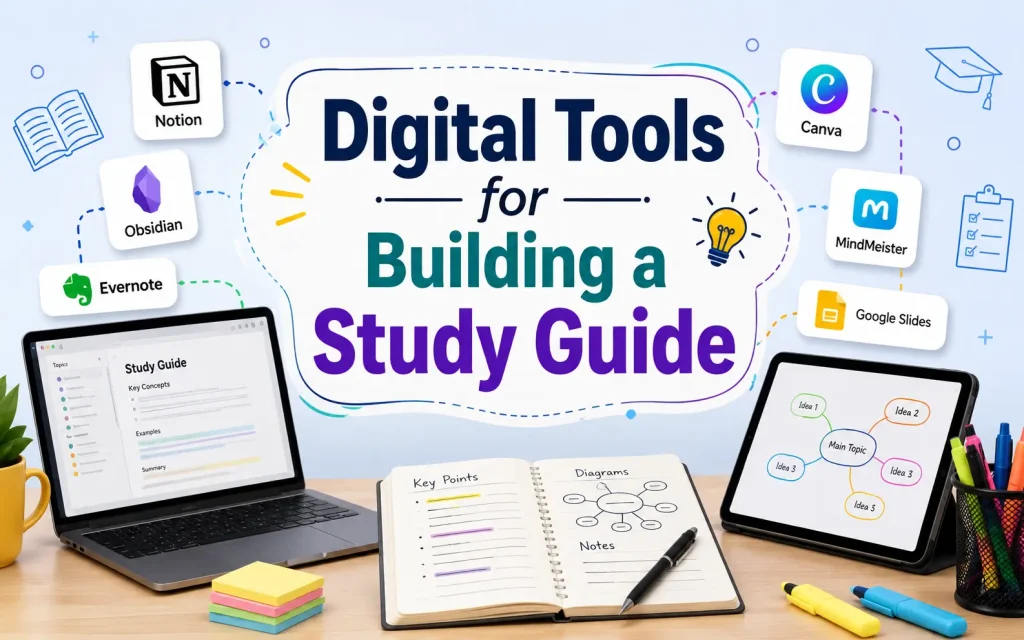
You do not need fancy software, but digital tools can save time and make your guide easier to maintain over the course of a term:
- Note-taking apps (such as Notion, OneNote, or Google Docs) make it easy to search, edit, and reorganize as you go. They are especially useful if you are building your guide gradually over several weeks instead of all at once.
- Cloud storage (Google Drive, Dropbox, iCloud) keeps your guide backed up and accessible from any device, which matters if you study across a laptop, tablet, and phone.
- Flashcard apps (such as Quizlet or Anki) turn your key terms into a self-testing tool you can use on your phone during short breaks, like waiting for a bus or between classes. Many of these apps also use spaced repetition, which automatically resurfaces cards you struggle with more often than ones you already know well.
- Mind-mapping tools (such as MindMeister or even a blank slide in Google Slides) make it easier to build concept maps without redrawing boxes and arrows by hand every time you revise.
- AI assistants can help you summarize long notes, generate practice questions, or build an outline quickly.
How to Make a Study Guide When You’re Short on Time
If your exam is tomorrow and you have not started, focus on impact over polish:
- Skim the syllabus or table of contents and list only the topics that are guaranteed to appear on the test.
- Write one sentence per topic explaining what it means.
- List any formulas, dates, or vocabulary you must memorize, with no extra explanation.
- Find or write five practice questions and test yourself once before the exam.
This will not replace a guide built over several days, but it covers far more ground than re-reading your notes passively.
FAQs
What is a study guide?
A study guide is an organized summary of important course material that helps students review key concepts, definitions, and information before exams.
How do I make a study guide for an exam?
Gather your notes, identify important topics, summarize key points, organize information into sections, and add practice questions for review.
What should be included in a study guide?
A good study guide should include key concepts, definitions, formulas, examples, diagrams, summaries, and practice questions.
Are digital study guides better than paper study guides?
Both are effective. Digital study guides are easier to edit and access, while paper study guides can improve focus and handwritten memory retention.
How long does it take to create a study guide?
The time varies depending on the subject and amount of material, but creating study guides regularly throughout a course is more effective than making one at the last minute.
Final Thoughts
The real value of a study guide is not the document itself. It is the thinking you do while building it. Organizing scattered notes into clear topics,
rewriting ideas in your own words, and testing yourself with practice questions all force your brain to engage with the material in a way that passive re-reading never will.
Start a few days before your exam, pick the format that fits your subject, and treat the process of building the guide as your first real study session.
You May Also Like It:
How to Meet Your Spirit Guides
How to Add Guides in Photoshop
How to Hide Guides in Photoshop
