
How To Case Studies and Guides Improve ROI most businesses are sitting on case studies and guides that should be generating millions in revenue but instead, they are treated like blog content that gets ignored.
The problem is not that your content is bad. The problem is that it is disconnected from how to buyers actually make decisions.
Case studies and guides are not just marketing material. When built and deployed correctly, they are two of the highest-returning assets a business can produce.They work at different stages of the buyer journey, serve different purposes, and together they create a content engine that actively drives revenue.
This article breaks down exactly how each one contributes to ROI, what your competitors are not doing, and how you can measure the results.
What Your Competitors Get Wrong About Case Studies and Guides
Most articles treat case studies and guides as separate topics. They focus on one or the other. What they miss is the combined ROI impact when both content types are used together as a system.
Your competitors also stop at metrics like page views and click-through rates. Those numbers matter, but they are not where the real financial return lives. The deeper ROI comes from deal velocity, close rate lifts, premium pricing justification, and long-term organic traffic. This article covers all of it.
What a Case Study Actually Does
A case study is proof. It answers the question every prospect quietly asks: “Has this worked for someone like me?”
It does not generate cold leads. Instead, it converts warm ones. A prospect who has already heard of you, visited your website, or received an email is on the fence. A well-structured case study pushes them off that fence and toward a decision.
This is why case studies live in the middle of the funnel. They accelerate the journey from consideration to conversion.
The Three Areas Where Case Studies Drive ROI
Case studies return value in three distinct ways, and you need to track all three to understand the full picture.
First, they improve lead conversion. A prospect who reads a relevant case study is far more likely to take the next step. Whether that step is booking a call, filling out a form, or replying to an email, the case study provides the final nudge.
Second, they shorten the sales cycle. When a prospect has already seen proof that your solution works, they spend less time doubting. Your sales team spends less time convincing. Deals close faster, which means your team can move on to new business sooner.
Third, they justify higher pricing. When your results are documented and verified, you are no longer competing on price. A case study that shows a client achieved a 40 percent reduction in cost or a seven-month payback period makes your fee look like an investment, not an expense.
The Gap Competitors Miss: What Case Studies Do for SEO
None of the three competitor articles we analyzed covered this point.
A well-written case study targeting specific search terms brings in organic traffic from prospects who are already researching solutions. These visitors are further along the buying journey than someone who found a blog post. They are looking for evidence. If your case study ranks for terms like “B2B lead generation results” or “ERP implementation success,” you are capturing decision-stage traffic without paying for ads.
Case studies also generate natural backlinks. Other websites, journalists, and industry publications reference real data and real outcomes. This improves your domain authority over time, which compounds the SEO value of everything else you publish.
What Makes a Case Study Actually Credible
The structure matters as much as the content. A case study that tells a vague story of success does not move buyers. One that follows a clear before-and-after format with verified numbers does.
Every strong case study should include:
- A description of the client’s situation before working with you, including the specific problem or pain point
- A clear explanation of what you did and why
- Quantified results with a defined timeframe (not just “we improved sales” but “revenue increased by 32 percent in six months”)
- A direct quote from the client tied to a specific outcome
- A short summary of the financial impact, such as payback period or cost saved
When the outcome is verifiable and the client is named, trust increases dramatically. Anonymous case studies with vague percentages do very little for conversion.
How to Measure the ROI of Your Case Studies
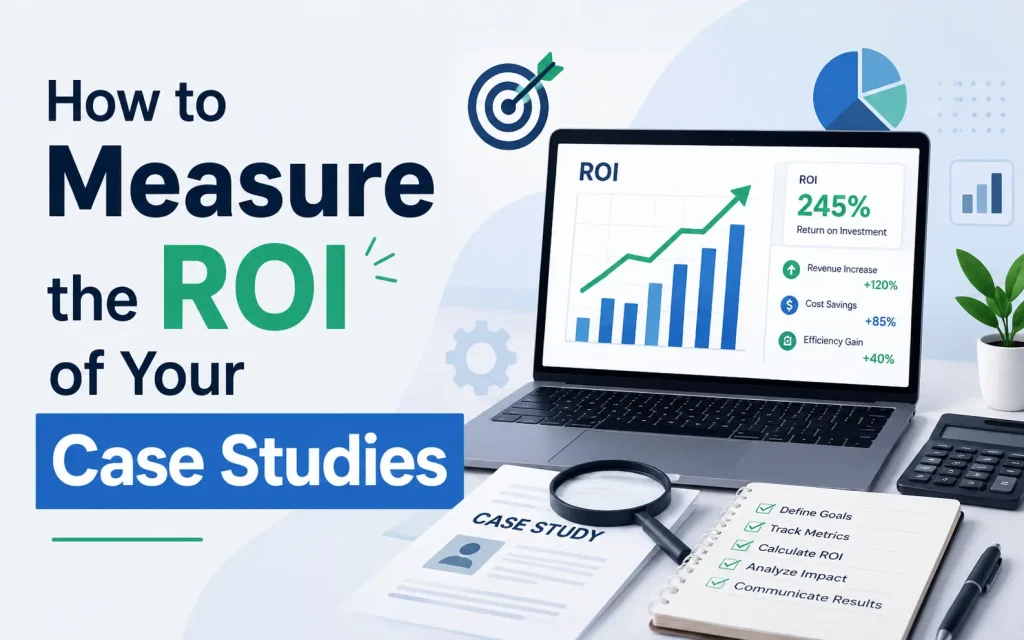
Tracking case study ROI requires you to connect your content to your sales data. Here is how to do it.
On your website, track how many people visit each case study page, how long they stay, and what they do next. A case study that keeps readers engaged for three or more minutes and converts five percent of visitors to a consultation request is performing well. One with a thirty-second average visit is not compelling enough.
In your CRM, create a field that records whether a case study was shared during the sales process. Then compare the close rate for deals where a case study was used against deals where it was not. If your standard close rate is fifteen percent but jumps to twenty-five percent when a relevant case study is shared, that ten-point difference is a direct, attributable return.
In your email campaigns, track the click-through rate on emails where a case study is the primary link. Case studies consistently outperform links to generic service pages because the reader knows they are getting evidence, not a sales pitch.
Finally, track average deal size in placements or projects where a specific case study was used in the proposal. If a case study of a niche or high-stakes engagement allows you to charge a higher fee, that premium is a measurable ROI.
What a Guide Actually Does
A guide serves a different purpose than a case study. While a case study proves what you have done, a guide demonstrates what you know. It builds authority, earns trust before a prospect is even ready to buy, and keeps your brand visible throughout the entire research phase.
Guides attract top-of-funnel traffic, capture leads, and nurture prospects over time. They are long-term assets that work for you continuously after the initial investment of writing them.
The Four Ways Guides Drive ROI
Guides generate compounding organic traffic. A comprehensive, well-optimized guide on a topic relevant to your audience can rank on Google for years. Every month it sits on page one, it delivers free traffic that would otherwise cost you in paid advertising. Over time, the cost per visitor from organic content drops to near zero.
Guides capture leads. When a guide is offered as a downloadable resource in exchange for an email address, it becomes a lead generation tool. The prospect who downloads a guide on a relevant topic is telling you exactly what problem they are trying to solve. That makes follow-up conversations much more targeted and effective.
Guides establish authority. In competitive markets, buyers often choose the vendor they trust most, not the cheapest one. A guide that genuinely teaches something valuable positions your business as the expert in the room. When that buyer is ready to act, you are the first call they make.
Guides support the sales conversation. Your sales team can share a relevant guide at the right moment to answer a common objection or educate a prospect on a process they do not fully understand. This replaces a lengthy back-and-forth email chain with a single, well-structured resource.
The Gap Competitors Miss: Guides as Lead Scoring Tools
This is something no competitor article addresses.
When a prospect downloads a guide, visits specific pages within it, or shares it with colleagues, that behavior tells you a great deal about their intent and stage in the buying cycle. Businesses that connect guide engagement to their CRM can score leads based on content consumption, not just form fills.
A prospect who has downloaded your beginner’s guide and then returned to read your advanced implementation guide is signaling readiness to buy. That signal should trigger a different, more direct follow-up than the prospect who only downloaded the first resource. This kind of behavior-based lead intelligence dramatically improves conversion rates from your content.
Measuring the ROI of Guides
The most direct way to measure guide ROI is to track the revenue generated from leads who first engaged through a guide.
Set up your CRM to record the first point of contact for every lead. When a deal closes, you can attribute a portion of that revenue to the guide that started the relationship. Even if the guide was the first of many touchpoints, it deserves recognition as the entry point that made everything else possible.
Also measure organic traffic growth from guide-related keywords over a six-to-twelve-month period. A guide that earns its way to the first page of search results for a competitive keyword is delivering a return that a single ad campaign could never match at the same cost.
Track the number of leads captured through gated guides per month, and measure what percentage of those leads convert to paying customers over time. Divide your total guide production cost by the number of customers attributed to guide-sourced leads. That gives you a cost-per-acquisition figure that you can compare directly to your paid channels.
The Combined ROI of Case Studies and Guides Working Together
This is the section that competitors leave out entirely.
Case studies and guides are most powerful when they work as a connected system rather than standalone pieces. Here is how the combination looks in practice.
A prospect searches Google for a problem they are experiencing. They find your comprehensive guide on that topic. They read it, find it useful, and download it or bookmark it. Your brand is now associated with expertise in their mind.
Two weeks later, they are considering vendors. They remember you. They return to your website and find a case study about a business similar to theirs. They see real results, a real timeline, and a real quote from a satisfied customer. Their hesitation drops significantly.
Your sales team follows up with a message that references both the guide they downloaded and a specific case study relevant to their industry. The conversation starts from a position of established trust rather than cold introduction.
This sequence consistently shortens the sales cycle, increases close rates, and justifies better pricing. The guide opened the door. The case study closed it.
Example 1 SaaS Company (Lead Conversion Improvement
A B2B SaaS company published detailed case studies of its clients highlighting cost reduction and performance improvements.
Results within 60 days:
- Landing page conversion rate increased by 18%
- Sales team spent less time handling objections
- Leads who read case studies were 2x more likely to book a demo
Result: Case studies directly improved the lead conversion rate.
Example 2: Digital Marketing Agency Faster Sales Cycle
A marketing agency created before vs after case studies for different industries.
Results:
- Average sales cycle reduced from 32 days to 21 days
- Prospects started coming in with more realistic expectations
- Close rate improved by 12%
Result: Deals started closing faster because trust was already built before the sales conversation.
Content Alignment by Buyer Stage
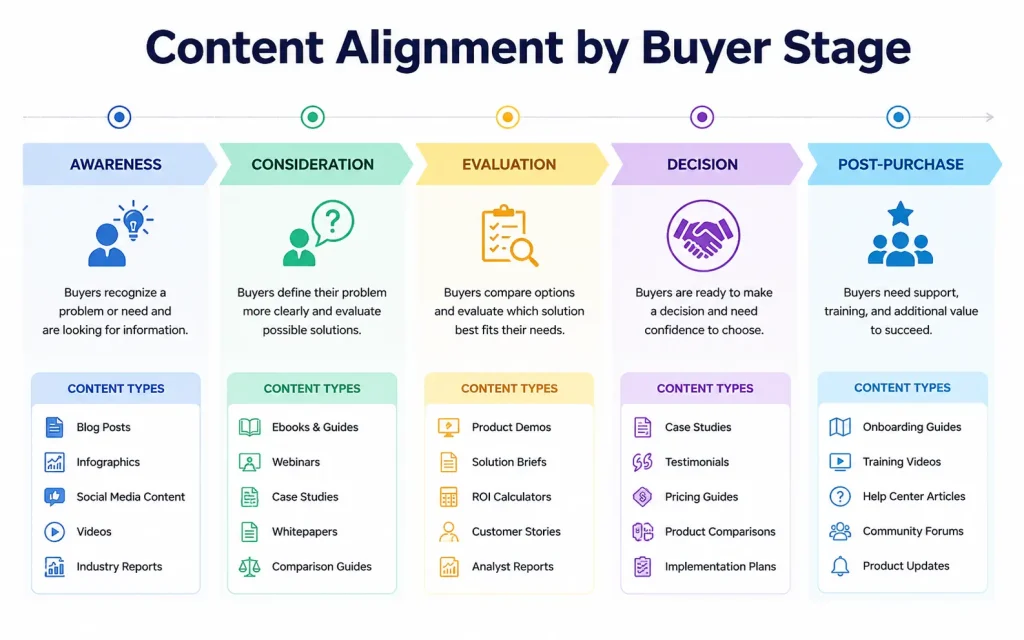
A common mistake is creating content without mapping it to where the buyer is in their journey. Here is how to think about alignment:
At the awareness stage, guides do the heavy lifting. Buyers are researching problems, not solutions. A guide that helps them understand their situation and what options exist brings them into your ecosystem early.
At the consideration stage, case studies take over. Buyers are now evaluating vendors. They want proof that you can deliver. This is where your most specific, most quantified case studies need to be visible and easy to find.
At the decision stage, both work together. A tailored case study sent directly to the prospect, combined with a guide that addresses a final objection, can tip the balance in your favor.
Example 2: Digital Marketing Agency Faster Sales Cycle
A marketing agency created before vs after case studies for different industries.
Results:
- Average sales cycle reduced from 32 days to 21 days
- Prospects started coming in with more realistic expectations
- Close rate improved by 12%
Result: Deals started closing faster because trust was already built before the sales conversation.
What a 90-Day Action Plan Looks Like
You do not need to overhaul your entire content strategy to start seeing results. A focused 90-day effort produces measurable outcomes.
In the first 30 days, audit what you already have. Identify your two or three strongest client success stories and your most-asked questions from prospects. These become your first case study and guide priorities. Set up tracking in Google Analytics for case study pages and create a CRM field to log case study usage in the sales process.
In days 31 to 60, produce the content. Write one detailed case study based on a real client outcome with verified numbers and a direct quote. Produce one comprehensive guide targeting a keyword your ideal prospects actually search for. Make both easy to find on your website.
In days 61 to 90, distribute and measure. Share the case study with your sales team and ask them to use it in active deals. Promote the guide through email and social channels. At the end of the period, compare close rates, deal velocity, and lead quality between contacts who engaged with the content and those who did not.
Frequently Asked Questions
How do case studies and guides contribute to ROI?
Case studies and guides contribute to ROI by improving trust, increasing lead quality, shortening sales cycles, and boosting conversion rates. Guides attract potential customers early in the research phase, while case studies help convert those leads into paying clients by providing proof of results.
Why are case studies important for business ROI?
Case studies improve ROI because they reduce buying resistance. When prospects see real results from similar clients, they are more likely to trust the business, make faster decisions, and accept higher pricing without hesitation.
How do guides help generate leads?
Guides attract organic traffic through SEO and provide valuable information that users are actively searching for. When offered as downloadable resources, they capture leads by collecting emails and starting the nurturing process.
Can case studies and guides improve sales conversion rates?
Yes, both directly impact conversion rates. Guides bring in informed traffic, while case studies provide proof that pushes prospects to take action. Together, they increase both lead-to-sale and demo-to-close conversions.
What is the difference between case studies and guides in ROI strategy?
Guides focus on attracting and educating potential customers at the awareness stage, while case studies focus on convincing and converting prospects at the decision stage. Both work together to maximize ROI across the full buyer journey
Final Thought
Case studies reduce buying resistance exactly when decisions are being made. Guides attract the right audience and keep your brand present throughout the research journey. Together, they form a system that builds trust, increases leads, shortens sales cycles, and supports higher pricing.
Businesses that properly measure this combination consistently see stronger returns than most paid channels, with results that continue to grow long after the initial effort.
The real question is not whether to invest in case studies and guides. It is whether you can afford not to.
You May Also Like It:
How to Meet Your Spirit Guides
How to Add Guides in Photoshop
How to Hide Guides in Photoshop
